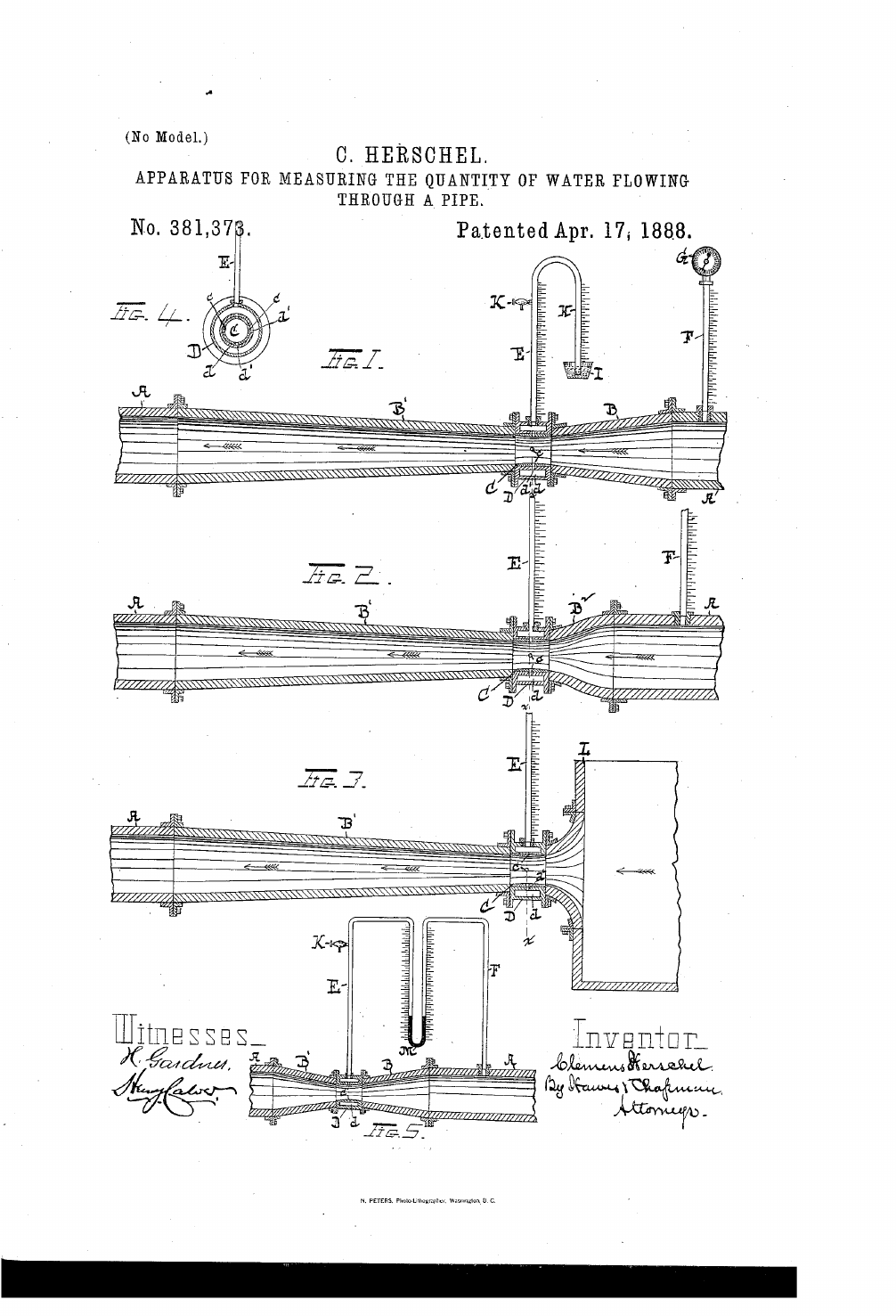


Venturi Meter
Instrucciones
Build the constriction
Build the constriction
A wide section, a smoothly narrowing cone, a short throat, then a gentle widening.
- Use pipe of one diameter with a reducer to a smaller throat.
- Make the entry cone short and the exit cone long and gradual.
- Keep the inside smooth — burrs cause turbulence and spoil the reading.
Materiales para este paso:
 Tubo de PVC1 length
Fit the pressure tappings
Fit the pressure tappings
Two vertical clear tubes turn pressure into a height you can read with a ruler.
- Drill one small tapping in the wide section and one at the throat.
- Fit clear vertical tubes into both, sealed so they do not leak.
- Mount a ruler behind them.
Materiales para este paso:
 Tubo de goma1 length
Herramientas necesarias:
 Regla
ReglaRun water and read the difference
Run water and read the difference
Start the flow and let the levels settle.
- Run water through at a steady rate.
- Read the height in each tube.
- Record the difference, Δh, in metres.
Calculate the flow
Calculate the flow
Geometry plus one measured height gives the flow rate.
- Measure the two internal diameters and compute areas A₁ and A₂.
- Apply: Q = A₂ × √( 2gΔh / (1 − (A₂/A₁)²) )
- g = 9.81 m/s². Q comes out in m³/s.
Check it against a bucket
Check it against a bucket
A calculation you have not checked is a guess. Catch the water and time it.
- Divert the outflow into a container for a measured number of seconds.
- Measure the volume collected.
- Q_actual = volume / time, and compare with the calculated Q.
Materiales para este paso:
 Vaso de precipitados de borosilicato1 pieza
Herramientas necesarias:
 Cronómetro
History and context
History and context
Clemens Herschel was an American hydraulic engineer working on water supply at Holyoke, Massachusetts, where mills bought water by the quantity and needed it measured fairly. Existing meters obstructed the pipe, wore out, or lost too much pressure. His patent, US 381,373 of 17 April 1888, describes an apparatus for measuring the quantity of water flowing through a pipe using the sucking action at the narrow section of a tapered tube.
He named it after someone else. Giovanni Battista Venturi, an Italian physicist, had investigated flow through tapered tubes in 1797 and described the pressure effect, but he built no meter and proposed no measurement method. Herschel turned the observation into an instrument and gave the instrument Venturi's name — an unusually generous piece of attribution in patent history.
Where it went: waterworks, sewage plants and process industries adopted it for large flows where a permanent pressure loss would be expensive. The same physics appears in the carburettor, where the pressure drop at a throat draws fuel into the air stream, and in the filter pump on a laboratory bench.
Its weakness: the pressure difference goes as the SQUARE of the flow, so at low flow rates Δh becomes very small and hard to read accurately. A Venturi sized for full flow is a poor meter at a trickle, which is why plants size them for the range they actually expect.
Materiales
3- 1 lengthMarcador de posición
- 1 lengthMarcador de posición
- Marcador de posición
Blueprints relacionados
Estos blueprints comparten conocimiento — técnicas, materiales o principios


CC0 Dominio público
Este Blueprint se publica bajo CC0. Eres libre de copiar, modificar, distribuir y usar este trabajo para cualquier propósito, sin pedir permiso.
Apoya al Maker comprando productos a través de su Blueprint, donde gana una Comisión del Maker establecida por los vendedores, o crea una nueva iteración de este Blueprint e inclúyela como conexión en tu propio Blueprint para compartir ingresos.