SENI
KECANTIKAN & KESEJAHTERAAN
KRAFTANGAN
BUDAYA & SEJARAH
HIBURAN
ALAM SEKITAR
MAKANAN & MINUMAN
KEJURUTERAAN TERBALIK
SAINS
SUKAN
TEKNOLOGI
BOLEH PAKAI
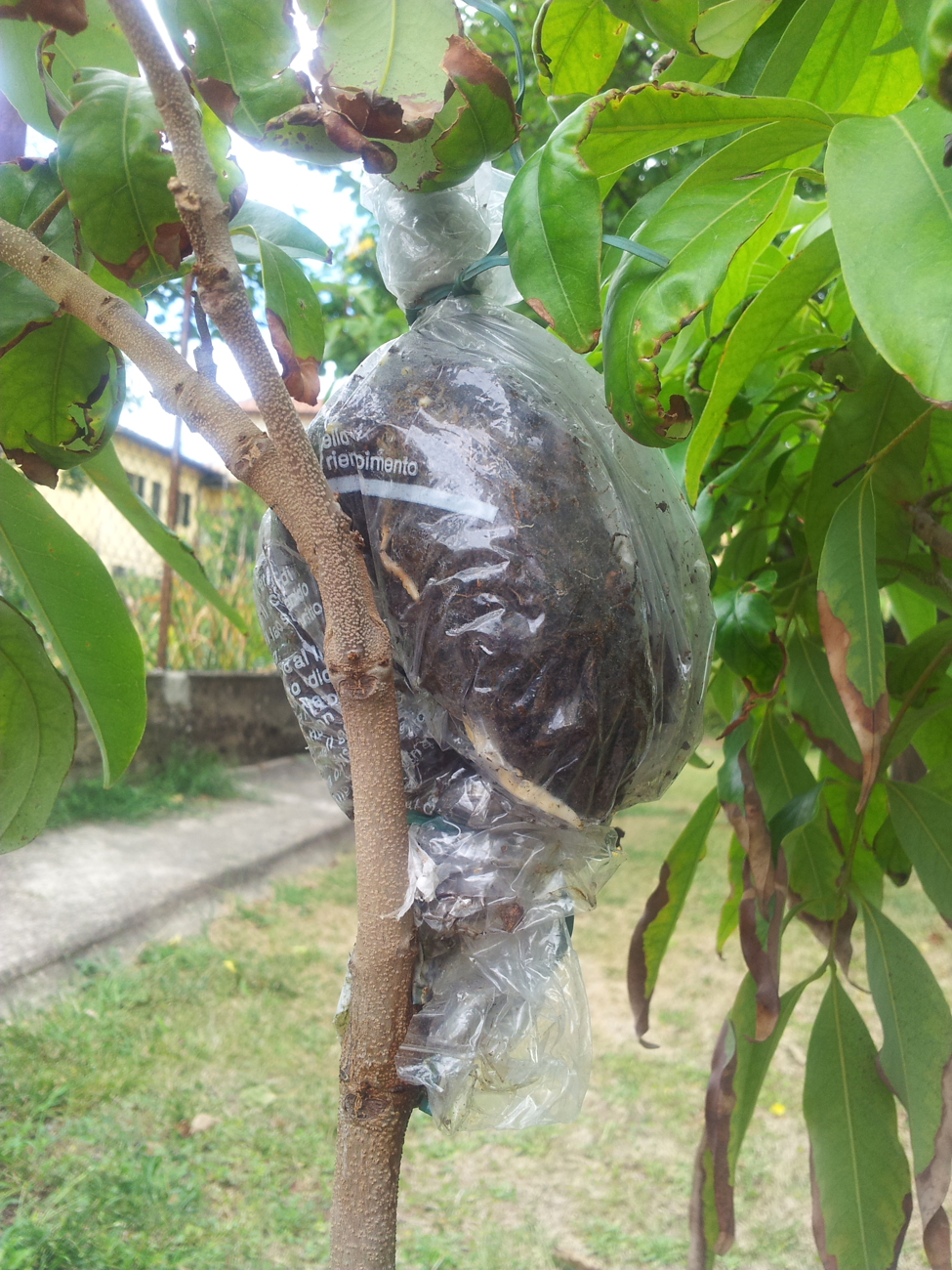
Iacopo Lorenzini (Wikimedia Commons) · CC BY-SA 3.0


Air Layering — Rooting a Branch While It Stays on the Tree
Root a branch in mid-air, while it is still attached to and fed by the parent plant — so it can never wilt or starve the way a cut-off cutting can. Girdle a ring of bark, wrap the wound in moist moss sealed in plastic, wait for roots to fill it, then cut off a ready-made new plant. A serious maker build in the girdle and why layering roots the plants that cuttings can't.
Pertengahan
A few weeks to a few months
Arahan
1
1
Roots in mid-air
Roots in mid-air
Air layering makes a branch grow roots while it is STILL joined to the parent plant. Because the branch stays attached, the parent keeps watering and feeding it the whole time it roots — so it cannot dry out or starve. Once roots have formed up in the air, you cut the branch off as a fully-rooted new plant.
2
2
Choose a healthy stem
Choose a healthy stem
Pick a healthy branch about pencil-to-finger thick, and a smooth section of it a hand's length back from the tip, just below a node. This works for many woody plants that are stubborn from cuttings — ficus, magnolia, citrus, rubber plant, croton, many shrubs.
3
3
Girdle the bark
Girdle the bark
Cut two rings around the stem about 2-3 cm apart and peel off the bark between them, then scrape the slippery green cambium off the bared wood so the bark cannot heal back over. This girdle is the trick: it blocks the food and rooting hormone travelling DOWN the bark, so they pool at the upper edge of the wound — exactly where you want roots.
Alatan diperlukan:
 Pisau cantas
4
4
Dust with rooting hormone (optional)
Dust with rooting hormone (optional)
Optional: brush a little rooting hormone, or willow-water soaked from young willow twigs, onto the upper cut edge to speed rooting. The plant already concentrates its own auxin here; this just adds more.
Bahan untuk langkah ini:
 Ranting willow (lentur)1 ikat
5
5
Wrap in moist moss
Wrap in moist moss
Take a fat handful of sphagnum or peat moss, soak it and wring it out so it is damp but not dripping, and pack it in a ball completely around the girdled section. The moss is the airy, ever-moist bed the new roots will grow into.
Bahan untuk langkah ini:
 Gambut sphagnum1 bag
6
6
Seal it in plastic
Seal it in plastic
Wrap the moss ball tightly in clear plastic film and tie it firmly at the top AND bottom so it seals in the moisture — a little greenhouse around the wound. A layer of foil over the top keeps it cool and shaded. Check now and then and re-wet the moss if it dries.
Bahan untuk langkah ini:
 Tali kebun1 gulung
Alatan diperlukan:
 Pembalut plastik
7
7
Sever and pot up
Sever and pot up
In a few weeks to a few months you'll see roots filling the moss through the plastic. Once it is well rooted, cut the branch off just BELOW the new root ball, unwrap the plastic (leave the moss), pot it up, and keep it humid and shaded while it learns to support itself on its own new roots.
Bahan untuk langkah ini:
 Label Pelekat1 helaian
8
8
Compendium — the girdle and the attached clone
Compendium — the girdle and the attached clone
Air layering is a clever fix for the one weakness of cuttings. A detached cutting has no roots and no supply line, so it races to grow roots before it wilts or starves — and for tough woody plants it often loses that race. Layering removes the deadline entirely by rooting the branch WHILE it is still plumbed into the parent: water keeps rising, food keeps arriving, so the branch stays alive and comfortable for as long as it needs to root. The girdle is where the biology sings. A stem has two transport layers: the XYLEM, deep in the wood, carries water UP from the roots; the PHLOEM, in the soft inner bark, carries sugars and hormones DOWN from the leaves. Cutting a ring of bark severs the phloem but leaves the xylem in the wood untouched — so water still flows up and the branch above stays turgid and fed by its own leaves, but the sugars and the rooting hormone (auxin) streaming down from those leaves hit the girdle and can go no further, so they PILE UP at the top lip of the wound. That rich, hormone-loaded, well-watered spot, wrapped in constantly-moist moss, is the perfect cradle for roots — and roots duly burst from it. Like a cutting, division or graft, the result is a genetic CLONE of the parent, but air layering hands you a big, already-substantial new plant far faster than a cutting could grow one. It belongs to the LAYERING family: its simpler cousin, ground layering, just bends a low branch down and buries a section until it roots, then severs it — air layering does the same job up in the air for branches that will never reach the soil. Perfected in China (where it is called marcotting or 'gootee') well over a thousand years ago, it is the gardener's surest way to clone a difficult tree.
Bahan
4- 1 ikatPemegang Tempat
- 1 bagPemegang Tempat
- 1 gulungPemegang Tempat
- 1 helaianPemegang Tempat
Alatan Diperlukan
2- Pemegang Tempat
- Pemegang Tempat
Blueprint ini membuat
Blueprint berkaitan
Blueprint ini berkongsi pengetahuan — teknik, bahan atau prinsip
CC0 Domain Awam
Blueprint ini dikeluarkan di bawah CC0. Anda bebas menyalin, mengubah, mengedar, dan menggunakan karya ini untuk sebarang tujuan, tanpa meminta kebenaran.
Sokong Pembuat dengan membeli produk melalui Blueprint mereka di mana mereka memperoleh Komisen Pembuat ditetapkan oleh Penjual, atau cipta iterasi baru Blueprint ini dan sertakan ia sebagai sambungan dalam Blueprint anda sendiri untuk berkongsi hasil.