SENI
KECANTIKAN & KESEJAHTERAAN
KRAFTANGAN
BUDAYA & SEJARAH
HIBURAN
ALAM SEKITAR
MAKANAN & MINUMAN
KEJURUTERAAN TERBALIK
SAINS
SUKAN
TEKNOLOGI
BOLEH PAKAI
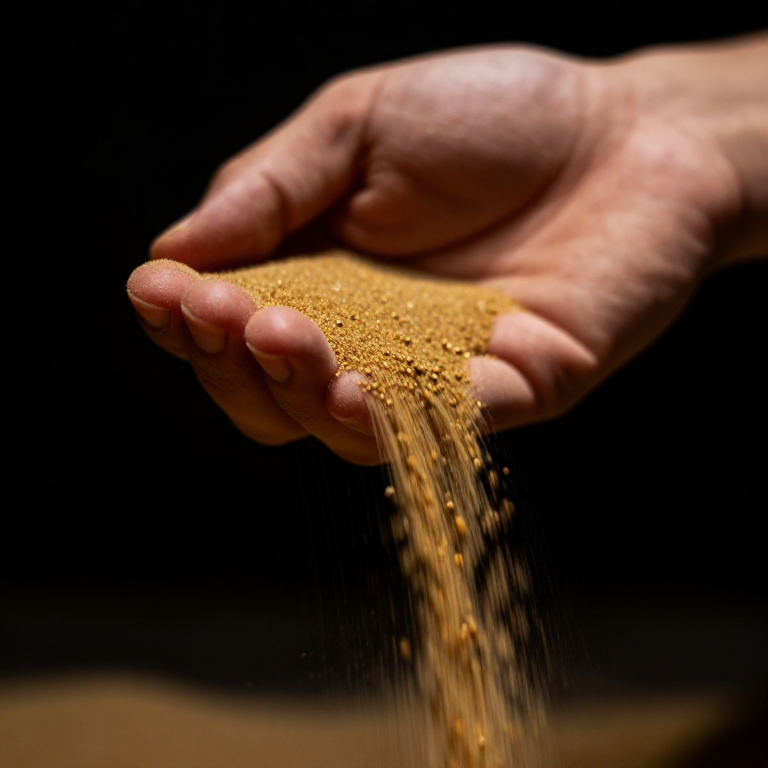


The Sand Reckoner — Count the Grains and Tame Huge Numbers
A hands-on maths project: weigh a pinch of sand, count the grains in a tiny sample, then scale up with powers of ten to estimate the grains in a cup, a bathtub -- even the universe, just as Archimedes did around 250 BC. A Python cell does the giant arithmetic and a compendium shows how exponents were born.
Pemula
30 minutes
Arahan
1
1
Counting the uncountable
Counting the uncountable
Around 250 BC Archimedes set himself a game: to count how many grains of sand would fill the whole universe, and to name that number. He had to invent a new way of writing numbers to do it. You will start the same way -- with real sand.
2
2
Weigh and count a sample
Weigh and count a sample
Weigh out a very small, known amount of dry sand -- say one gram -- on a kitchen scale. Counting every grain is impossible, so count the grains in a TINY measured pinch (a few dozen) and scale up, or estimate. Work out roughly how many grains are in one gram.
Bahan untuk langkah ini:
 Pasir1 kg
 Balang Kaca Bertutup1 keping
Alatan diperlukan:
 Penimbang Dapur Digital
3
3
Scale up with powers of ten
Scale up with powers of ten
Now multiply up. If one gram holds a few thousand grains, a cupful (a couple of hundred grams) holds a few hundred thousand, a bag holds millions, a bathtub holds hundreds of millions. Write each answer as a 1 followed by zeros -- and notice you are just counting the zeros. That count is the 'power of ten', or exponent.
Alatan diperlukan:
 Kalkulator
4
4
Let the computer scale to the universe
Let the computer scale to the universe
Memuatkan buku nota Jupyter…
Alatan diperlukan:
 Komputer MejaKalkulator
5
5
Compendium: no largest number
Compendium: no largest number
What the sand teaches. (1) Writing a huge number as 10-to-a-power (scientific notation) turns dozens of zeros into a single small exponent -- exactly how scientists write the sizes of atoms and galaxies today. (2) To MULTIPLY two powers of ten you just ADD their exponents (10^63 times 10^24 is 10^87) -- an idea that, centuries later, became logarithms. (3) Archimedes' real point was philosophical: numbers never run out. However vast a pile of sand, you can always name a bigger number. A game about grains quietly invented one of the most useful ideas in mathematics.
Bahan
3- 1 kgPemegang Tempat
- 1 kepingPemegang Tempat
- 1 helaianPemegang Tempat
Alatan Diperlukan
4- Pemegang Tempat
- Pemegang Tempat
- Pemegang Tempat
- Pemegang Tempat
Blueprint berkaitan
Blueprint ini berkongsi pengetahuan — teknik, bahan atau prinsip
CC0 Domain Awam
Blueprint ini dikeluarkan di bawah CC0. Anda bebas menyalin, mengubah, mengedar, dan menggunakan karya ini untuk sebarang tujuan, tanpa meminta kebenaran.
Sokong Pembuat dengan membeli produk melalui Blueprint mereka di mana mereka memperoleh Komisen Pembuat ditetapkan oleh Penjual, atau cipta iterasi baru Blueprint ini dan sertakan ia sebagai sambungan dalam Blueprint anda sendiri untuk berkongsi hasil.