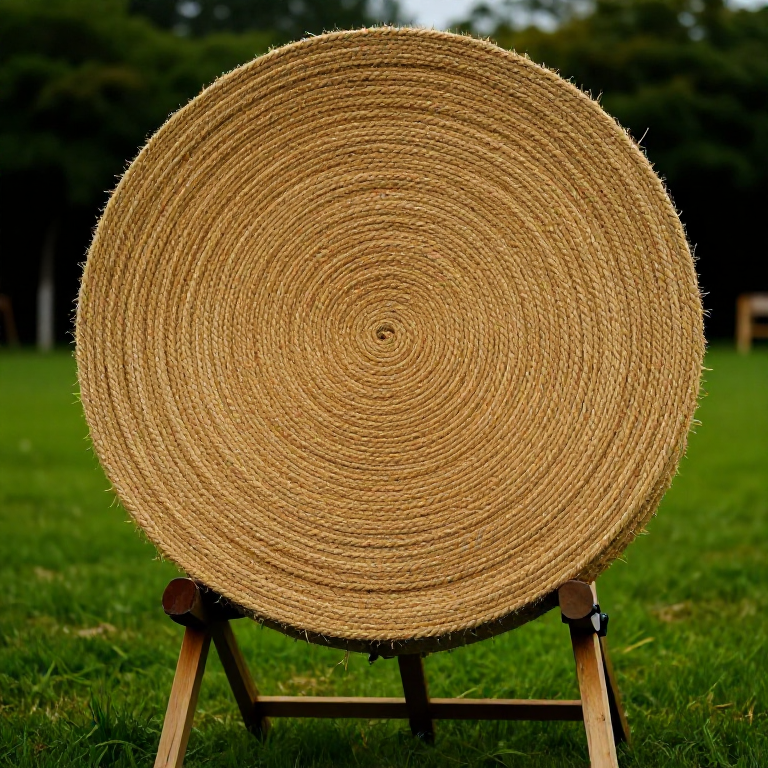


Archery Butt
For two centuries English law required every able-bodied man to own a bow and shoot at the butts on Sundays. The butt was the target: a mound of earth or a great disc of coiled straw set up on the village green, and the reason a medieval kingdom could field thousands of longbowmen was that every parish had one.
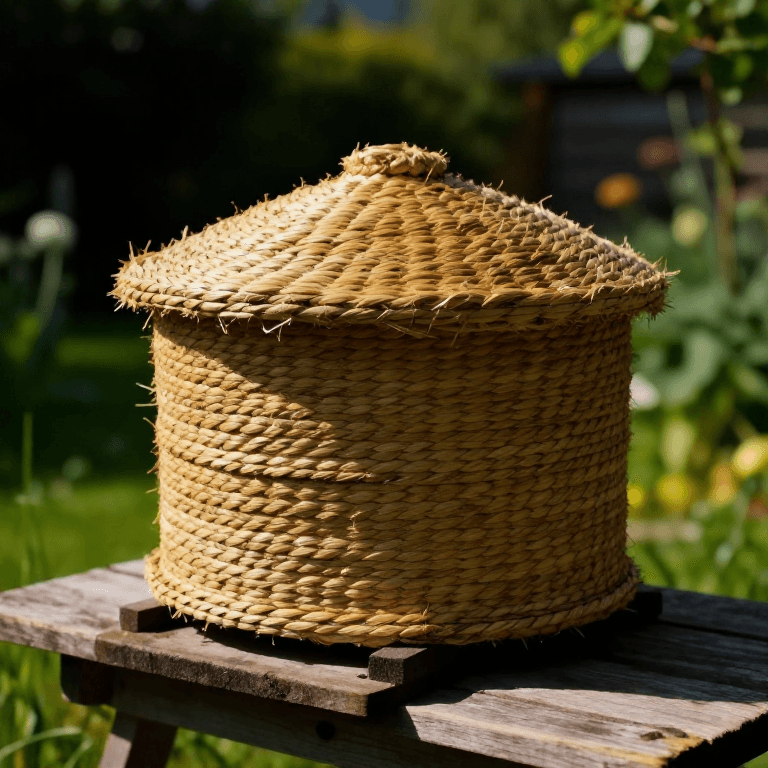
The straw boss is made by a technique that has nothing to do with archery and everything to do with basketry. You twist straw into a continuous rope, wind that rope into a flat spiral, and stitch each turn to the one before. It is exactly how a coiled straw beehive is built. The result stops an arrow dead, grips it without splitting the shaft, and can be repaired by restitching rather than replacing.
Rye straw, twine, a big needle, and a long afternoon.
Arahan
Set the range rules before you build anything
Set the range rules before you build anything
Decide where the boss will stand and what is behind it. You need a solid backstop and a clear overshoot area — an arrow that misses carries a long way. Nobody goes downrange while anyone holds a bow.
Choose long-stemmed rye straw
Choose long-stemmed rye straw
Rye straw is the traditional choice: long, hollow, springy stems that compress without shattering. Wheat straw works but is shorter and more brittle. You will need roughly 15-20 kg for a boss 900 mm across.
Bahan untuk langkah ini:
 Jerami rai18 kg
Comb out the short and broken stems
Comb out the short and broken stems
Pull handfuls through your fingers or a coarse comb to remove leaf, chaff and short pieces. Only clean full-length stems go into the rope; debris makes soft spots that arrows punch straight through.
Damp the straw lightly
Damp the straw lightly
Sprinkle with water and leave it under a cloth for an hour until it bends without cracking. Bone-dry straw snaps as you twist it; soaking wet straw rots inside the finished boss.
Twist the first straw rope
Twist the first straw rope
Take a bundle about 40 mm thick, twist it along its length, and feed in fresh stems continuously so the rope never runs out. Aim for an even 40-50 mm diameter — thickness variation shows as a lumpy face later.
Keep the rope tight and unbroken
Keep the rope tight and unbroken
Overlap each new handful well back into the twist before the old one runs out. A single continuous rope makes a far stronger boss than several joined lengths.
Start the centre coil
Start the centre coil
Wind the first 200 mm of rope into a tight flat spiral and stitch through it several times to lock the centre. The centre takes the most hits, so it must be the densest part of the boss.
Stitch each new turn to the one before
Stitch each new turn to the one before
Pass jute twine through the new coil and into the previous one with a long sacking needle, at 50-70 mm intervals, pulling each stitch hard. This is identical to the coiling used for a straw bee skep.
Bahan untuk langkah ini:
 Tali guni60 meter
Keep the spiral flat as it grows
Keep the spiral flat as it grows
Work on a flat surface and press each turn down level with its neighbour. A boss that domes as it grows will not sit square on a stand and shoots inconsistently.
Build out to 900 mm diameter
Build out to 900 mm diameter
Continue coiling and stitching to about 900 mm across and 100-150 mm thick. Measure across several axes as you go — the spiral drifts oval if you do not check.
Alatan diperlukan:
 Pembaris
Finish and bind the outer edge
Finish and bind the outer edge
Taper the last of the rope, tuck it under the previous coil and stitch it down hard. Then run a continuous binding of twine right around the rim to stop the outermost coil unwinding.
Test the density with a hand push
Test the density with a hand push
Press hard with your thumb: it should barely dent. A soft boss lets arrows pass through; an over-hard one buries arrows so deep you damage shafts pulling them out. Restitch any slack area now.
Build a stand with the boss leaning back
Build a stand with the boss leaning back
Make a tripod or A-frame that holds the face tilted back by roughly 10-15°. The lean means arrows enter closer to perpendicular and it sheds rain off the straw.
Pin on a target face
Pin on a target face
Fix a paper or card face with target pins. The modern World Archery face is 122 cm for long distances and 80 cm for shorter ones; a medieval butt had no rings at all, just a mark.
Store it dry and rotate it
Store it dry and rotate it
Keep it under cover between sessions — a soaked straw boss rots and loses all its stopping power. Rotate it a quarter turn regularly so the wear spreads instead of chewing one hole through the middle.
History & Context — practice enforced by statute
History & Context — practice enforced by statute
Shooting at the butts was a legal obligation, not a pastime. Edward III issued an ordinance in 1363 directing able-bodied men to practise archery on Sundays and holidays rather than waste time on other games, and the requirement was restated repeatedly for two centuries. The Unlawful Games Act of 1541 obliged men under sixty to keep a bow and arrows and to shoot, while banning a long list of competing amusements. The point was military: the longbow needed a lifetime of training to draw properly — the skeletal deformation visible in archers recovered from the Mary Rose shows what that training did to their bodies — and no state could produce such men on demand. It had to produce them continuously, in every parish, by law.
Butt, boss and mark. The words are not interchangeable. The butt was properly the earthen mound or bank the target stood against; the boss is the straw disc; the mark was the aiming point. Many village butts were exactly that — a mound of turf — with a piece of cloth or a white card pinned on it. The coiled straw boss belongs to the same tradition but is a portable, repairable refinement, and it is what survived into modern target archery.
Why coiled straw and not a board. An arrow arriving at sixty metres a second must be stopped over a short distance without breaking the shaft or blunting the point. Coiled straw does this by friction along the whole length of the arrow rather than by impact: the compressed stems grip the shaft and decelerate it progressively. A hard flat surface would shatter or bounce the arrow; loose material would let it through. The same properties that make coiled straw good at holding a beehive's shape — springy, dense, repairable — make it good at catching arrows, and the craft transferred directly.
An honest note on the decline. The longbow was not defeated by the musket's accuracy, which was worse, or its rate of fire, which was far worse. It was defeated by training time. A serviceable musketeer could be made in weeks; an effective longbowman took years, and once the statutory practice lapsed the pool of them vanished within a generation. The butt in the churchyard was the infrastructure that made the weapon possible, and when the butts fell out of use the weapon went with them.
Bahan Blueprint Bersambung

Blueprint ini membuat
Blueprint berkaitan
Blueprint ini berkongsi pengetahuan — teknik, bahan atau prinsip


CC0 Domain Awam
Blueprint ini dikeluarkan di bawah CC0. Anda bebas menyalin, mengubah, mengedar, dan menggunakan karya ini untuk sebarang tujuan, tanpa meminta kebenaran.
Sokong Pembuat dengan membeli produk melalui Blueprint mereka di mana mereka memperoleh Komisen Pembuat ditetapkan oleh Penjual, atau cipta iterasi baru Blueprint ini dan sertakan ia sebagai sambungan dalam Blueprint anda sendiri untuk berkongsi hasil.