
Autographic Stencil
Printing a hundred copies of a page used to mean typesetting it. Someone assembles the text out of metal sorts, locks it in a forme, and prints — which is fast for a book and absurd for an office memo, a school worksheet or a handbill. Below a few hundred copies, the setup costs more than the copies are worth.
A stencil skips typesetting entirely: you write, and the writing becomes the printing surface. Lay a sheet on a bed of fine points and draw on it with a blunt stylus. Wherever the stylus presses, the points pierce the sheet. The page is now a mask perforated in the exact shape of your own handwriting, and ink pushed through it reproduces that handwriting as often as you like.
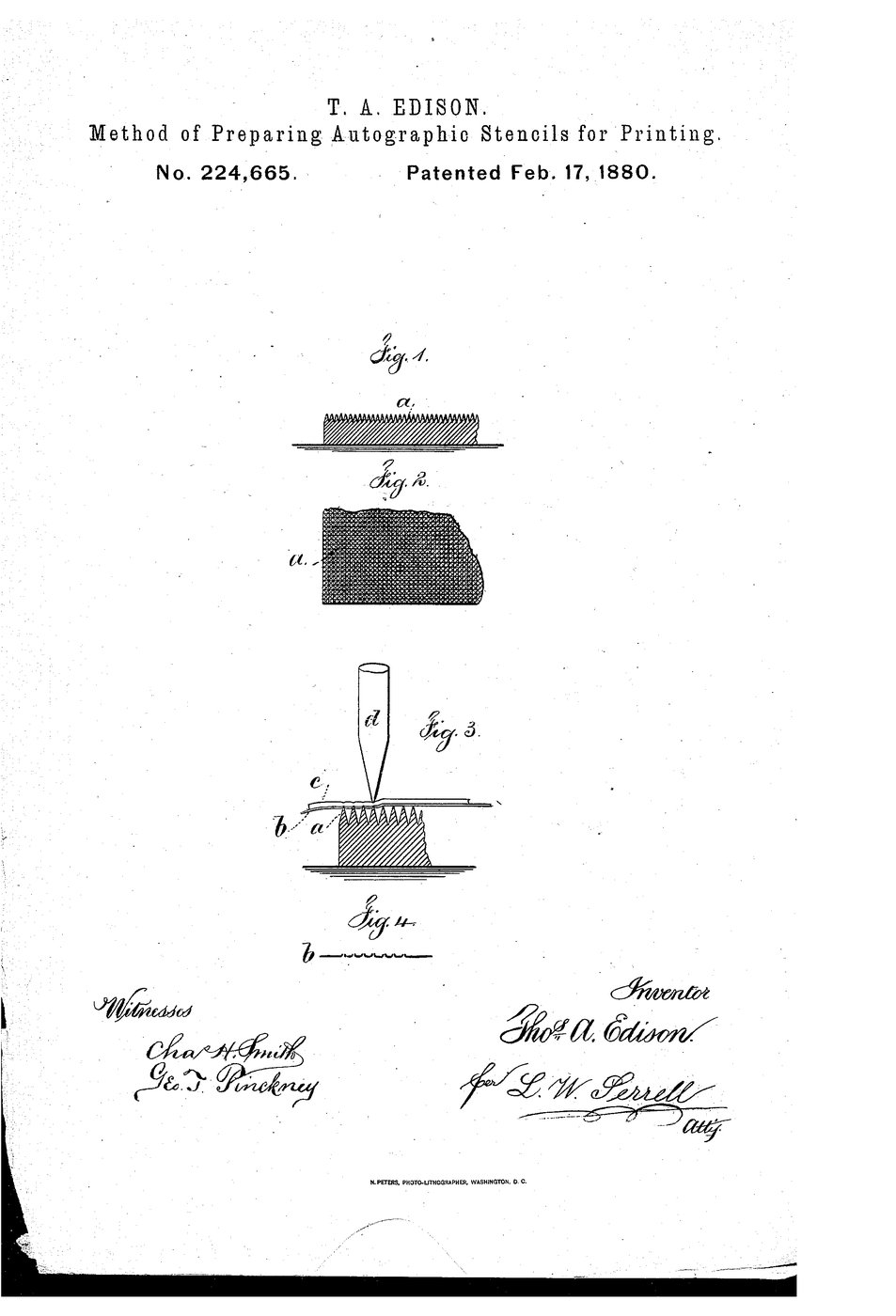
US Patent 224,665, "Method of Preparing Autographic Stencils for Printing", filed 17 March 1879 and granted 17 February 1880 to Thomas A. Edison. He specifies "a slab or plate with a surface of numerous sharp points", and notes the holes come out larger underneath so semi-fluid ink flows through them.
Arahan
Read US 224,665 and note which way the holes taper
Read US 224,665 and note which way the holes taper
Edison says the perforations are larger on the underside. The stencil has a right way up, and it is not the side you wrote on.
Write on plain paper and try to print it
Write on plain paper and try to print it
Write a word on ordinary paper, ink over it and press a blank sheet on top. Nothing transfers usefully. Writing is not a printing surface — that is the problem being solved.
Make the point slab
Make the point slab
Use a fine steel file, a rasp, or coarse abrasive paper bonded to a flat board. Edison unified needle points with solder; any dense field of hard sharp points works.
Alatan diperlukan:
 Set Kikir Jarum
Check the slab is flat
Check the slab is flat
Lay a sheet on it and rub with a fingertip. If some regions dimple and others do not, the points are uneven and letters will drop out mid-stroke.
Choose a thin, tough sheet
Choose a thin, tough sheet
Use thin waxed or glazed paper. It must perforate cleanly without tearing between neighbouring holes — ordinary printer paper shreds along a stroke.
Bahan untuk langkah ini:
 Gulung kertas surih corak1 gulung
Write with a blunt stylus, not a pen
Write with a blunt stylus, not a pen
Draw your text firmly with a smooth rounded point. A sharp nib cuts the sheet instead of pressing it onto the points and gives ragged, blotting lines.
Alatan diperlukan:
 Pelipat tulang
Hold the sheet still while you write
Hold the sheet still while you write
Tape one edge to the slab. A sheet that shifts perforates twice in different places and prints a doubled ghost.
Lift and hold the stencil to the light
Lift and hold the stencil to the light
Your writing should appear as a line of pinholes. Gaps mean too little pressure; a continuous slit means too much.
Lay the stencil taper-side down
Lay the stencil taper-side down
Put the stencil on a clean sheet with the larger holes facing the paper, as the patent specifies. The taper meters the ink.
Roll a thin film of stiff ink across it
Roll a thin film of stiff ink across it
Charge a roller lightly and pass once. Edison's ink is semi-fluid — thin ink floods through and bleeds, stiff ink will not pass at all.
Bahan untuk langkah ini:
 Dakwat Cetakan Blok1 keping
Alatan diperlukan:
 Penggelek getah dakwat
Lift the stencil and read the copy
Lift the stencil and read the copy
Peel it away carefully. Your handwriting is reproduced in ink, in your own hand, without a single piece of type.
Print nine more without re-writing
Print nine more without re-writing
Re-ink and print repeatedly. Count how many good copies come off before the perforations clog or tear — this number is the entire economics of the method.
Deliberately over-ink one pull
Deliberately over-ink one pull
Flood the roller and print again. The letters fill in and close up. Note it, then go back to a thin film.
Draw a picture and print that
Draw a picture and print that
Stencil a simple line drawing. The method has no alphabet and no typeface — anything a stylus can trace, it can multiply.
History & Context — the office copier before the office copier
History & Context — the office copier before the office copier
The patent. US 224,665, "Method of Preparing Autographic Stencils for Printing", filed 17 March 1879 and granted 17 February 1880 to Thomas A. Edison. The granted title never uses the word mimeograph, and neither did Edison at this point.
This is not Edison's first stencil patent, and the famous one is different. His electric pen of 1876 perforated the sheet with a needle driven up and down at high speed by a small electric motor — a handheld machine, heavy, battery-powered and genuinely startling in an 1870s office. The 1880 patent here does the same job with no moving parts at all: put the points under the paper instead of in the pen, and an ordinary stylus does the work. It is a rare example of an inventor replacing his own powered device with a simpler unpowered one, and it is the version that lasted.
The name came from someone else. "Mimeograph" was a trademark of A. B. Dick, who licensed Edison's process in 1887 and sold the machines that put stencil duplication into schools, churches, offices and political movements for the next eighty years. Edison supplied the method; Dick supplied the product and the word. Crediting the mimeograph to Edison alone flattens that, and crediting it to Dick alone ignores the patent.
Why the taper matters more than it sounds. A hole punched by a point is a cone, not a cylinder — wider where the point exited than where it entered. Laid taper-down, each perforation acts as a tiny funnel that lets ink through under roller pressure and stops it wicking sideways when the pressure is released. Laid the other way up, the same stencil bleeds and closes. This is the difference between a legible copy and a smudge, it is a single sentence in the patent, and it is the sort of detail that vanishes from every popular retelling.
What it made possible. Stencil duplication is cheap, needs no typesetter and no press, and reproduces handwriting and drawings as easily as text. That combination made it the technology of the unofficial document: parish newsletters, school papers, union bulletins, fanzines, samizdat. It is worth noticing what the method is bad at — long runs, fine detail, and anything needing more than one colour — and that those weaknesses are exactly why it stayed cheap and stayed out of the print trade's hands.
Bahan
2- 1 gulungPemegang Tempat
- 1 kepingPemegang Tempat
Alatan Diperlukan
3- Pemegang Tempat
- Pemegang Tempat
- Pemegang Tempat
Blueprint berkaitan
Blueprint ini berkongsi pengetahuan — teknik, bahan atau prinsip
CC0 Domain Awam
Blueprint ini dikeluarkan di bawah CC0. Anda bebas menyalin, mengubah, mengedar, dan menggunakan karya ini untuk sebarang tujuan, tanpa meminta kebenaran.
Sokong Pembuat dengan membeli produk melalui Blueprint mereka di mana mereka memperoleh Komisen Pembuat ditetapkan oleh Penjual, atau cipta iterasi baru Blueprint ini dan sertakan ia sebagai sambungan dalam Blueprint anda sendiri untuk berkongsi hasil.