

The Bathyscaphe
Arahan
Why a cable cannot reach the bottom
Why a cable cannot reach the bottom
Alatan diperlukan:
 Komputer Meja
Petrol as buoyancy — the counter-intuitive core
Petrol as buoyancy — the counter-intuitive core
Test the property the whole vessel depends on.
- Seal a measured volume of petrol in a strong flexible container and weigh it in air and in water to get its effective lift.
- Do the same with air in a rigid container.
- Now subject both to pressure in a test vessel and re-measure the volume.
Air loses almost all its lift under pressure because it compresses; petrol keeps nearly all of its lift because a liquid barely compresses at all. At 1000 bar, air is compressed to a fraction of a percent of its surface volume and provides essentially no buoyancy — a bathyscaphe using air floats would sink and never return.
The float is therefore NOT a pressure vessel. It is a thin shell — 12 mm on the model in the next step — open at the bottom to the sea, so the pressure inside and outside is always equal. It needs no strength at all, only tightness.
Petrol is flammable and this is a real hazard, deliberately accepted because nothing else had the right combination of low density, incompressibility and availability. Modern deep submersibles use syntactic foam — glass microspheres in resin — which is safer, does not need a shell, and did not exist in 1948.Bahan untuk langkah ini:
 Pengedap Silikon1 tube
Alatan diperlukan:
 Penimbang Digital
 Tolok Tekanan
 Pemampat udara 30 gelen
 Alat pemadam api
 Perisai Muka
 Cermin Mata Keselamatan Jernih
 Petrol (sampel kecil bermeterai)
 Bejana tekanan jernih (bertaraf)
Descend and return on iron shot
Descend and return on iron shot
Follow the loop. There is no propulsion in the vertical axis at all: the vessel goes down because it is heavy and comes up because it stopped being heavy, and the only control is how much iron shot it is still carrying.
The fail-safe is the detail worth stealing. The shot sits in hoppers held closed by electromagnets, so a power failure — the classic deep-sea nightmare — releases the ballast automatically and the vessel floats up. The system does not need to work in order to be safe; it needs to work in order to stay down.
Compare the emergency ballast blow in the submarine blueprint: same reasoning, opposite mechanism. When in doubt, both designs fail UPWARD, because an uncontrolled ascent is survivable and an uncontrolled descent is not. Design the failure, not just the function.Flow
Bahan untuk langkah ini:
 Gotri besi (pemberat)2 kg
 Elektromagnet2 keping
Alatan diperlukan:
Komputer Meja Multimeter Digital Gred MakmalPenimbang Digital
The window, and what a cracking noise means at 10 km
The window, and what a cracking noise means at 10 km
The hardest component is not the steel. It is the hole you must see through.
- Consider why a flat window fails: pressure bends it, and glass in bending cracks.
- Now consider a truncated CONE of acrylic, narrow end inward, seated in a matching conical seat.
- Reason about what pressure does to that shape.
A conical plug is driven HARDER into its seat by the pressure trying to get in, so the seal improves with depth and the material works in compression rather than bending. Acrylic is used rather than glass because it deforms visibly and gradually before it fails, rather than shattering without warning.
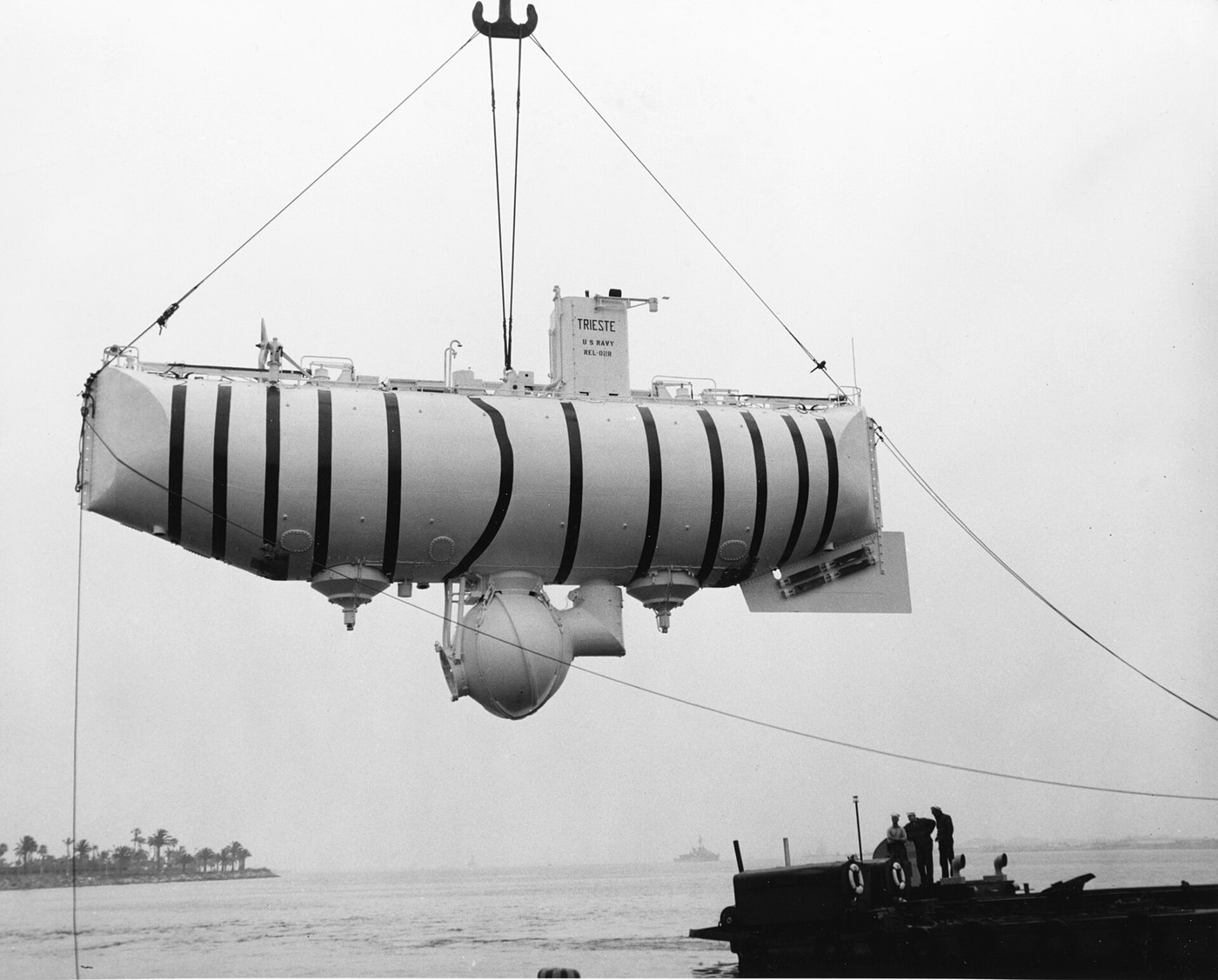
On the Challenger Deep dive in 1960, Trieste’s crew heard a loud crack at about 9,000 m — an outer window of the access trunk had failed. They continued, reached the bottom, and returned. The sphere itself was never breached, because the trunk was already flooded and was never a pressure boundary.
That is the value of separating what must hold pressure from what merely must be watertight, and it runs through this whole batch: the helmet versus the suit, the main ballast tanks versus the depth-control tanks, the float versus the crew sphere. Know which parts are structural and spend your steel only there.Bahan untuk langkah ini:
 Rod akrilik1 kepingPengedap Silikon1 tube
Alatan diperlukan:
 Mesin Pelarik Logam
 Angkup Digital 6 InciTolok TekananPerisai MukaCermin Mata Keselamatan Jernih
Bahan
4- 1 tubePemegang Tempat
- Pemegang Tempat
- 2 kepingPemegang Tempat
- 1 kepingPemegang Tempat
Alatan Diperlukan
12- Pemegang Tempat
- Pemegang Tempat
- Pemegang Tempat
- Pemegang Tempat
- Pemegang Tempat
- Pemegang Tempat
- Pemegang Tempat
- Pemegang Tempat
- Pemegang Tempat
- Pemegang Tempat
- Pemegang Tempat
- Pemegang Tempat
Blueprint berkaitan
Blueprint ini berkongsi pengetahuan — teknik, bahan atau prinsip
CC0 Domain Awam
Blueprint ini dikeluarkan di bawah CC0. Anda bebas menyalin, mengubah, mengedar, dan menggunakan karya ini untuk sebarang tujuan, tanpa meminta kebenaran.
Sokong Pembuat dengan membeli produk melalui Blueprint mereka di mana mereka memperoleh Komisen Pembuat ditetapkan oleh Penjual, atau cipta iterasi baru Blueprint ini dan sertakan ia sebagai sambungan dalam Blueprint anda sendiri untuk berkongsi hasil.