
Anodising Aluminium
Aluminium already protects itself. Exposed to air it grows an oxide film a few nanometres thick, and that film is why aluminium does not rust away like iron. It is also far too thin to survive handling, and it offers nothing to a dye.
Anodising makes the metal grow that film deliberately, hundreds of times thicker. Make the aluminium the anode in an acid bath and the oxygen liberated at its surface converts the metal into aluminium oxide — not deposited on it, converted from it. The layer grows downward into the part as much as outward, so dimensions barely change, and it cannot flake off because there is no interface for it to part along.
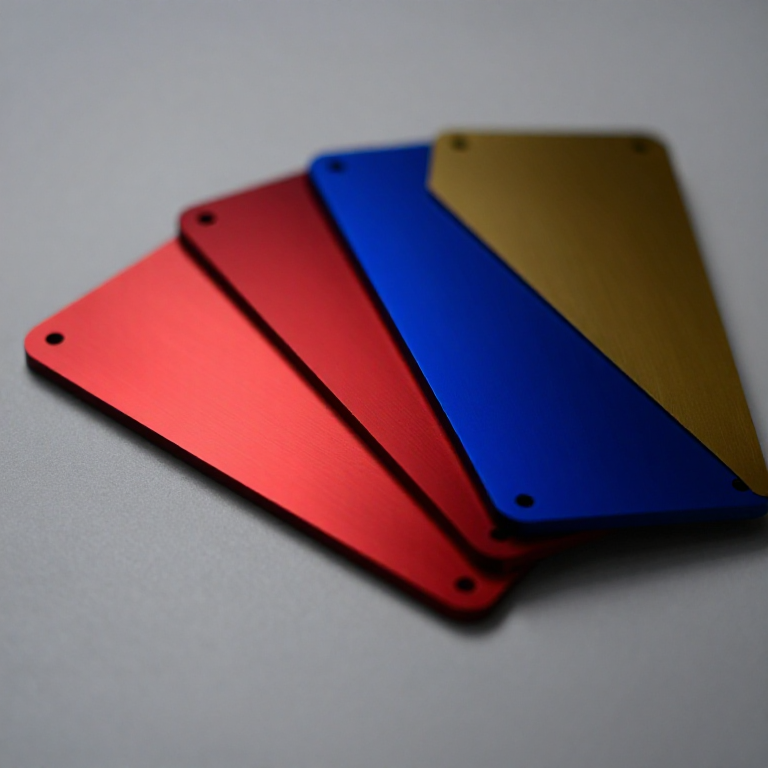
The grown film is also porous, a dense array of fine tubes standing on the metal. That porosity is the whole commercial value: the pores take up dye, and are then sealed shut in boiling water. Every coloured aluminium object you own — a carabiner, a phone body, a cooking pot — is dyed in those pores.
The first commercial process is Bengough and Stuart's, using chromic acid: British priority GB 223,994 of 2 August 1923, and US 1,771,910, "Process of protecting surfaces of aluminum or aluminum alloys", filed 28 July 1924 and granted 29 July 1930 to Guy Dunstan Bengough and John McArthur Stuart of London. It was developed for the Air Ministry to stop seaplane parts corroding.
This blueprint uses sulfuric acid, not chromic. Chromic acid is hexavalent chromium — a confirmed human carcinogen. The original chemistry is described in the history step and is not to be attempted outside industrial containment.
Kandungan berbahaya
Blueprint ini mengandungi prosedur berbahaya. Log masuk dan aktifkan kandungan berbahaya dalam tetapan akaun anda untuk melihat arahan langkah demi langkah.
Log masukBlueprint ini membuat
Blueprint berkaitan
Blueprint ini berkongsi pengetahuan — teknik, bahan atau prinsip

CC0 Domain Awam
Blueprint ini dikeluarkan di bawah CC0. Anda bebas menyalin, mengubah, mengedar, dan menggunakan karya ini untuk sebarang tujuan, tanpa meminta kebenaran.
Sokong Pembuat dengan membeli produk melalui Blueprint mereka di mana mereka memperoleh Komisen Pembuat ditetapkan oleh Penjual, atau cipta iterasi baru Blueprint ini dan sertakan ia sebagai sambungan dalam Blueprint anda sendiri untuk berkongsi hasil.