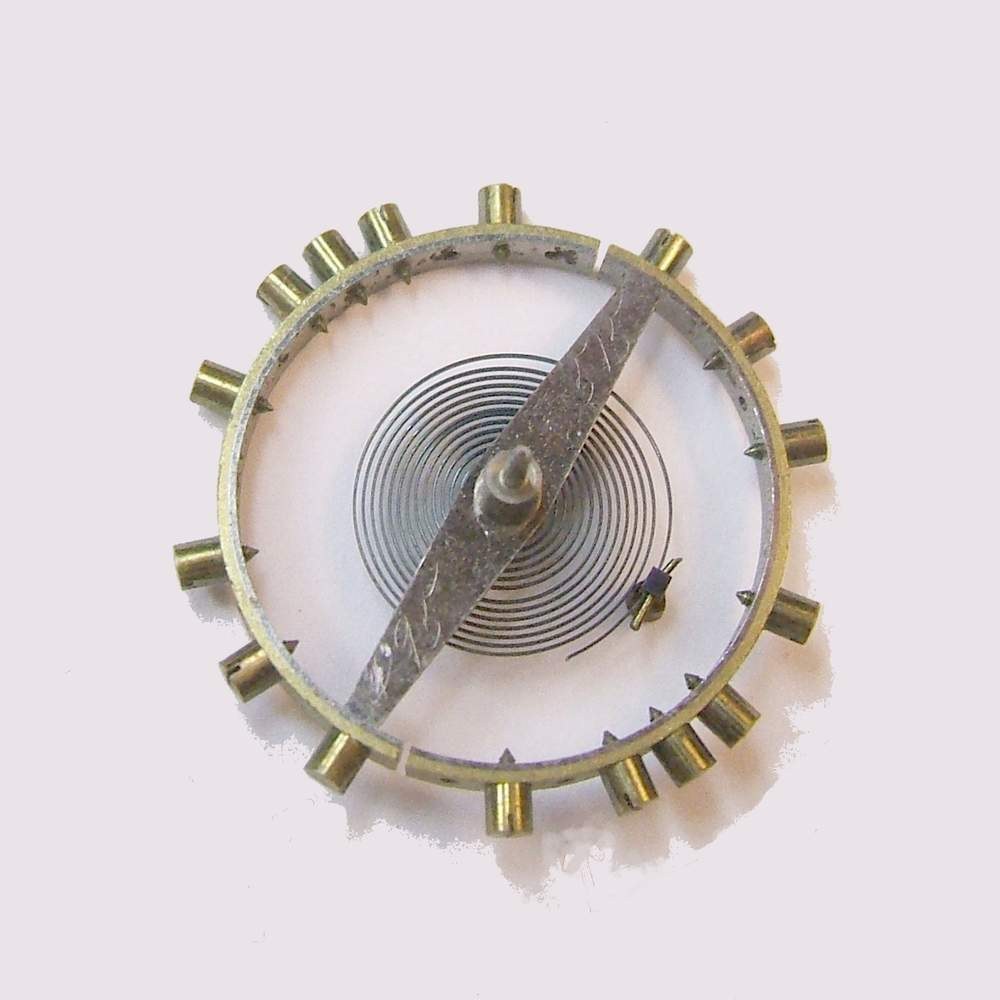


The Bimetallic Compensation Balance
The gridiron pendulum cancels temperature error by opposing two metals. A watch cannot use it, because a watch has no pendulum — it has a balance wheel and a spring, and both of them change with temperature.
The larger culprit is not the metal expanding. It is that the balance spring gets WEAKER when warm: its elastic modulus falls, so it pulls back less firmly and the watch runs slow. The wheel also grows, raising its inertia, which slows it further. Both errors point the same way, and together they are worth several seconds a day for a modest temperature change — fatal for a chronometer.
The fix is to make the wheel shrink as it warms, by exactly enough.
Build the rim from a bimetallic strip — brass fused outside, steel inside — cut through near each arm so the rim is two free-ended curved arms rather than a closed ring. Warm it, and the brass expands more than the steel, so each arm curls INWARD. The rim weights move towards the centre, the moment of inertia falls, and the balance speeds up.
Set the weights so that gain exactly offsets the loss from the softening spring. Turn the wheel into its own thermometer, wired backwards.
Arahan
Separate the two temperature errors
Separate the two temperature errors
Take your balance-and-spring oscillator and time it cold and warm — first with the whole assembly heated, then with only the spring warmed while the wheel stays cool.
Expect warming everything to slow it, and warming the spring alone to produce most of that slowing.
Record the split.
This is the measurement that tells you what to compensate. Most of a watch's temperature error lives in the SPRING's stiffness, not in the wheel's size — which is why the cure has to be applied to the wheel in the opposite direction rather than by simply making the wheel out of something stable.
Bahan untuk langkah ini:
 Kerajang tembaga C110 0,025 mm1 helaian
 Dawai Keluli Bersadur Zink1 m
Alatan diperlukan:
 Termometer
Make a strip that curls when warmed
Make a strip that curls when warmed
Bond a strip of brass to a strip of steel along their length — riveted, soldered or clamped at intervals — and warm the pair.
Expect it to bend, curving towards the steel side, because the brass grows more and the bond forces them to stay together.
Measure the deflection against temperature and check it is repeatable on cooling.
You have made the fundamental sensor of an entire century of control engineering. Two materials with different expansions, joined, convert temperature into MOTION — and motion is something a mechanism can use.
Cut the rim so it is free to move
Cut the rim so it is free to move
Form the bimetal into a circular rim on a two-armed cross, then cut the rim through near each arm so you have two free-ended curved arms rather than a closed circle.
Warm it and watch the free ends.
Expect them to move inwards.
Now try it uncut and warm it again.
Expect almost nothing: a closed ring simply grows slightly, because it cannot curl without somewhere to go.
The cut is not a detail, it is the mechanism. A compensator needs a free end, exactly as the gridiron needs its rods actually in the load path.
Tune it with weights until the error vanishes
Tune it with weights until the error vanishes
Fit small weights on the free arms and time the watch cold and hot. Move the weights towards the free ends and repeat; then towards the fixed ends and repeat.
Expect weights near the free ends to give strong compensation and weights near the arms to give little, because the free end travels furthest.
Adjust until hot and cold rates match.
Note what you have just done: you did not remove an error, you introduced a second error of equal size and opposite sign. The watch is now wrong in two ways that cancel — which is a completely respectable engineering answer and worth being honest about.
Find middle temperature error
Find middle temperature error
With the balance set to agree at, say, 5 °C and 30 °C, now time it at 17 °C, halfway between.
Expect it not to agree — expect a small error in the middle of the range.
The reason is that the spring's stiffness falls almost linearly with temperature while the bimetal's curl does not, so two curves that cross at two points must diverge between them.
Matching a curve at two points does not match it everywhere. This residual, called middle temperature error, was the last significant defect of the mechanical chronometer, and it was never fully solved by mechanism — only by inventing a spring alloy that barely changed at all.
History & Context
History & Context
It grew out of the chronometer trade, and its parentage is shared. John Harrison used a bimetallic strip as a temperature compensator in his sea clocks; Pierre Le Roy, John Arnold and Thomas Earnshaw developed the cut bimetallic rim into the form the trade actually used. Earnshaw and Arnold argued publicly about priority for years. As with the balance spring, the geometry is unambiguous and the credit is shared.
It is what made chronometers a PRODUCT rather than a masterpiece. Harrison's H4 was a unique object requiring its maker. A compensation balance, a detent escapement and jewelled bearings could be made to a pattern by a trade of specialists — and by the middle of the nineteenth century chronometers were made in hundreds and sold to any shipowner. The invention that matters commercially is usually the one that makes the first invention repeatable.
The same strip went on to run the twentieth century's thermostats. A bimetallic strip that bends with temperature and closes a contact is the thermostat in the incubator blueprint, in an iron, in a kettle, in a car's choke and in an oven. One idea — join two materials with different expansions — appears here as a compensator and there as a sensor, and it is worth being able to see that they are the same object used two ways.
Then Guillaume made it unnecessary, twice. Invar gave a balance that barely expands, and Elinvar gave a balance SPRING whose elasticity barely changes with temperature — removing the dominant error at its source. A plain monometallic balance with an Elinvar spring outperforms an elaborate cut bimetallic one. Second time in this batch that a beautiful compensating mechanism was retired by a new alloy; when you meet an intricate compensator, ask what material would delete it.
Honest limits. It cancels only at the two temperatures it was adjusted for, leaving middle temperature error. It is a cut, weighted, delicate structure that shock can distort and that adds parts to the most sensitive component in the watch. Its adjustment is skilled hand work, done by timing at temperature over days. And it does nothing at all for the other errors — position, magnetism, shock, and the ageing of the spring itself.
Bahan
2- 1 helaianPemegang Tempat
- Pemegang Tempat
Alatan Diperlukan
1- Pemegang Tempat
Bahan Blueprint Bersambung
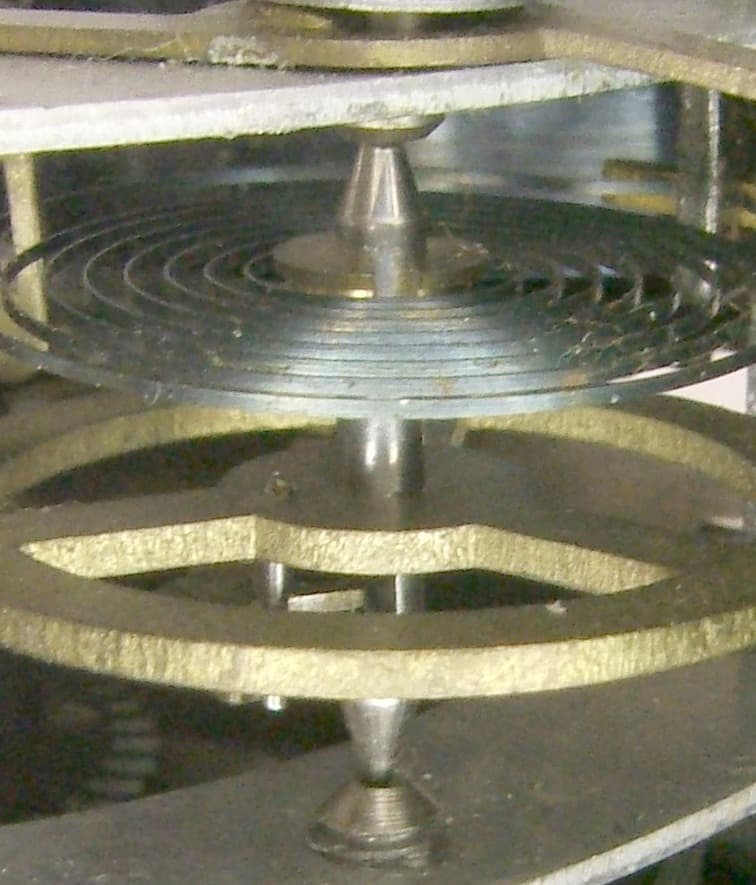

Blueprint berkaitan
Blueprint ini berkongsi pengetahuan — teknik, bahan atau prinsip

CC0 Domain Awam
Blueprint ini dikeluarkan di bawah CC0. Anda bebas menyalin, mengubah, mengedar, dan menggunakan karya ini untuk sebarang tujuan, tanpa meminta kebenaran.
Sokong Pembuat dengan membeli produk melalui Blueprint mereka di mana mereka memperoleh Komisen Pembuat ditetapkan oleh Penjual, atau cipta iterasi baru Blueprint ini dan sertakan ia sebagai sambungan dalam Blueprint anda sendiri untuk berkongsi hasil.