SENI
KECANTIKAN & KESEJAHTERAAN
KRAFTANGAN
BUDAYA & SEJARAH
HIBURAN
ALAM SEKITAR
MAKANAN & MINUMAN
KEJURUTERAAN TERBALIK
SAINS
SUKAN
TEKNOLOGI
BOLEH PAKAI



Bore and Tone Holes: A Hole Can Be Made Bigger and Not Smaller
A wind instrument is a column of air with a length. Change the length and the note changes, and the whole craft is about changing it in controlled steps.
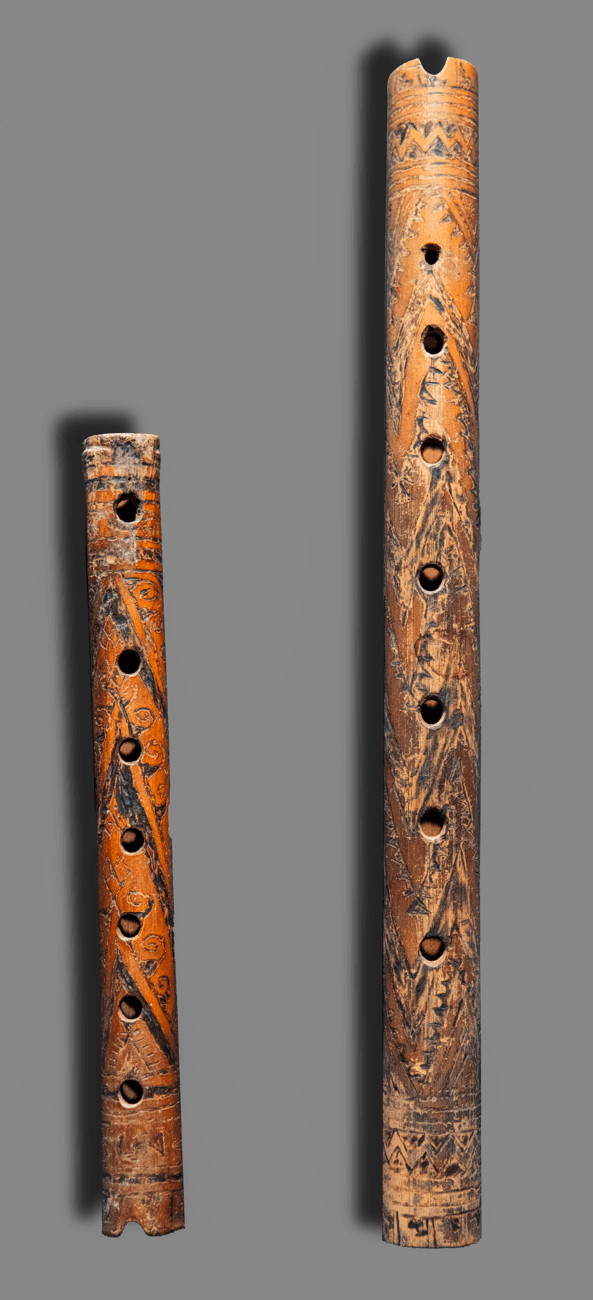
Two facts decide almost everything. A pipe closed at one end sounds an octave lower than an open one of the same length, which is why panpipes are surprisingly short. And a tone hole does not end the air column at the hole — it ends it somewhere below, by an amount that depends on how big the hole is.
That second fact is the working rule of the whole craft: cut every hole small and tune it by enlarging it, because wood cannot be put back.
Pertengahan
5 hours
Arahan
1
1
Open, closed, and how the instrument is excited
Open, closed, and how the instrument is excited
**An open pipe** — a flute, a recorder, a quena — resonates at a half wavelength and overblows to the octave, then the twelfth, giving the full harmonic series.
**A pipe closed at one end** — a panpipe, a stopped organ pipe, a clarinet — resonates at a quarter wavelength. It sounds an octave lower for the same length and it produces only the odd harmonics, so it overblows to the twelfth and skips the octave entirely. That is why a clarinet's fingering changes so awkwardly between registers, and why its lowest note is so low for its size.
How the column is set going is a separate question from its length:
**An air jet across an edge** — flute, quena, shakuhachi, panpipes, and the fipple of a recorder or whistle. The jet flaps in and out of the pipe at the resonance.
**A beating reed** — clarinet, oboe, bagpipe chanter. A tongue of cane opens and closes the entrance, and it acts as a closed end.
**A free reed** — sheng, khaen, accordion, harmonica. The tongue swings through a slot and its own stiffness sets the pitch, so the pipe is a resonator rather than the thing that decides the note.
Bahan untuk langkah ini:
 Buluh3 keping
Alatan diperlukan:
 Pembaris
 Penala kromatik dan metronom (jepit)
2
2
Lengths, corrections and hole positions
Lengths, corrections and hole positions
Memuatkan buku nota Jupyter…
Alatan diperlukan:
 Komputer Meja
3
3
Cutting and tuning a simple flute
Cutting and tuning a simple flute
Work in this order and nothing is wasted.
**Cut the tube long.** Longer than the calculation, by 20 mm or more. The overall length is the one dimension that can be corrected by cutting, and only in one direction.
**Make the embouchure or fipple first and tune the whole tube.** With no finger holes at all, the pipe sounds one note. Shorten it until that note is right. Now the length is known to be correct before a single hole is drilled.
**Mark the holes from the calculation, then drill them undersized.** Two millimetres under is a reasonable start.
**Tune from the bottom hole upwards**, enlarging each until it is in tune, because each hole's pitch depends on the ones below it being open.
**Undercut rather than enlarge, when the hole is already as big as a finger can seal.** Angling the walls of the hole inside the bore raises the pitch further while the opening the finger covers stays the same size. That is the traditional fix for a hole that has run out of room.
Check the tuning warm and with the pipe wet. Both change the pitch, and the instrument is played in that state, not cold and dry.
Bahan untuk langkah ini:
Buluh2 keping Lilin Lebah1 keping
Alatan diperlukan:
 Set Mata Gerudi
 Set Kikir Jarum
 Angkup Digital 6 InciPenala kromatik dan metronom (jepit)
 Kertas pasir halus
4
4
The bore is not just a hole through the middle
The bore is not just a hole through the middle
A cylinder is the simplest bore and not the only one, and the shape changes which harmonics line up.
**Cylindrical** — flute, clarinet, most bamboo flutes. Simple to make, and the harmonic behaviour follows the open or closed rule directly.
**Conical, widening towards the bell** — oboe, bassoon, saxophone, many folk shawms. A cone driven by a reed at its narrow end behaves like an OPEN pipe: it overblows to the octave and gives all the harmonics, although the reed closes one end. That is why a saxophone overblows an octave and a clarinet a twelfth, although both are single-reed instruments.
**Bore diameter changes the tone more than the pitch.** A wider bore for a given length is louder, darker, harder to overblow; a narrow bore is quieter, brighter and jumps to the upper registers easily. The shakuhachi's wide bore and the quena's narrow one are two deliberate answers.
**Small irregularities matter.** A ridge, a node left in a bamboo tube, or a rough patch sits somewhere in a standing wave, and its effect depends on where. Near a pressure maximum it changes the note; near a node it does almost nothing. This is why traditional makers ream and polish a bore, and why two tubes of identical length do not always play the same.
Bahan untuk langkah ini:
Buluh3 kepingAlatan diperlukan:
Angkup Digital 6 Inci Kikir kasarKertas pasir halusPenala kromatik dan metronom (jepit)
Alatan Diperlukan
8- Pemegang Tempat
- Pemegang Tempat
- Pemegang Tempat
- Pemegang Tempat
- Pemegang Tempat
- Pemegang Tempat
- Pemegang Tempat
- Pemegang Tempat
Blueprint berkaitan
Blueprint ini berkongsi pengetahuan — teknik, bahan atau prinsip
CC0 Domain Awam
Blueprint ini dikeluarkan di bawah CC0. Anda bebas menyalin, mengubah, mengedar, dan menggunakan karya ini untuk sebarang tujuan, tanpa meminta kebenaran.
Sokong Pembuat dengan membeli produk melalui Blueprint mereka di mana mereka memperoleh Komisen Pembuat ditetapkan oleh Penjual, atau cipta iterasi baru Blueprint ini dan sertakan ia sebagai sambungan dalam Blueprint anda sendiri untuk berkongsi hasil.