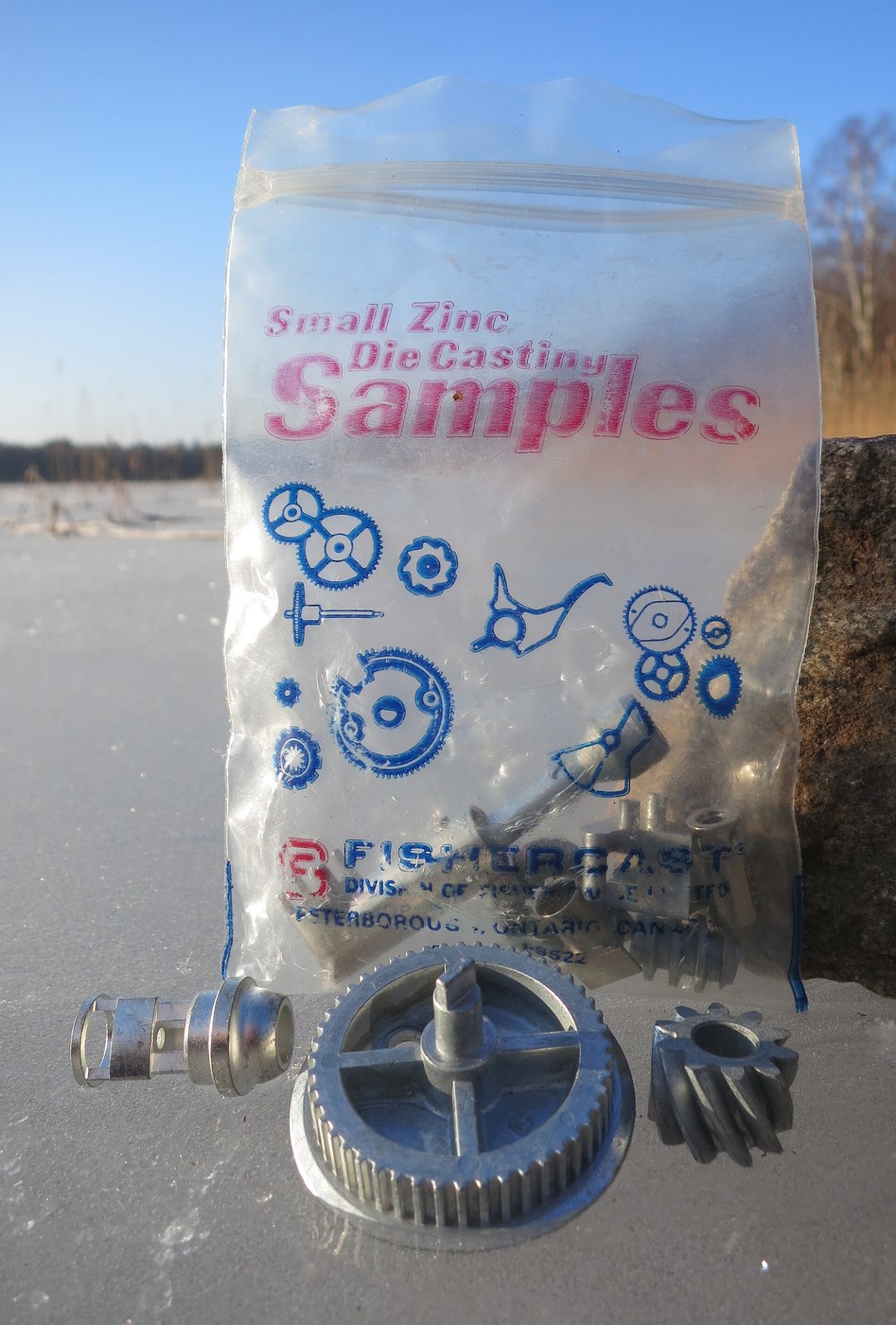


Die Casting
Arahan
Cast into sand for comparison
Cast into sand for comparison
Make the baseline before improving on it. Work with a low-melting alloy only.
- Press a pattern into damp casting sand to make a cavity.
- Melt pewter and pour it in.
- Break out the casting and examine the surface and edges.
Bahan untuk langkah ini:
 Jongkong piuter500 g
Alatan diperlukan:
 Termometer Bacaan Serta-merta
Make a reusable two-part die
Make a reusable two-part die
A permanent mould that opens, in metal or high-temperature board.
- Cut matching halves with the cavity split across a chosen parting line.
- Add locating pins so the halves register exactly.
- Cut a sprue to admit metal and thin vents at the far extremities.
Bahan untuk langkah ini:
 Bata Tahan Api2 keping
Add draft, and learn why
Add draft, and learn why
No cavity wall may be parallel to the opening direction.
- Taper every wall by a degree or two so it narrows away from the parting line.
- Cast once with a deliberately parallel wall and try to open the die.
- Compare with the tapered version.
Add pressure and compare the detail
Add pressure and compare the detail
Pressure is what separates die casting from gravity permanent-mould casting.
- Fill once by gravity alone and examine fine detail and corners.
- Fill again while applying steady pressure at the sprue as it solidifies.
- Compare edge sharpness and any porosity when you cut a casting through.
Bahan untuk langkah ini:
 Jongkong Zink1 ingot
History and context
History and context
Sturges patented a hand-operated die casting machine in 1849, and the application was printing type. Type demands exactly what die casting provides — identical pieces, crisp fine detail, and enormous quantities — and the Linotype and Monotype machines later cast type on demand as an integral part of typesetting.
Zinc made it general. Zinc alloys melt low enough to be handled by a hot-chamber machine, where the injection mechanism sits in the molten metal itself, giving very fast cycles. Aluminium attacks steel injection parts at temperature, so it uses cold-chamber machines where metal is ladled in for each shot — slower, and the reason aluminium castings cost more than zinc ones.
The honest weakness is porosity. Injecting metal at high speed entrains air, which is trapped as fine bubbles through the casting. That makes conventional die castings hard to weld or heat-treat, because trapped gas expands and blisters. Vacuum die casting and squeeze casting exist specifically to address it — and it is why a structural part is often forged rather than die cast.
Safety, plainly: molten metal and moisture are a serious combination — water trapped in a mould flashes to steam and throws metal violently. Everything that touches melt must be bone dry and preheated. Do not attempt this with zinc or aluminium without proper equipment; the pewter steps here are at a temperature a workshop can handle safely with full face and hand protection.
Bahan
3- 500 gPemegang Tempat
- 2 kepingPemegang Tempat
- 1 ingotPemegang Tempat
Alatan Diperlukan
1- Pemegang Tempat
Blueprint berkaitan
Blueprint ini berkongsi pengetahuan — teknik, bahan atau prinsip
CC0 Domain Awam
Blueprint ini dikeluarkan di bawah CC0. Anda bebas menyalin, mengubah, mengedar, dan menggunakan karya ini untuk sebarang tujuan, tanpa meminta kebenaran.
Sokong Pembuat dengan membeli produk melalui Blueprint mereka di mana mereka memperoleh Komisen Pembuat ditetapkan oleh Penjual, atau cipta iterasi baru Blueprint ini dan sertakan ia sebagai sambungan dalam Blueprint anda sendiri untuk berkongsi hasil.