
Mengekstrak Timah dari Kasiterit — Panning dan Mencairkan Bijih Timah
Arahan
Memahami kasiterit
Memahami kasiterit
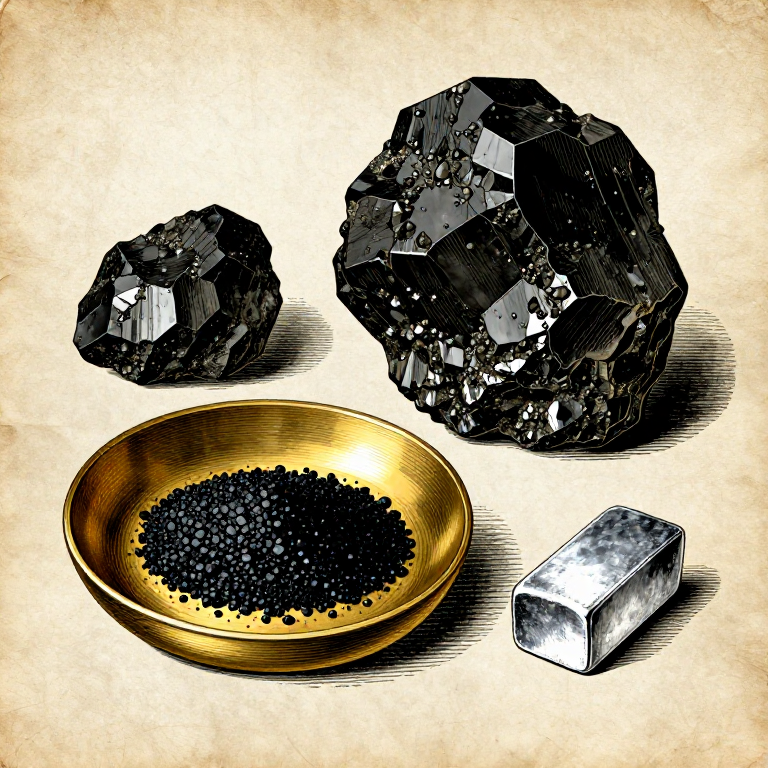
Kasiterit (SnO₂) ialah timah dioksida, bijih utama timah. Ia mempunyai kekerasan Mohs 6-7, graviti tentu yang sangat tinggi iaitu 6.8-7.1 (jauh lebih berat daripada pasir biasa pada 2.6), dan berwarna dari hitam hingga perang kemerahan. Ketumpatan yang tinggi menjadikannya mudah dipisahkan secara graviti (dulang), serupa dengan mendulang emas.
Mencari kasiterit aluvium
Mencari kasiterit aluvium
Kasiterit ditemui sebagai butiran hitam berat atau perang gelap dalam mendapan aluvium (sungai) di hilir granit yang mengandungi timah. Cari di kelikir sungai, di bahagian dalam selekoh sungai di mana mineral berat tertumpu, dan di belakang batu-batan besar. Kawasan timah bersejarah termasuk Cornwall (UK), Asia Tenggara, Bolivia, dan Afrika tengah.
Collect stream gravel
Collect stream gravel
Shovel gravel and sand from locations where heavy minerals accumulate: bedrock crevices, behind boulders, and the inside of river bends. Fill a bucket with raw gravel. The cassiterite grains are small (1-5 mm) and mixed with ordinary sand, quartz, and other minerals.
Bahan untuk langkah ini:
 Kerikil sungai20 kilogram
Alatan diperlukan:
 Penyodok gali
 Baldi 20 Liter
Pan for cassiterite
Pan for cassiterite
Use a gold pan or wide shallow bowl. Add a scoop of gravel and fill halfway with water. Swirl and tilt to wash away light material. Heavy cassiterite grains sink to the bottom center. Continue washing until only black heavy grains remain. This is identical to gold panning technique.
Alatan diperlukan:
 Dulang emas
Identify cassiterite grains
Identify cassiterite grains
Cassiterite grains are: black to dark reddish-brown, very heavy (noticeably heavier than quartz), have a brilliant adamantine (diamond-like) luster when scratched, and a white to pale brown streak. Magnetite (another heavy black mineral) is magnetic — test with a magnet to separate it from cassiterite.
Alatan diperlukan:
 Magnet
 Kanta Tangan 10x
Concentrate the ore
Concentrate the ore
Repeat panning until you have a concentrate of mostly cassiterite. Use the magnet to remove any magnetite grains. You need at least 500 g of clean cassiterite concentrate for a worthwhile smelt. From 20 kg of gravel in a good tin-bearing stream, expect 100-500 g of concentrate.
Dry the concentrate
Dry the concentrate
Spread the cassiterite concentrate on a flat surface in the sun to dry completely. Wet ore in a hot crucible causes dangerous steam explosions. Drying takes 2-4 hours in direct sunlight. The dry concentrate should feel gritty and pour freely.
Prepare the crucible and charcoal
Prepare the crucible and charcoal
Use a clay or graphite crucible that can withstand 1200°C. Mix the dry cassiterite with an equal volume of powdered charcoal. The charcoal provides carbon for reduction: SnO₂ + 2C → Sn + 2CO₂. Tin melts at only 232°C, far below the smelting temperature, so it collects as liquid at the bottom.
Bahan untuk langkah ini:
 Arang500 gram
 Mangkuk Pijar Tanah Liat Tahan Api1 keping
Set up the forge
Set up the forge
Place the loaded crucible in a charcoal forge with bellows. Tin smelting requires lower temperature than copper or iron — about 1000-1200°C is sufficient for reduction. Pack charcoal around and above the crucible. Put on safety equipment: leather apron, face shield, leather gloves.
Bahan untuk langkah ini:
 Cakera arang10 kilogram
Alatan diperlukan:
 Hembusan Angin
 Apron Kulit
 Perisai Muka
Smelt for 1-2 hours
Smelt for 1-2 hours
Pump the bellows to bring the forge to operating temperature. Maintain heat for 1-2 hours. The cassiterite reduces to metallic tin which, being liquid above 232°C, pools at the bottom of the crucible below a layer of slag and ash. Tin smelting is one of the easiest metal reductions.
Pour the molten tin
Pour the molten tin
Using crucible tongs, lift the crucible from the forge. Carefully pour the contents into a preheated sand or stone mold. The heavy molten tin pours first (bottom of crucible), followed by lighter slag. Tin is silvery-white when molten and solidifies quickly due to its low melting point.
Alatan diperlukan:
 Penyepit Mangkuk Pijar
 Acuan jongkong batu pasir
Cool and extract the ingot
Cool and extract the ingot
Tin solidifies within minutes. Once cool, remove the ingot from the mold. The tin ingot will be covered with a thin layer of slag — break this off by tapping. Clean tin is silvery-white and very soft — you can scratch it with a fingernail (Mohs hardness 1.5).
Verify it is tin
Verify it is tin
Tin has distinctive properties: bending a tin bar produces an audible crackling sound called 'tin cry' caused by crystal twinning. It is very soft (scratched by a coin), silvery-white, and does not rust. When heated, it melts easily at 232°C — far below a candle flame temperature.
Weigh and record yield
Weigh and record yield
Weigh the clean tin ingot. From 500 g of good cassiterite concentrate, expect 300-350 g of metallic tin (60-70% yield). Record the source location, concentrate weight, smelt time, and tin yield. This tin is ready for alloying with copper to make bronze, or for tinplating, soldering, and pewterwork.
Alatan diperlukan:
 Penimbang Dapur Digital
Bahan
4- 20 kilogramPemegang Tempat
- 500 gramPemegang Tempat
- Pemegang Tempat
- 10 kilogramPemegang Tempat
Alatan Diperlukan
11- Pemegang Tempat
- Pemegang Tempat
- Pemegang Tempat
- Pemegang Tempat
- Pemegang Tempat
- Pemegang Tempat
- Pemegang Tempat
- Pemegang Tempat
- Pemegang Tempat
- Pemegang Tempat
- Pemegang Tempat
Bahan Blueprint Bersambung

Blueprint ini membuat
CC0 Domain Awam
Blueprint ini dikeluarkan di bawah CC0. Anda bebas menyalin, mengubah, mengedar, dan menggunakan karya ini untuk sebarang tujuan, tanpa meminta kebenaran.
Sokong Pembuat dengan membeli produk melalui Blueprint mereka di mana mereka memperoleh Komisen Pembuat ditetapkan oleh Penjual, atau cipta iterasi baru Blueprint ini dan sertakan ia sebagai sambungan dalam Blueprint anda sendiri untuk berkongsi hasil.