SENI
KECANTIKAN & KESEJAHTERAAN
KRAFTANGAN
BUDAYA & SEJARAH
HIBURAN
ALAM SEKITAR
MAKANAN & MINUMAN
KEJURUTERAAN TERBALIK
SAINS
SUKAN
TEKNOLOGI
BOLEH PAKAI
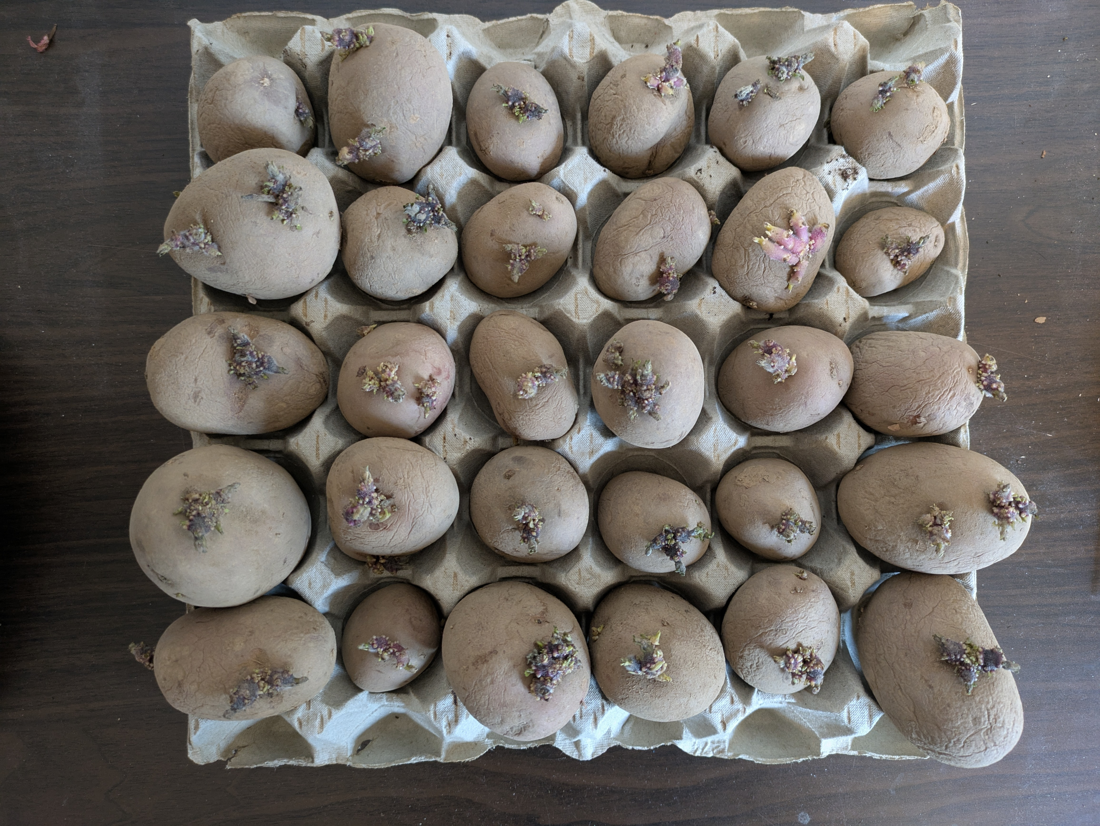
Kangarooth (Wikimedia Commons) · CC BY-SA 4.0


Growing Potatoes from Tubers — Planting the Eyes
Grow potatoes from seed potatoes — because true potato seed never comes true, you plant the tuber itself, and each 'eye' is a bud that clones a whole new plant. Chit the tubers, plant them, earth them up to make more potatoes and keep them from greening, then harvest and save your best tubers for next year. A buildable school project in vegetative propagation from a tuber.
Pemula
One growing season (spring to late summer)
Arahan
1
1
The eyes are buds
The eyes are buds
A potato tuber is really a swollen underground STEM, and its 'eyes' are buds — each one can grow into a whole new plant. Potatoes can make true seed in little green berries, but that seed does NOT come true (every seedling is different), so gardeners clone the plant by replanting the tuber instead.
2
2
Chit the seed potatoes
Chit the seed potatoes
A few weeks before planting, stand the seed potatoes eyes-up in a cool, LIGHT place (not dark) to pre-sprout — 'chitting'. Light grows short, stubby, green sprouts that give a faster, earlier crop; darkness grows long, pale, weak ones. Use certified or known-healthy seed potatoes, not old shop ones that may carry disease or sprout-inhibitor.
Bahan untuk langkah ini:
 Ubi benih kentang1 kg
3
3
Cut large tubers and let them callus
Cut large tubers and let them callus
Plant egg-sized tubers whole. Cut bigger ones into chunks, each with one or two eyes, and leave the cut faces to dry and skin over (callus) for a day or two — this stops them rotting in the ground.
4
4
Plant in spring
Plant in spring
After the last frost, plant the tubers eyes-up about 10-15 cm deep and 30 cm apart in a sunny bed. Potatoes are hungry — plenty of compost pays off in the harvest.
Bahan untuk langkah ini:
 Kompos1 bag
Alatan diperlukan:
 Sudip kebun
5
5
Earth up as they grow
Earth up as they grow
As the shoots grow, keep mounding soil or straw up around the stems ('earthing up'). New potatoes form on side-shoots ABOVE the seed tuber along the buried stem, so hilling gives them more room to form — and, just as importantly, keeps them covered. A tuber exposed to light turns GREEN and makes bitter, toxic solanine.
Bahan untuk langkah ini:
 Jerami Cincang1 bag
6
6
Harvest after the tops die back
Harvest after the tops die back
For storing potatoes, wait until the leafy tops (haulm) yellow and die down, then leave them two more weeks so the skins toughen. Lift gently with a fork, starting wide so you don't spear the tubers, and let them dry a few hours before storing.
Alatan diperlukan:
 Serampang kebun
7
7
Save the best tubers for seed
Save the best tubers for seed
Set aside smooth, egg-sized, blemish-free tubers from your HEALTHIEST plants as next year's seed. Store them cool, dark, humid and airy (never the fridge — cold turns their starch sugary). Eating potatoes must be kept in the dark so they don't green, but greening a SEED potato is harmless. Grow potatoes in a different bed each year to dodge disease.
Bahan untuk langkah ini:
 Guni kain kasar1 keping
 Label Pelekat1 helaian
8
8
Compendium — cloning from a storage stem
Compendium — cloning from a storage stem
Like garlic, the potato is grown by VEGETATIVE (clonal) propagation, not from seed — but it shows why a crop does this. Potato flowers CAN be pollinated and set true seed in small green berries, yet that seed is a wild genetic lottery: the potato is highly heterozygous, so every seedling comes out different, few any good. To keep a variety — its size, flavour, colour, cooking quality — you must copy the exact plant, and the tuber lets you do it, because a tuber is a swollen stem packed with the food and the buds ('eyes') to launch identical clones. This is the same clone logic as garlic: fast, certain, perfectly true — but with the same two catches. There is no genetic mixing, so improvement comes only from selecting among existing clones; and diseases, above all VIRUSES and the spores of late blight, ride along inside the tubers and build up generation after generation, which is exactly why gardeners buy 'certified' virus-free seed potatoes, save only from visibly healthy plants, and rotate to a fresh bed each year. Two bits of potato biology are worth carrying away. HILLING works because new tubers grow on stolons off the buried stem above the seed piece, so burying more stem makes more tuber-bearing zone — and it keeps the crop dark. That darkness matters: a potato is a stem, and a stem exposed to light turns green and makes SOLANINE, a natural toxin, so green potatoes must not be eaten (though a greened SEED potato plants perfectly well). Storage is the mirror image of seed storage — a tuber, like a biennial's root, is a living store you keep cool, dark and just-humid over winter, but never freezing-cold, since cold makes it turn sweet. Domesticated in the Andes some eight to ten thousand years ago and cloned by hand ever since, the potato became one of the most important food crops on Earth.
Bahan
5- Pemegang Tempat
- 1 bagPemegang Tempat
- 1 bagPemegang Tempat
- 1 kepingPemegang Tempat
- 1 helaianPemegang Tempat
Alatan Diperlukan
2- Pemegang Tempat
- Pemegang Tempat
Blueprint berkaitan
Blueprint ini berkongsi pengetahuan — teknik, bahan atau prinsip
CC0 Domain Awam
Blueprint ini dikeluarkan di bawah CC0. Anda bebas menyalin, mengubah, mengedar, dan menggunakan karya ini untuk sebarang tujuan, tanpa meminta kebenaran.
Sokong Pembuat dengan membeli produk melalui Blueprint mereka di mana mereka memperoleh Komisen Pembuat ditetapkan oleh Penjual, atau cipta iterasi baru Blueprint ini dan sertakan ia sebagai sambungan dalam Blueprint anda sendiri untuk berkongsi hasil.