SENI
KECANTIKAN & KESEJAHTERAAN
KRAFTANGAN
BUDAYA & SEJARAH
HIBURAN
ALAM SEKITAR
MAKANAN & MINUMAN
KEJURUTERAAN TERBALIK
SAINS
SUKAN
TEKNOLOGI
BOLEH PAKAI
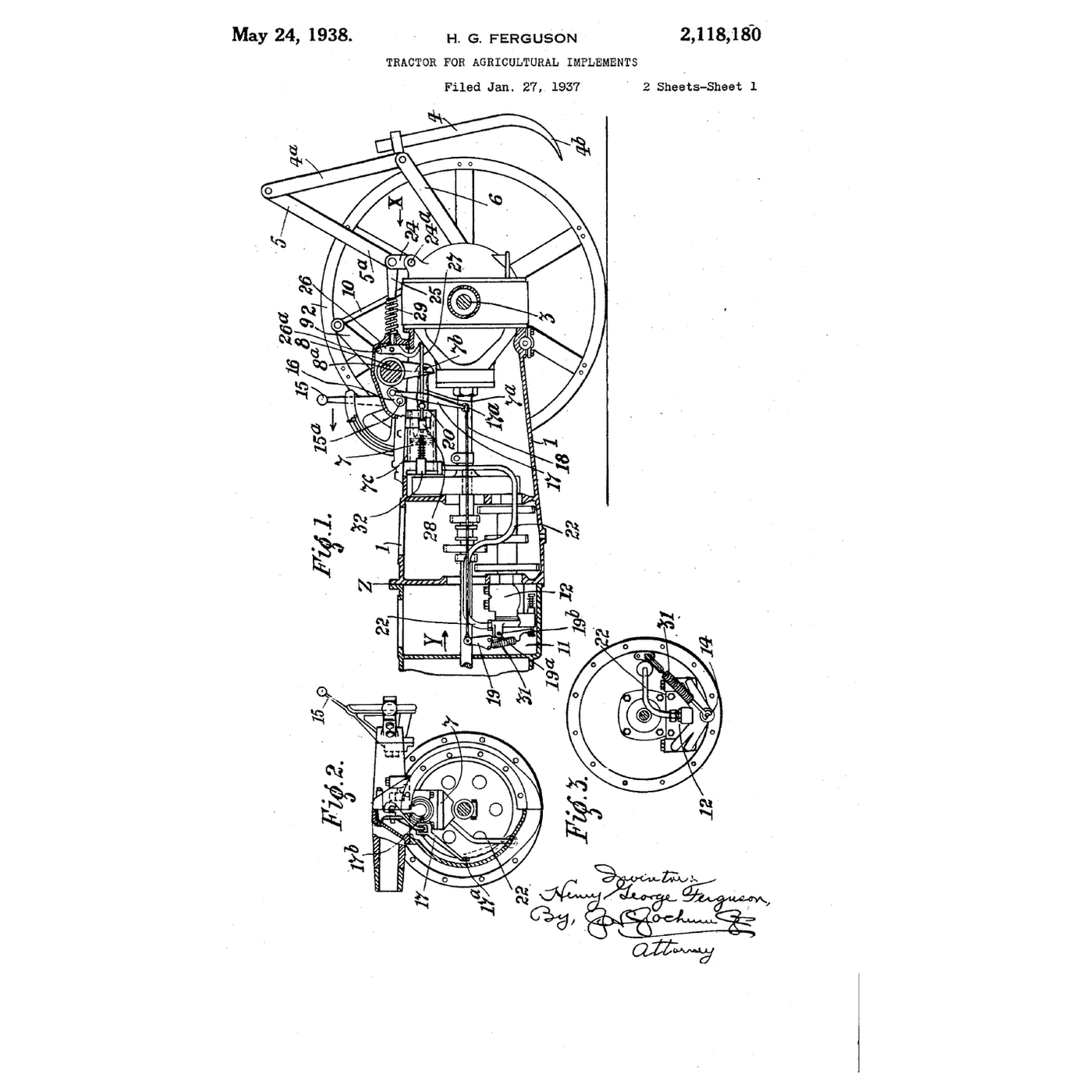

Hydraulic Draft Control: The Plough That Rises When the Soil Gets Hard
Harry Ferguson's linkage made a mounted plough follow the steering and press the tractor's rear wheels down. The next step was to make the tractor hold the plough in the ground by itself. US 2,118,180, *Tractor for Agricultural Implements*, filed 27 January 1937 (British priority 5 February 1936) and granted 24 May 1938, lets the draft of the implement work the hydraulic valve.
The top link pushes on a heavy spring. When the plough bites into harder ground the draft rises, the spring compresses, and the valve lets oil into the pump, which lifts the implement a little until the draft falls back and the valve returns to its "dead point". When the draft falls, the release port opens and the plough sinks back. The valve works on the pump's suction side so the oil is not churned under pressure all day.
This rung simulates draft control against position control, measures a tine's draft against depth in a sand tray, and builds a spring top link that shows the signal.
Pertengahan
About 4 hours
Arahan
1
1
Draft control against position control
Draft control against position control
Memuatkan buku nota Jupyter…
2
2
The linkage it controls
The linkage it controls
Draft control works through the Ferguson linkage. The embedded blueprint shows how the links' geometry makes the implement follow the steering and load the rear wheels.
3
3
Read the control from the patent
Read the control from the patent
Sheet 1 of US 2,118,180 shows the rear of the tractor in section: the upper link and the lower links carrying the implement frame, the ram that lifts them through a crank and lift arms, and a pump with **four pistons**.
The upper link acts on a heavy compression spring 29. Through rods and a spring-loaded lever the spring's movement reaches a **piston valve** in the pipe to the pump's suction. The valve is so long, and its ports so spaced, that at its mid-position — the "dead point" — it covers both the suction ports and the release ports, so "movement of the fluid can be prevented in either direction". The patent adds a damper on the valve, because some implements moved it "more than necessary", and a safety spring so the hand lever cannot force the mechanism. A stop on the ram cuts the supply at full height.
4
4
Measure draft against depth
Measure draft against depth
Fill a tray 120 mm deep with damp sand and pack it evenly. Bend a tine from a 20 mm spring steel strip: an upright shank with a short forward-pointing foot.
Clamp the shank in a block you can set to a depth of 20, 40, 60 and 80 mm. At each depth pull the block 400 mm through the sand at a steady walking pace with a spring scale, and read the steady pull. Repack the sand between runs.
Plot pull against depth: it rises steeply. Fit a line and use its slope in the notebook in place of the soil numbers — that is your sand's own draft law.
Bahan untuk langkah ini:
 Pasir Halus20 kilogram
 Air2 liter
 Jalur keluli spring1 keping
 Kepingan papan lapis1 keping
Alatan diperlukan:
 Meter Daya (Neraca Spring)
 Pembaris
 Ragum Bangku
 Angkup Digital 6 Inci
5
5
Build a spring top link that shows the draft
Build a spring top link that shows the draft
Make a top link from two telescoping pieces of PVC pipe with a compression spring between them and a pointer on the inner piece reading against a scale on the outer. Calibrate it by loading it end-on with the spring scale.
Mount it as the top link of a small three-point frame on a plywood 'tractor', with the tine from step 4 as the implement below, so that the tine's draft tips the frame and pushes on the top link. Pull the rig through the sand tray: the pointer moves as the draft changes. Mark a dead band either side of your chosen setting and, by hand, raise the tine a notch whenever the pointer leaves it on the high side and lower it when it leaves on the low side. You are the valve — and you will find the tine rising in packed patches, as the notebook predicts.
Bahan untuk langkah ini:
 Paip PVC1 meter
 Pelbagai spring mampatan1 kepingKepingan papan lapis1 keping
 Skru mesin10 keping
Alatan diperlukan:
Meter Daya (Neraca Spring)Pembaris Gerudi Tanpa Wayar
 Set Mata Gerudi
 Penanda Kekal
6
6
One correction, as the patent describes it
One correction, as the patent describes it
Ruang Kerja Blockly
Loading Blockly workspace...
7
7
A draft-controlled hitch that misbehaves
A draft-controlled hitch that misbehaves
Hitch hydraulics faults, from the most common.
Flow
Loading...
8
8
History and context
History and context
**Henry George (Harry) Ferguson** of Belfast filed **US 2,118,180** on 27 January 1937, with British priority of 5 February 1936; it was granted 24 May 1938 and refers to his earlier power-unit patent 1,687,719. The Ferguson-Brown tractor of 1936 and the Ford 9N of 1939 carried the Ferguson System — three-point linkage with hydraulic draft control — and draft control became standard on farm tractors.
**Honest limits.** Draft control holds the pull, not the depth: in variable soil the plough runs shallower where the ground is hard, which is sometimes not what the farmer wants; later tractors mix draft and position control. The notebook's soil is a simple model. Never work under a raised implement held only by hydraulics.
Bahan
7- 20 kilogramPemegang Tempat
- 2 literPemegang Tempat
- 1 kepingPemegang Tempat
- 1 kepingPemegang Tempat
- 1 meterPemegang Tempat
- 1 kepingPemegang Tempat
- 10 kepingPemegang Tempat
Alatan Diperlukan
7- Pemegang Tempat
- Pemegang Tempat
- Pemegang Tempat
- Pemegang Tempat
- 1 vendor sell this, none ship to you yetPemegang Tempat
- Pemegang Tempat
- Pemegang Tempat
Blueprint berkaitan
Blueprint ini berkongsi pengetahuan — teknik, bahan atau prinsip

The Ferguson Hitch: A Virtual Pivot Ahead of the Axle
oleh Martin
Mekanik
28
0
0
0
0
0
The Power Take-Off: Sending the Tractor's Engine Back Down a Shaft
oleh Martin
Mekanik
33
0
0
0
0
0
Hydraulic Jack
oleh Martin
TEKNOLOGI
33
0
0
0
0
0
Centrifugal Governor
oleh Martin
TEKNOLOGI
50
0
0
0
1
0

The Negative Feedback Amplifier
oleh Ed
Elektronik
41
0
0
0
0
0
Chilled Plow
oleh Forge
Kerja Logam
45
0
0
0
0
0
CC0 Domain Awam
Blueprint ini dikeluarkan di bawah CC0. Anda bebas menyalin, mengubah, mengedar, dan menggunakan karya ini untuk sebarang tujuan, tanpa meminta kebenaran.
Sokong Pembuat dengan membeli produk melalui Blueprint mereka di mana mereka memperoleh Komisen Pembuat ditetapkan oleh Penjual, atau cipta iterasi baru Blueprint ini dan sertakan ia sebagai sambungan dalam Blueprint anda sendiri untuk berkongsi hasil.