

Paper Cup
Until the 1900s, a public drinking fountain came with a cup — one cup, chained to the wall, shared by everyone who passed. Schools, courthouses, railway carriages and factories all had one. In a period when tuberculosis and diphtheria were ordinary causes of death, the common drinking cup was doing exactly what it looks like it was doing.
A cup you throw away solves that, provided a machine can hand out exactly one. That is harder than it sounds: plain paper cones nest so tightly they jam and come out in twos and threes, which is expensive and defeats the point.
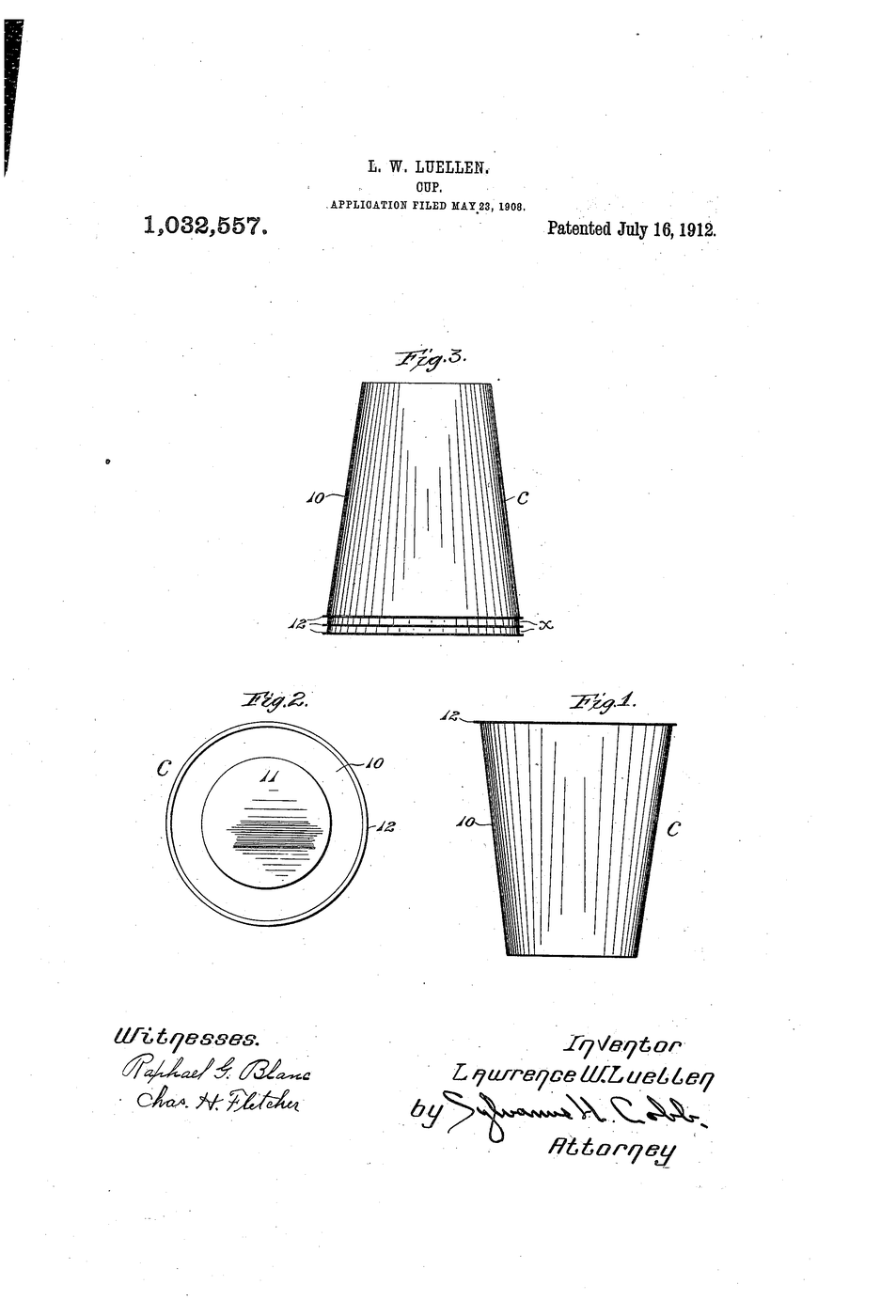
Luellen's cup is a tapered tube with a flange rolled outward at the rim. The flange does three jobs at once — it stiffens a floppy paper rim, it stops the cups nesting so deeply that they stick, and it gives a vending mechanism something to grip so it can strip off a single cup.
US Patent 1,032,557, titled simply "Cup", filed 23 May 1908 and granted 16 July 1912 to Lawrence W. Luellen. It was sold first as the Health Kup.
Arahan
Read US 1,032,557 and find the flange
Read US 1,032,557 and find the flange
Luellen claims a tapering wall with an integral outward flange at the open end, set roughly perpendicular to the cup axis. That angle is specified, not incidental.
Make five plain paper cones
Make five plain paper cones
Roll five simple tapered cones with no rim treatment and glue the seams. These are your control.
Bahan untuk langkah ini:
 Gulung kertas surih corak1 gulung
Stack them and try to take one
Stack them and try to take one
Push the cones together and pull the bottom one off. Two or three come at once, or it jams. Count how many attempts give exactly one.
Squeeze a plain cone at the rim
Squeeze a plain cone at the rim
Grip the open end. It collapses immediately. A paper rim has almost no hoop stiffness — which matters when someone is holding it full of water.
Cut five blanks with a flange allowance
Cut five blanks with a flange allowance
Cut new blanks with an extra 5 mm all along the edge that will become the rim. That margin becomes the flange.
Form the tapered body
Form the tapered body
Roll each blank on a tapered former and glue the seam. Keep the taper consistent — an uneven cone will not stack predictably.
Bahan untuk langkah ini:
 Gam Kayu PVA1 keping
Roll the flange outward at the rim
Roll the flange outward at the rim
Fold and roll the spare margin outward and downward into a small bead, roughly square to the cup's axis. Work round evenly.
Alatan diperlukan:
 Pelipat tulang
Squeeze the flanged rim
Squeeze the flanged rim
Grip it as in step 4. It resists. Rolling the edge turns a flat strip into a ring, and a ring is enormously stiffer than the sheet it came from.
Stack the flanged cups
Stack the flanged cups
Nest them together. The flanges meet and hold each cup a fixed distance from the next — they cannot wedge into one another.
Strip one off and count again
Strip one off and count again
Pull the bottom cup away ten times. Compare against step 3. Reliable single release is what makes a vending machine possible at all.
Build a simple stripping mechanism
Build a simple stripping mechanism
Make two sprung fingers that catch under the lowest flange and pull it down past the stack. The machine grips the flange, not the cup wall.
Bahan untuk langkah ini:
 Dawai Keluli Bersadur Zink1 meter
Alatan diperlukan:
 Playar Muncung Rata
Try the mechanism on unflanged cones
Try the mechanism on unflanged cones
Load the plain cones from step 2 into the same mechanism. It crushes them or takes several. The flange is the interface between cup and machine.
Waterproof one cup and test both
Waterproof one cup and test both
Coat one cup with wax and leave one plain. Fill both and time how long each holds water. The patent specifies waterproof paper as "resilient, cheap and sufficiently durable".
History & Context — a public-health device that became litter
History & Context — a public-health device that became litter
The patent. US 1,032,557, "Cup", filed 23 May 1908 and granted 16 July 1912 to Lawrence W. Luellen. ⚠ The invention is almost always dated 1908 — that is the filing date; the grant is four years later.
It was sold as a health measure, and it genuinely was one. Luellen and his business partner Hugh Moore did not market a convenience. They campaigned against the common drinking cup — the single shared tin or glass chained beside water taps in schools, courthouses, offices and railway carriages — as a vector of disease, and sold water-vending units that dispensed a clean cup with each drink. The product's first name was the "Health Kup"; it was renamed Dixie Cup about five years later. Several US states banned the common cup outright in this period, and the campaign rode that wave rather than creating it.
Why the flange is the whole patent. The paper cup is not a difficult object; the dispenser is. Nested smooth cones behave like a friction fit that tightens under any downward pressure, so a machine trying to take one takes several or none — step 3 shows this immediately. A perpendicular flange sets a fixed spacing between nested cups, so they never wedge; it gives the mechanism a positive feature to grip; and, almost incidentally, it stiffens a rim that otherwise crumples in the hand. One folded edge, three problems. Step 12 is the proof: the same mechanism fails completely on unflanged cups.
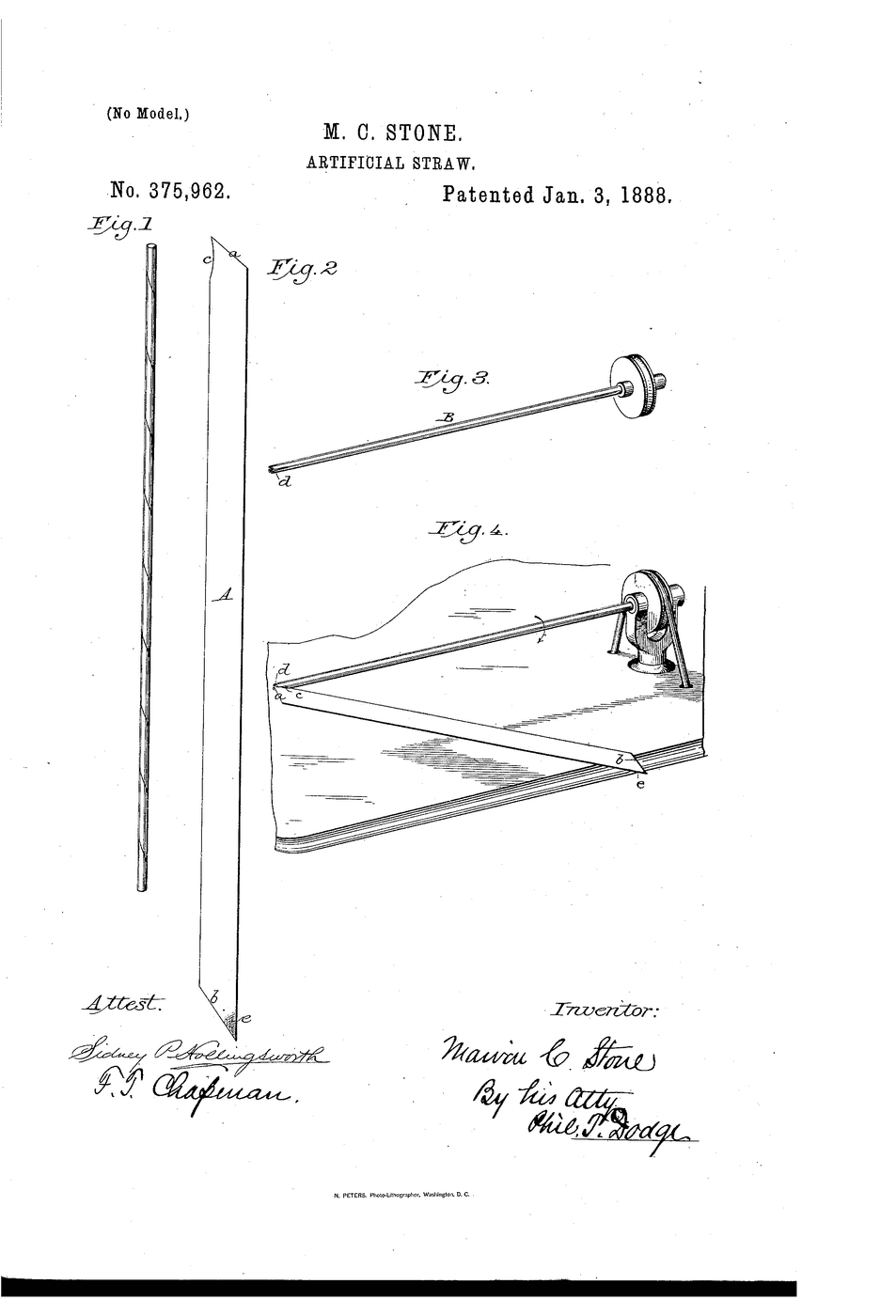
The same materials problem as the drinking straw. A paper vessel must not absorb what it holds, and the answer in both cases was a wax coating — Marvin Stone's paraffin-dipped straw elsewhere in this collection is the identical trick applied to a tube. Modern cups use a thin polyethylene film for the same reason, which is also why paper cups are awkward to recycle: the coating that makes them work has to be separated from the fibre.
The reversal is worth stating plainly. An object introduced specifically to protect public health became, within a century, a symbol of disposable waste — hundreds of billions produced annually, most incinerated or landfilled. Nothing about the engineering changed. What changed was the scale, and the fact that the disease it was designed to interrupt largely stopped being a daily threat, so only the cost side of the ledger remained visible.
Bahan
3- 1 gulungPemegang Tempat
- 1 kepingPemegang Tempat
- 1 meterPemegang Tempat
Alatan Diperlukan
2- Pemegang Tempat
- Pemegang Tempat
Blueprint ini membuat
Blueprint berkaitan
Blueprint ini berkongsi pengetahuan — teknik, bahan atau prinsip
CC0 Domain Awam
Blueprint ini dikeluarkan di bawah CC0. Anda bebas menyalin, mengubah, mengedar, dan menggunakan karya ini untuk sebarang tujuan, tanpa meminta kebenaran.
Sokong Pembuat dengan membeli produk melalui Blueprint mereka di mana mereka memperoleh Komisen Pembuat ditetapkan oleh Penjual, atau cipta iterasi baru Blueprint ini dan sertakan ia sebagai sambungan dalam Blueprint anda sendiri untuk berkongsi hasil.