SENI
KECANTIKAN & KESEJAHTERAAN
KRAFTANGAN
BUDAYA & SEJARAH
HIBURAN
ALAM SEKITAR
MAKANAN & MINUMAN
KEJURUTERAAN TERBALIK
SAINS
SUKAN
TEKNOLOGI
BOLEH PAKAI
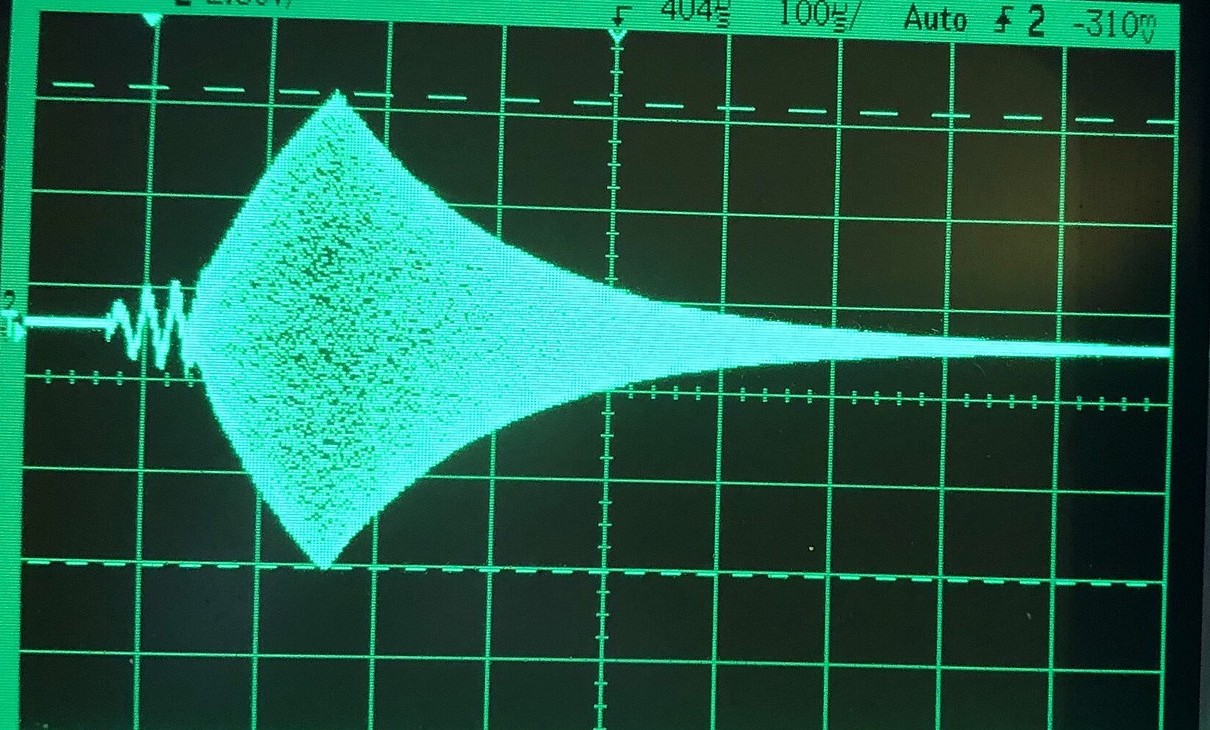


Nyquist's Stability Criterion
Black's feedback amplifiers worked, and some of them sang. Adding more feedback made every measurable property better right up to the point where the amplifier turned into an oscillator, and nobody could say in advance which side of that line a new design was on.
Maxwell's method cannot help. It needs the coefficients of the differential equation, and a Bell Labs repeater full of hand-wound transformers, valves and stray capacitance does not come with coefficients - you would have to guess them, and the guess is exactly what is in question.
Harry Nyquist's paper of January 1932 asks a question you can answer with a signal generator instead. Send a sine wave once around the OPEN loop and look at what comes back. If at some frequency it returns the same size and exactly upside down, then joining the loop lets it sustain that sine wave with no input at all, which is what singing is. Plot what comes back over the whole frequency range and the test becomes a count: how many times does the curve go around the point minus one?
Two numbers fall straight out and are still how amplifiers are specified. Gain margin is how much more gain the loop would take before it sang; phase margin is how much more lag. Both are read off a measurement of a machine you never modelled.
The criterion also handles the case Maxwell's cannot touch at all: a pure time delay. A microphone a few metres from its own loudspeaker has no polynomial to write down, and Nyquist predicts the pitch of the howl and how it changes when you move the microphone.
Lanjutan
3 hours
Arahan
1
1
Make a loop howl, on purpose
Make a loop howl, on purpose
Point a microphone at a loudspeaker two metres away with an amplifier between them, and raise the volume until it howls. Record it and read the pitch off the spectrum.
Now halve the distance and do it again. The pitch rises, and it rises in the way the notebook predicts from the flight time of sound alone.
Alatan diperlukan:
 Pembesar suara (makmal)
 Mikrofon
 Penguat audio
 Pita Ukur
 Komputer Meja
 Pita pelekat kertas
2
2
Measure a loop instead of modelling it
Measure a loop instead of modelling it
Break the feedback loop of the amplifier from the previous blueprint, drive the input from the generator and measure amplitude and phase at the far end, decade by decade.
Find the frequency where the phase reaches minus 180 degrees and read the gain there. That one number is the gain margin, and you obtained it without writing down a single differential equation. Plot amplitude against phase on the graph paper as you go: that curve IS the Nyquist diagram, and you can see how close it passes to minus one.
Bahan untuk langkah ini:
 Kertas Graf4 helaian
Alatan diperlukan:
 Penjana Isyarat DDS
 Osiloskop Digital
 Papan Roti
 Set Pensel Grafit
3
3
Margins, encirclements, and four ways to ask the question
Margins, encirclements, and four ways to ask the question
Memuatkan buku nota Jupyter…
Alatan diperlukan:
Komputer Meja4
4
Compendium: conditional stability, and why the curve is a circle
Compendium: conditional stability, and why the curve is a circle
The count is of encirclements, not of crossings, and the distinction matters because a loop can be stable with high gain and UNSTABLE with low gain. Wind the volume down on such a system and it starts oscillating - which is exactly backwards from everybody's intuition, and it is why the criterion is stated as a winding number rather than as a rule about crossing the negative axis. Conditionally stable loops are common wherever a designer has shaped the response to get more feedback than the plain rule allows, and they are dangerous for a reason that has nothing to do with mathematics: the gain is low during start-up, during a fault, and while an operator is turning the knob.
The full statement counts open-loop unstable poles too. Nyquist's theorem says the closed loop is stable when the number of clockwise encirclements of minus one equals minus the number of poles the open loop already has in the right half plane, which is why the criterion works on systems that are unstable to begin with - a rocket balancing on its thrust, an inverted pendulum, a modern aircraft deliberately built unstable for manoeuvrability. For everything in this batch that number is zero and the rule reduces to the simple form: no encirclements, no singing.
Bahan
1- 4 helaianPemegang Tempat
Alatan Diperlukan
10- Pemegang Tempat
- 3 vendors sell this, none ship to you yetPemegang Tempat
- 2 vendors sell this, none ship to you yetPemegang Tempat
- 1 vendor sell this, none ship to you yetPemegang Tempat
- Pemegang Tempat
- Pemegang Tempat
- Pemegang Tempat
- 1 vendor sell this, none ship to you yetPemegang Tempat
- 1 vendor sell this, none ship to you yetPemegang Tempat
- Pemegang Tempat
Blueprint berkaitan
Blueprint ini berkongsi pengetahuan — teknik, bahan atau prinsip


CC0 Domain Awam
Blueprint ini dikeluarkan di bawah CC0. Anda bebas menyalin, mengubah, mengedar, dan menggunakan karya ini untuk sebarang tujuan, tanpa meminta kebenaran.
Sokong Pembuat dengan membeli produk melalui Blueprint mereka di mana mereka memperoleh Komisen Pembuat ditetapkan oleh Penjual, atau cipta iterasi baru Blueprint ini dan sertakan ia sebagai sambungan dalam Blueprint anda sendiri untuk berkongsi hasil.