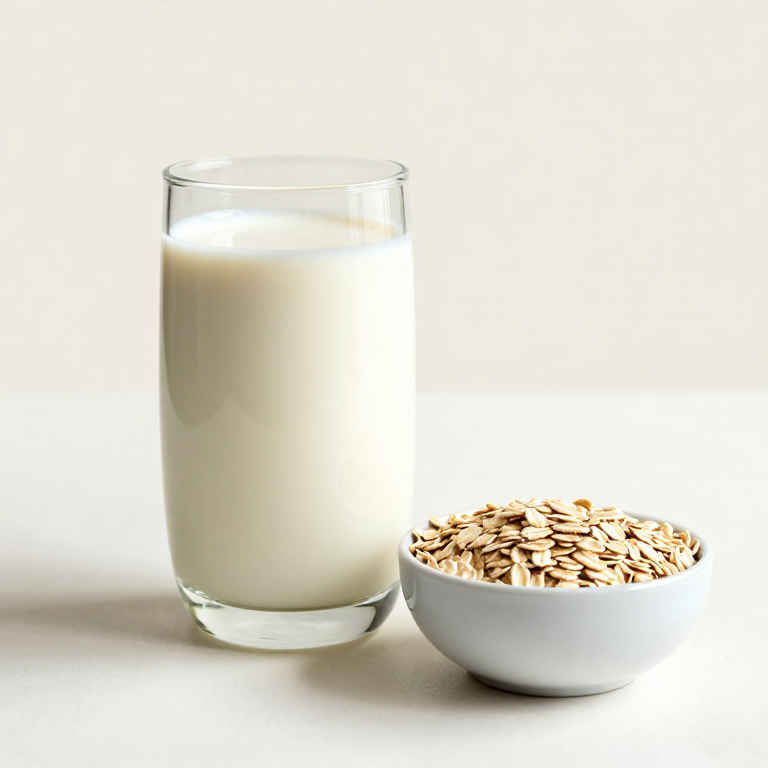


Oat Milk
Home-made oat milk usually comes out slimy, and the reason is the single most interesting thing about it.
Oats are mostly starch. Blend them in water and you release starch granules; warm them, or blend them long enough to heat the mixture by friction, and those granules gelatinise — they swell, burst and thicken the liquid exactly as they would if you were making porridge. What people call slimy oat milk is a very dilute porridge, and no amount of straining removes it, because the thickening is dissolved rather than suspended.
So the home method is entirely about not cooking it: cold water, ice if you have it, the shortest blend that does the job, and a fine strain.
Commercial oat milk solves the same problem the opposite way. Instead of avoiding starch release it embraces it, then adds enzymes — amylases — to cut the long starch chains into short sugars. That removes the viscosity and produces the characteristic sweetness, which is why a carton with no added sugar still tastes sweet. The sugar was in the oats as starch, and an enzyme unlocked it.
Make three batches that differ in one variable each and the whole thing becomes obvious.
Arahan
Blend cold, and blend briefly
Blend cold, and blend briefly
Combine 80 g rolled oats with 1 litre of very cold water. Blend for no more than 30 seconds.
Feel the jug afterwards.
If it is warm, you have already gone too far. Blender blades put real energy into the liquid, and heat is what starts gelatinisation — this is why the cold water matters more than the strainer.
Bahan untuk langkah ini:
 Oat leper80 g
Alatan diperlukan:
 Pengisar
 Termometer Bacaan Serta-merta
Strain once, and do not squeeze
Strain once, and do not squeeze
Pour through a fine cloth into a jug. Let it drain under gravity.
Do not wring the bag.
Squeezing forces fine starch and oat solids through the cloth, and those are precisely what makes the result gluey and chalky. You are trading a little yield for most of the quality, which is the same bargain as not pressing the grounds in cold-brew coffee.
Alatan diperlukan:
 Kain Kasa Halus
Make the slimy one on purpose
Make the slimy one on purpose
Repeat with warm water and a three-minute blend. Strain the same way.
Pour both from a spoon and compare how they run.
Expect the second to be visibly thicker and to trail.
One variable, one dramatic difference. Keeping the failed batch beside the good one is worth more than any written instruction about being gentle.
Measure the viscosity instead of judging it
Measure the viscosity instead of judging it
Time how long a fixed volume of each batch takes to run out of a funnel, three times each, and average.
Compare against water and against dairy milk.
Expect the cold-blended batch to be close to milk and the warm one markedly slower.
A funnel and a stopwatch is a real viscometer, and it turns "a bit slimy" into a number you can put on a graph.
Alatan diperlukan:
 Jam Randik
 Kertas Graf
Show the enzyme doing the industrial trick
Show the enzyme doing the industrial trick
Take a portion of the deliberately-thick batch, warm it gently to about 60 °C, and stir in a pinch of amylase enzyme powder. Hold it for 20 minutes, then chill.
Re-run the funnel test and taste it.
Expect it to be much thinner and noticeably sweeter.
Nothing was added but a catalyst. The sweetness came out of the starch that was making it thick.
Bahan untuk langkah ini:
 Serbuk enzim alfa-amilase5 g
Stabilise it and test it in use
Stabilise it and test it in use
Add a small pinch of salt and, if you want, a spoonful of oil, and blend for two seconds.
Leave a glass to stand for an hour, then pour some into hot coffee.
Expect some settling and possibly curdling in coffee.
Home oat milk has no added emulsifier or acidity regulator. Barista cartons contain both, which is the entire reason they foam and do not split — a formulation difference, not a quality one.
Bahan untuk langkah ini:
 Minyak zaitun dara tulen10 ml
 Garam Laut Halus1 pinch
Compendium — starch, enzymes and honest nutrition
Compendium — starch, enzymes and honest nutrition
Gelatinisation is the mechanism behind half of cooking. Starch granules are dense, ordered packets that are insoluble in cold water. Heat them in water past a threshold — for oats, well below boiling — and they absorb water, swell enormously and rupture, releasing long amylose and amylopectin chains that thicken the liquid. It is why a roux thickens, why rice absorbs water, and why a potato goes from crunchy to fluffy. Here it is the enemy, and everything in steps 1 and 2 is about staying below the threshold.
What the enzyme actually is. Alpha-amylase cuts starch chains at internal points, dropping the average chain length fast and therefore the viscosity; beta-amylase chews maltose off the ends, producing sweetness. Commercial oat-milk production deliberately gelatinises the starch and then treats it with these enzymes — the same enzymes, and very nearly the same process step, as the mashing stage of brewing beer. An oat-milk plant and a brewery are doing the same chemistry to the same molecule, and only the fermentation afterwards differs.
Why oat milk displaced the others commercially. Oats grow in cool wet climates where almonds cannot, use dramatically less water than almonds, and the enzymatic route gives a sweet, neutral, coffee-friendly product without added sugar. It is also nut-free and soy-free, which matters for allergen management in cafés. Its weaknesses are equally real: it is low in protein compared with dairy or soy, and the enzymatic conversion produces free sugars, so the glycaemic response is higher than the whole grain it came from.
The honest nutrition comparison. Commercial plant milks are fortified with calcium, vitamin D and often B12; home-made is not, and substituting home-made oat milk for dairy in a child's diet without accounting for that is a genuine nutritional gap. Home-made also has no added protein. This blueprint makes a drink and demonstrates a mechanism; it does not make a nutritional equivalent of milk, and it should not be presented as one.
Allergen and safety notes. Oats are frequently cross-contaminated with wheat during growing and milling, so oat milk is not automatically gluten-free — certified oats are required for anyone coeliac. Home-made keeps only a few days refrigerated and has no preservative; make small batches, keep it cold, and discard it if it smells sour. Clean the blender immediately, because gelatinised starch sets like glue once it dries.
Bahan
4- 80 gPemegang Tempat
- Pemegang Tempat
- Pemegang Tempat
- 1 pinchPemegang Tempat
Alatan Diperlukan
5- Pemegang Tempat
- Pemegang Tempat
- Pemegang Tempat
- Pemegang Tempat
- Pemegang Tempat
Bahan Blueprint Bersambung

Blueprint ini membuat
Blueprint berkaitan
Blueprint ini berkongsi pengetahuan — teknik, bahan atau prinsip
CC0 Domain Awam
Blueprint ini dikeluarkan di bawah CC0. Anda bebas menyalin, mengubah, mengedar, dan menggunakan karya ini untuk sebarang tujuan, tanpa meminta kebenaran.
Sokong Pembuat dengan membeli produk melalui Blueprint mereka di mana mereka memperoleh Komisen Pembuat ditetapkan oleh Penjual, atau cipta iterasi baru Blueprint ini dan sertakan ia sebagai sambungan dalam Blueprint anda sendiri untuk berkongsi hasil.