

The Rocket Equation
Arahan
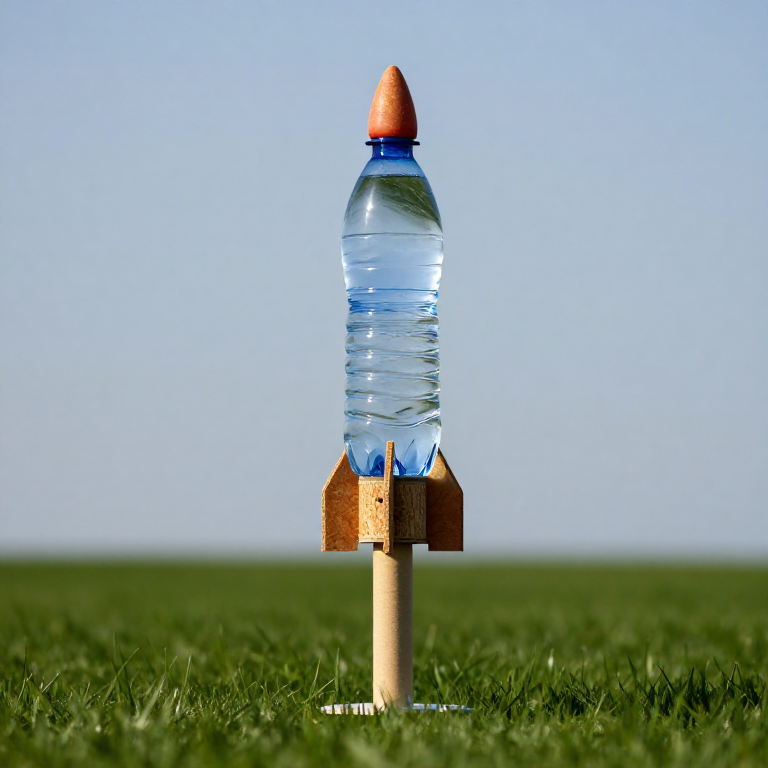
Build a water rocket you can weigh precisely
Build a water rocket you can weigh precisely
Water rockets are the honest bench-scale rocket: the propellant is heavy, visible and measurable.
- Make a launcher from a bottle-neck seal, a compressed air line and a quick-release mechanism.
- Fit a fin set and a nose cone to a plastic bottle so it flies straight.
- Weigh the empty rocket precisely, and calibrate a water fill line in 50 ml increments.
- Establish a safe launch area with everyone behind the launch point, and never lean over a pressurised rocket.
Record the dry mass carefully — it is the denominator of every mass ratio you are about to test, and an error there propagates into every result.
A pressurised bottle stores real energy and the failure mode is sudden. Use bottles rated for carbonated drinks, never glass, never a bottle that has been scratched or previously burst, and pressurise remotely rather than standing over it.Bahan untuk langkah ini:
 Botol PET (minuman berkarbonat)4 keping
 Kepingan Kayu Balsa1 helaian
 Paip PVC1 keping
 Set Gelang O1 kit
Alatan diperlukan:
 Penimbang Digital
 Angkup Digital 6 Inci
 Pisau hobi dengan mata ganti
 Pemampat udara 30 gelen
 Tolok Tekanan
 Cermin Mata Keselamatan Jernih
 Perisai Muka
Vary the mass ratio and plot the logarithm
Vary the mass ratio and plot the logarithm
Change one variable — how much water you load — and watch the returns diminish.
- Launch at a fixed pressure with 200 ml of water, filming against a measured background to determine peak altitude.
- Repeat with 400, 600, 800, 1000 and 1200 ml, three launches at each.
- Compute the mass ratio for each — full mass divided by empty mass.
- Plot peak altitude against mass ratio, and then against the NATURAL LOG of mass ratio.
The plot against mass ratio curves over and flattens; the plot against its logarithm is far closer to a straight line. You have measured Tsiolkovsky’s equation in a car park.
Notice where the peak is. Too little water and there is not enough mass to throw; too much and you are lifting water you never expel before the air runs out. There is an optimum around a third of the bottle volume, and it is a real optimum rather than an artefact.
The diminishing return is the whole lesson. Going from a mass ratio of 2 to 4 buys as much velocity as going from 4 to 8 — each doubling adds the SAME increment, and the increments never get bigger no matter how much propellant you add.Bahan untuk langkah ini:
Botol PET (minuman berkarbonat)2 keping Kertas Graf1 pad
Alatan diperlukan:
Penimbang Digital Telefon Pintar dengan Video Gerak Perlahan
 Pita UkurTolok TekananPemampat udara 30 gelen
 ProtraktorCermin Mata Keselamatan JernihPerisai Muka
Now vary exhaust velocity and compare the leverage
Now vary exhaust velocity and compare the leverage
Change the other term and see how differently it behaves.
- Keep the water volume at its optimum and vary launch pressure instead — try 3, 4, 5 and 6 bar.
- Higher pressure means the water leaves faster, which is a direct proxy for exhaust velocity.
- Measure peak altitude at each pressure, three launches each.
- Plot altitude against exit velocity and compare the slope with the mass-ratio plot.
Exhaust velocity pays back proportionally, with no logarithm blunting it. A 40 percent increase in exhaust velocity buys roughly 40 percent more delta-v; a 40 percent increase in propellant buys far less.
This is why enormous effort goes into propellant chemistry and nozzle design for what look like small percentage gains. A 10 percent improvement in specific impulse is worth more than a 10 percent improvement in almost anything else on the vehicle, and that single fact explains the entire history of rocket propellant development.
It also explains hydrogen. Liquid hydrogen is a nightmare — it boils at 20 K, it embrittles metals, it leaks through seals nothing else escapes, and its density is so low the tanks are absurd. It is used anyway, because its exhaust velocity is the highest of any practical chemical propellant, and that term is the one with leverage.Bahan untuk langkah ini:
Botol PET (minuman berkarbonat)2 kepingKertas Graf1 padAlatan diperlukan:
Tolok TekananPemampat udara 30 gelenTelefon Pintar dengan Video Gerak PerlahanPita UkurPenimbang DigitalCermin Mata Keselamatan JernihPerisai MukaCompute what orbit actually demands
Compute what orbit actually demands
Put real numbers into the equation and see why the problem is hard.
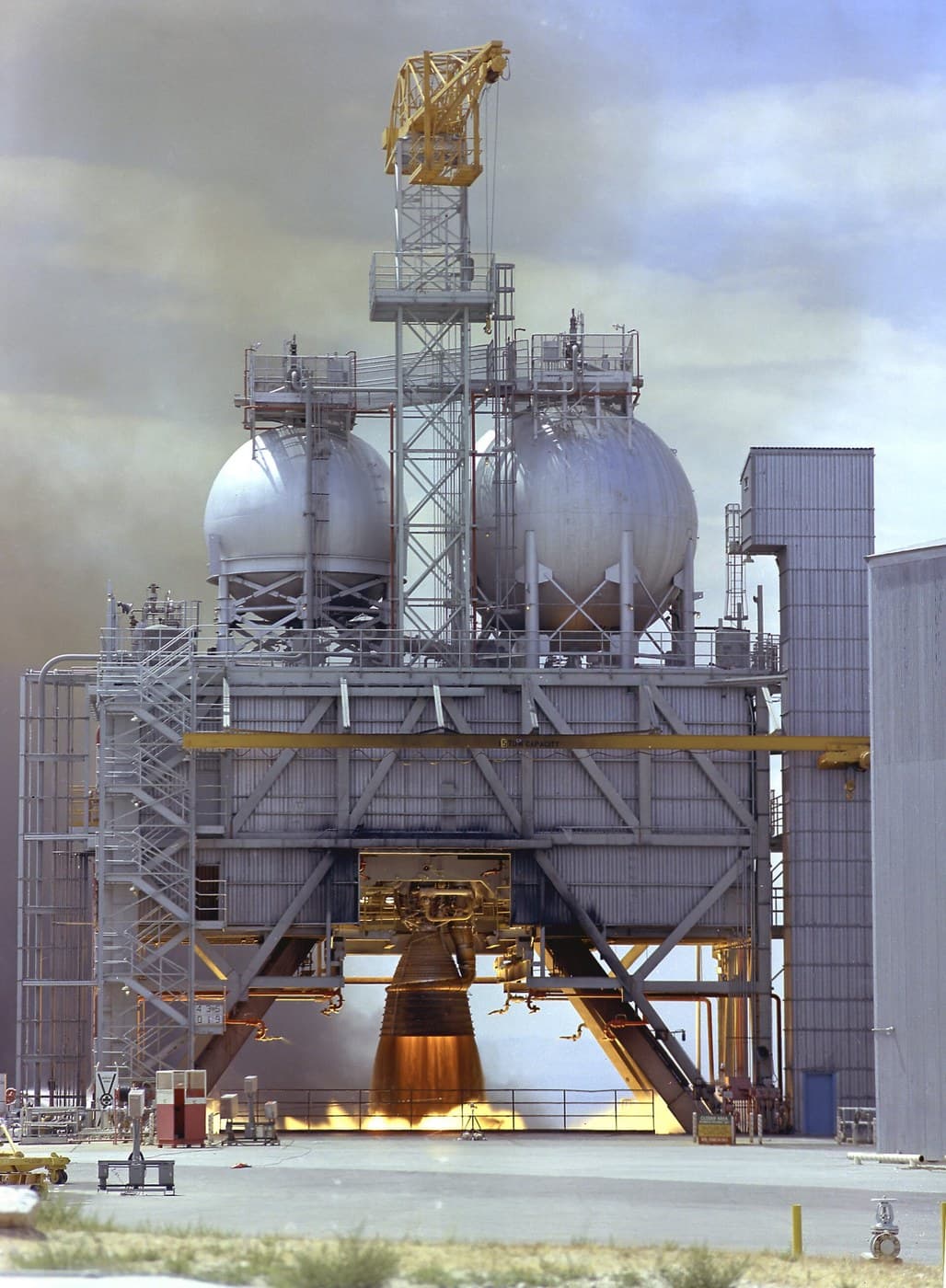
- Low Earth orbit needs roughly 7.8 km/s of orbital velocity, plus around 1.5 to 2 km/s lost to gravity and drag during ascent — call it 9.4 km/s of delta-v.
- Take a good kerosene and liquid oxygen engine at about 3.3 km/s exhaust velocity.
- Rearrange the rocket equation to find the required mass ratio.
- Convert that into a propellant fraction — what percentage of the vehicle must be fuel.
The answer is a mass ratio of about 17, meaning roughly 94 percent of the launch mass must be propellant. That leaves six percent for tanks, engines, structure, guidance, and the payload you actually wanted to deliver.
Now try to improve it by making the tanks lighter and you find you are fighting for fractions of that six percent. Try to improve it by carrying more fuel and the logarithm mocks you. Single-stage-to-orbit is not impossible, but it sits so close to the edge of what materials permit that no one has flown one.
Run the same calculation for a solid motor at 2.5 km/s exhaust velocity and the required propellant fraction rises above 97 percent — which is why solids are used as boosters and upper stages rather than as whole launch vehicles.Bahan untuk langkah ini:
Kertas Graf1 padAlatan diperlukan:
Angkup Digital 6 InciPenimbang DigitalPlot the equation and see the asymmetry
Plot the equation and see the asymmetry
Alatan diperlukan:
 Komputer Meja
Throw the empty tank away, and beat the logarithm
Throw the empty tank away, and beat the logarithm
The only real escape is to stop carrying what you have finished using.
- Take your 9.4 km/s requirement and split it between two stages — say 4.7 km/s each.
- Compute the mass ratio each stage needs at the same exhaust velocity.
- Multiply the two ratios to get the overall ratio, and compare with the single-stage answer.
- Now try three stages and compare again.
Two stages need a much smaller total mass ratio than one stage for the same total delta-v. The reason is that the second stage never has to accelerate the first stage’s empty tanks, engines and structure — that dead mass is dropped the instant it stops being useful.
So staging is not an optimisation or a convenience. It is the only way anyone has found to defeat an exponential, and it is why every vehicle that has ever reached orbit has thrown away most of itself on the way.
The returns diminish too: three stages beat two by much less than two beat one, and each separation adds a mechanism that must work perfectly or the mission ends. Most launchers settle at two or three stages, which is where the arithmetic and the reliability curve cross. That trade is the subject of the multistage blueprint later in this batch.Bahan untuk langkah ini:
Kertas Graf1 padAlatan diperlukan:
Angkup Digital 6 InciPenimbang DigitalBahan
5- 8 kepingPemegang Tempat
- 1 helaianPemegang Tempat
- Pemegang Tempat
- 1 kitPemegang Tempat
- 1 padPemegang Tempat
Alatan Diperlukan
11- Pemegang Tempat
- Pemegang Tempat
- Pemegang Tempat
- Pemegang Tempat
- Pemegang Tempat
- Pemegang Tempat
- Pemegang Tempat
- Pemegang Tempat
- 1 vendor sell this, none ship to you yetPemegang Tempat
- Pemegang Tempat
- Pemegang Tempat
Blueprint berkaitan
Blueprint ini berkongsi pengetahuan — teknik, bahan atau prinsip



CC0 Domain Awam
Blueprint ini dikeluarkan di bawah CC0. Anda bebas menyalin, mengubah, mengedar, dan menggunakan karya ini untuk sebarang tujuan, tanpa meminta kebenaran.
Sokong Pembuat dengan membeli produk melalui Blueprint mereka di mana mereka memperoleh Komisen Pembuat ditetapkan oleh Penjual, atau cipta iterasi baru Blueprint ini dan sertakan ia sebagai sambungan dalam Blueprint anda sendiri untuk berkongsi hasil.