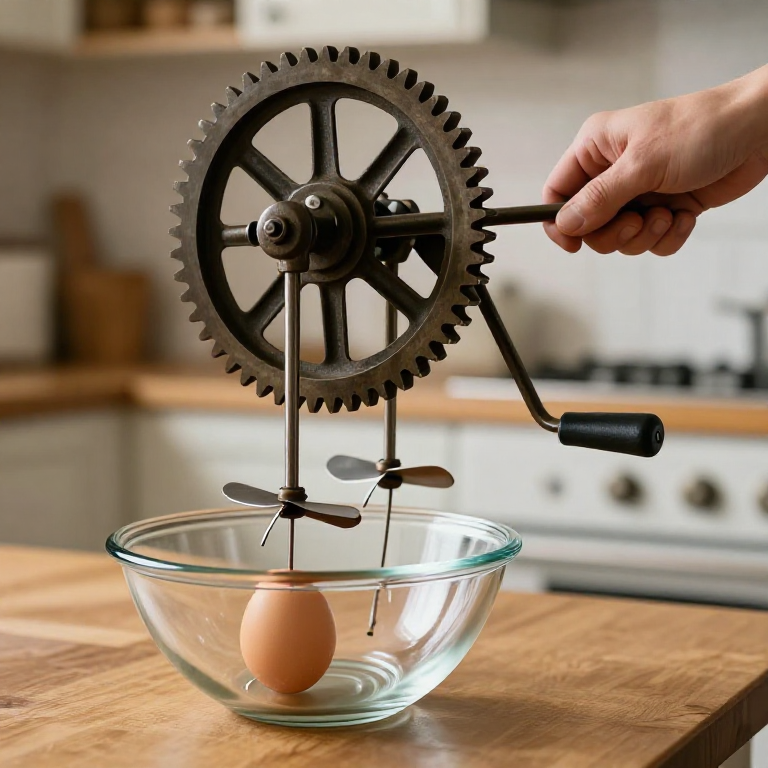


Rotary Egg Beater
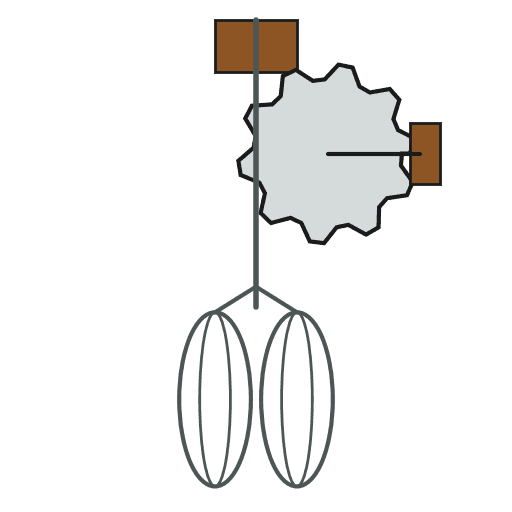
Beating egg whites by hand with a bundle of twigs or a flat whisk takes a strong arm and the better part of half an hour. The rotary beater does it in three minutes, and it does it because of one small piece of geometry: a large hand-turned wheel driving small pinions, so every turn of the crank spins the blades several times.
Willis Johnson's 1884 patent went further than speed. His machine was double-acting, with two chambers — you could beat eggs in one while batter was worked in the other, or clean one while the other kept running. It was designed for a working bakery, not a kitchen table.
The mechanism is a gear train you can hold in your hand, and building one teaches more about gearing than any diagram.
Arahan
Use food-safe metal for anything touching food
Use food-safe metal for anything touching food
Stainless steel or tinned steel for the blades and shafts. Avoid lead-bearing solder and galvanised parts anywhere the beater enters the bowl.
Cut the frame from sheet steel
Cut the frame from sheet steel
Cut a flat backbone about 200 mm long with a handle at the top and two bearing holes at the bottom, spaced for the two beater shafts.
Bahan untuk langkah ini:
 Kepingan Keluli Lembut1 helaian
Alatan diperlukan:
 Kikir (Kikir Tangan)
Drill the drive wheel bearing in the middle
Drill the drive wheel bearing in the middle
Drill a hole partway up the frame for the crank shaft. Its position sets how the big wheel meets the two pinions.
Make the large drive gear
Make the large drive gear
Cut a wheel about 70 mm across with teeth around its rim. Even spacing matters more than perfect tooth shape — an uneven wheel binds once per revolution.
Alatan diperlukan:
 Pembaris
Make two pinions about 20 mm across
Make two pinions about 20 mm across
Cut two small gears with the same tooth pitch as the wheel. A 70 mm wheel driving 20 mm pinions gives roughly 3.5 blade turns per crank turn.
Check the tooth pitch matches exactly
Check the tooth pitch matches exactly
Lay a pinion against the wheel and roll it by hand. Teeth must be the same pitch or nothing will mesh — this is the one dimension you cannot fudge.
Fit the crank to the drive wheel
Fit the crank to the drive wheel
Rivet a cranked handle to the wheel's shaft, with a free-spinning wooden knob. The knob must turn independently or the hand blisters within a minute.
Bahan untuk langkah ini:
 Rivet keluli6 keping
Mount the two beater shafts
Mount the two beater shafts
Fit each pinion on its shaft through the lower bearings, so both hang below the frame and both mesh with the wheel.
Confirm the beaters counter-rotate
Confirm the beaters counter-rotate
Turn the crank. The two beaters must spin in OPPOSITE directions — that is what drags air into the mix instead of just swirling the bowl around.
Form the beater blades from wire
Form the beater blades from wire
Bend stainless wire into two matching open loops per shaft, crossing at right angles, and fix them to the shaft ends. Open loops cut through the mix; solid paddles push it.
Bahan untuk langkah ini:
 Dawai keluli tahan karat2 meter
Set the blades to interleave without touching
Set the blades to interleave without touching
Position the two beaters so their loops pass between each other with 2 mm clearance. Interleaving is what shears the mixture; contact wrecks both sets.
Test the gear train dry
Test the gear train dry
Turn the crank through twenty full revolutions. It should run smoothly with no tight spot. A tight spot once per turn means the wheel is off-centre.
Count the gear ratio for yourself
Count the gear ratio for yourself
Mark one blade, turn the crank exactly once and count the blade revolutions. Compare with the tooth counts — the ratio should equal wheel teeth ÷ pinion teeth.
Test on egg whites and time it
Test on egg whites and time it
Beat two egg whites to stiff peaks and time it. Then do the same by hand with a fork. The difference you feel is the gear ratio doing the work.
History & Context — gearing arrives in the kitchen
History & Context — gearing arrives in the kitchen
The patent. Willis Johnson of Cincinnati, Ohio was granted US Patent 292,821 on 5 February 1884 for an improved egg beater. The specification is explicit that it is not only for eggs: the machine was intended for batter and other bakers' ingredients, and its double-acting arrangement of two chambers let one section be worked or cleaned while the other kept running. Johnson assigned one half of the patent to Jacob Shaw. He was one of a small number of African-American inventors holding patents in the 1880s, when such grants were rare.
He improved rather than invented. Rotary beaters predate him — the Monroe patent of 1859 is usually cited as the first practical one — and dozens of variants were patented through the century. Johnson's contribution is the multi-chamber, continuous-working arrangement aimed at a commercial bakery rather than a household. Calling him the inventor of the egg beater, as some accounts do, overstates it; what he built was a better production machine, which is a different and equally real achievement.
Why gearing matters here. A hand can comfortably turn a crank at perhaps two revolutions a second. Whipping air into egg white needs far more blade speed than that. A large wheel driving a small pinion multiplies rotational speed by the ratio of their tooth counts, at the cost of torque — and torque is exactly what you have to spare and speed is what you lack. The rotary beater is a textbook speed-increasing gear train solving a domestic problem, and it put the principle in millions of kitchens decades before electric motors did.
Why the loops are open. Beating is not stirring. The blades must shear the liquid and drag air bubbles down into it, then break those bubbles smaller. Open wire loops cut through and leave turbulence behind them; a solid paddle mostly pushes the whole mass around the bowl. Counter-rotation matters for the same reason — two beaters turning the same way would set the bowl spinning and beat nothing.
Bahan
3- 1 helaianPemegang Tempat
- 6 kepingPemegang Tempat
- 2 meterPemegang Tempat
Blueprint ini membuat
CC0 Domain Awam
Blueprint ini dikeluarkan di bawah CC0. Anda bebas menyalin, mengubah, mengedar, dan menggunakan karya ini untuk sebarang tujuan, tanpa meminta kebenaran.
Sokong Pembuat dengan membeli produk melalui Blueprint mereka di mana mereka memperoleh Komisen Pembuat ditetapkan oleh Penjual, atau cipta iterasi baru Blueprint ini dan sertakan ia sebagai sambungan dalam Blueprint anda sendiri untuk berkongsi hasil.