SENI
KECANTIKAN & KESEJAHTERAAN
KRAFTANGAN
BUDAYA & SEJARAH
HIBURAN
ALAM SEKITAR
MAKANAN & MINUMAN
KEJURUTERAAN TERBALIK
SAINS
SUKAN
TEKNOLOGI
BOLEH PAKAI
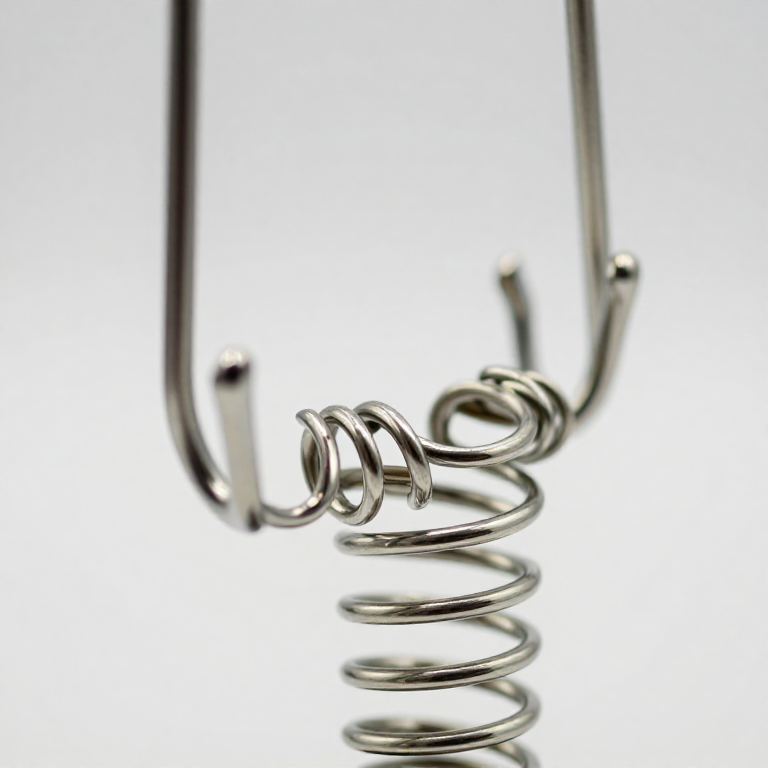


Hooke's Law — Stretch a Spring and Find Its Stiffness
A hands-on school project: hang known weights on a spring, measure how far it stretches with a ruler, and discover Hooke's law — the stretch is proportional to the force. A Python cell checks your readings and works out the spring's stiffness, and a closing compendium explains springs from mattresses to mechanical watches.
Pemula
30 minutes
Arahan
1
1
As the stretch, so the force
As the stretch, so the force
In 1660 Robert Hooke found how springs behave and hid it in an anagram, later revealed as 'ut tensio, sic vis' — as the extension, so the force. The pull needed to stretch a spring is proportional to how far it stretches. You will measure that straight-line law yourself.
2
2
Set up the spring
Set up the spring
Hang a spring from a firm support with a ruler fixed vertically beside it. Note where the bottom of the unstretched spring sits — that is your zero. (A force meter, which is just a spring in a tube, works too and reads the force directly.)
Bahan untuk langkah ini:
 Set Spring Mampatan1 keping
Alatan diperlukan:
 Pembaris
 Meter Daya (Neraca Spring)
3
3
Hang weights and measure the stretch
Hang weights and measure the stretch
Hang a known weight on the spring and read how far the bottom has dropped on the ruler — that is the extension. Add more weight, one step at a time, recording the mass and the extension each time. Take four or five readings. Do not overload it: if you stretch a spring too far it never springs back, and Hooke's law stops working (the 'elastic limit').
Alatan diperlukan:
 Set pemberat buku lali (boleh laras, buatan sendiri)
4
4
Check the straight line and find k
Check the straight line and find k
Memuatkan buku nota Jupyter…
Alatan diperlukan:
 Komputer Meja
 Kalkulator
5
5
Compendium: the physics of springs
Compendium: the physics of springs
What your straight line means. (1) The slope of your force-versus-stretch line IS the stiffness k, measured in newtons per metre; a stiff spring gives a steep line. (2) The energy stored in a stretched spring grows as one-half k times the stretch squared — which is why a bow or a catapult stores so much punch at full draw. (3) The law only holds up to the elastic limit; beyond it the material deforms permanently, and this is exactly how engineers test the strength of metals. (4) Springs following Hooke's law are everywhere: bathroom and kitchen scales, car and train suspensions, mattresses and trampolines, the tiny hairspring that keeps a mechanical watch ticking, and — generalised into 'Young's modulus' — the stiffness of every beam and bridge. A mass bouncing on a spring is also the textbook model of every vibration in nature.
Bahan
2- 1 kepingPemegang Tempat
- 1 helaianPemegang Tempat
Alatan Diperlukan
6- Pemegang Tempat
- Pemegang Tempat
- Pemegang Tempat
- Pemegang Tempat
- Pemegang Tempat
- Pemegang Tempat
Blueprint berkaitan
Blueprint ini berkongsi pengetahuan — teknik, bahan atau prinsip




CC0 Domain Awam
Blueprint ini dikeluarkan di bawah CC0. Anda bebas menyalin, mengubah, mengedar, dan menggunakan karya ini untuk sebarang tujuan, tanpa meminta kebenaran.
Sokong Pembuat dengan membeli produk melalui Blueprint mereka di mana mereka memperoleh Komisen Pembuat ditetapkan oleh Penjual, atau cipta iterasi baru Blueprint ini dan sertakan ia sebagai sambungan dalam Blueprint anda sendiri untuk berkongsi hasil.