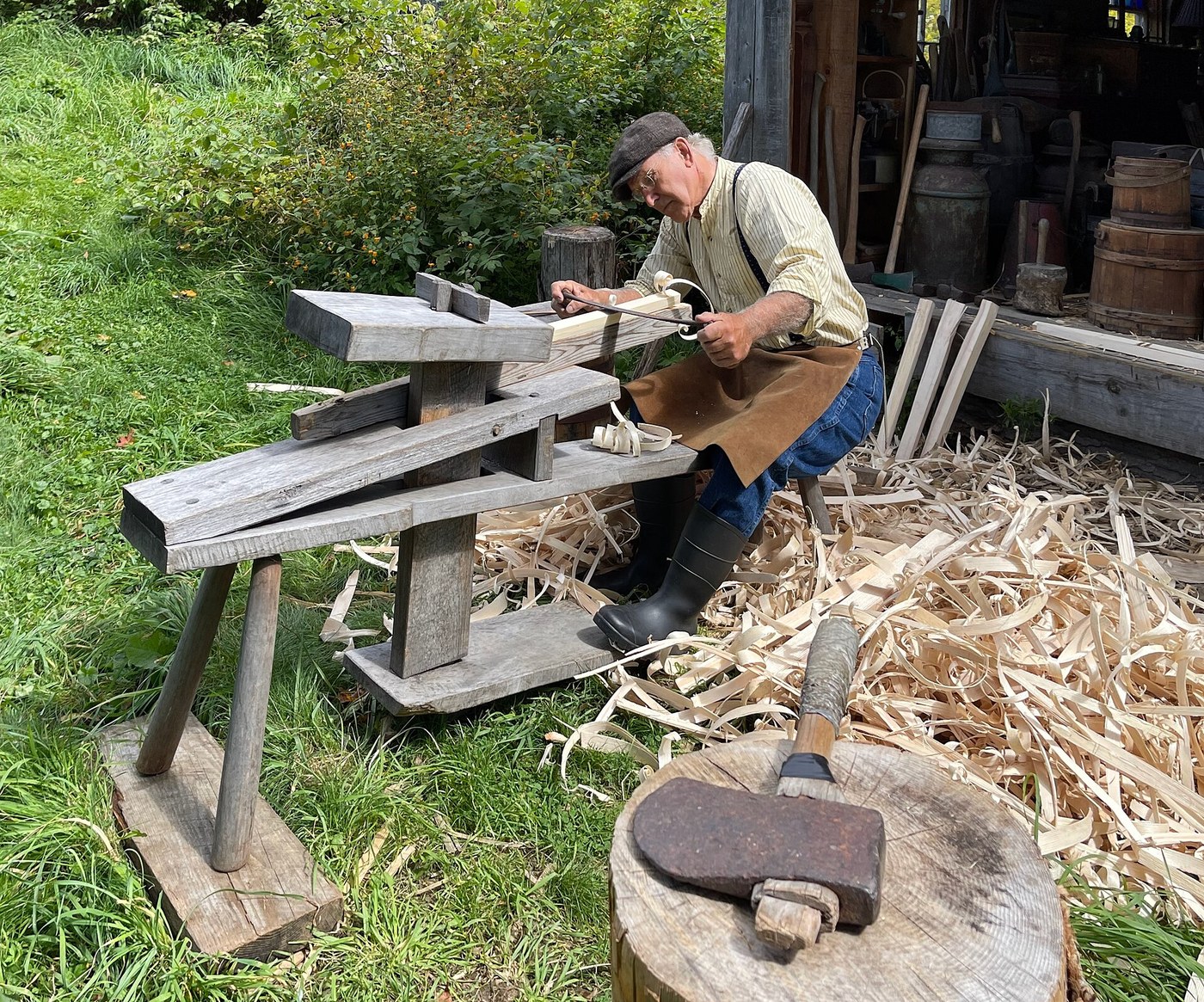


Shaving Horse
Arahan
Try shaping wood without one
Try shaping wood without one
Feel the problem the horse solves.
- Clamp a stick in an ordinary vice and work it with a drawknife.
- Now try to rotate the piece to work a different face.
- Time how long the winding open and shut takes over ten rotations.
Bahan untuk langkah ini:
 Papan kayu ash1 board
Build the bench and the sloping ramp
Build the bench and the sloping ramp
A seat, four legs, and an inclined platform in front of it.
- Make a stout plank seat on splayed legs at a comfortable height.
- Fix a sloping ramp at the far end, rising toward you.
- Cut a slot through the ramp for the arm to pass.
Bahan untuk langkah ini:
 Papan oak putih1 board
Fit the pivoting arm
Fit the pivoting arm
One pivot, a head above the ramp, a footrest below.
- Hang the arm on a cross-pin through the slot so it swings freely.
- Fit a wide head at the top that bears on the work.
- Fit a broad footrest at the bottom.
Bahan untuk langkah ini:
 Set rod dowel pain1 set
Alatan diperlukan:
 Gerimit Tangan
Measure the self-tightening effect
Measure the self-tightening effect
Show that the grip responds to the cut.
- Clamp a piece with light foot pressure and pull the knife gently — note any slipping.
- Take a heavier cut and notice that your foot pushes harder without you deciding to.
- Try to pull the work out while pulling the knife hard.
History and context
History and context
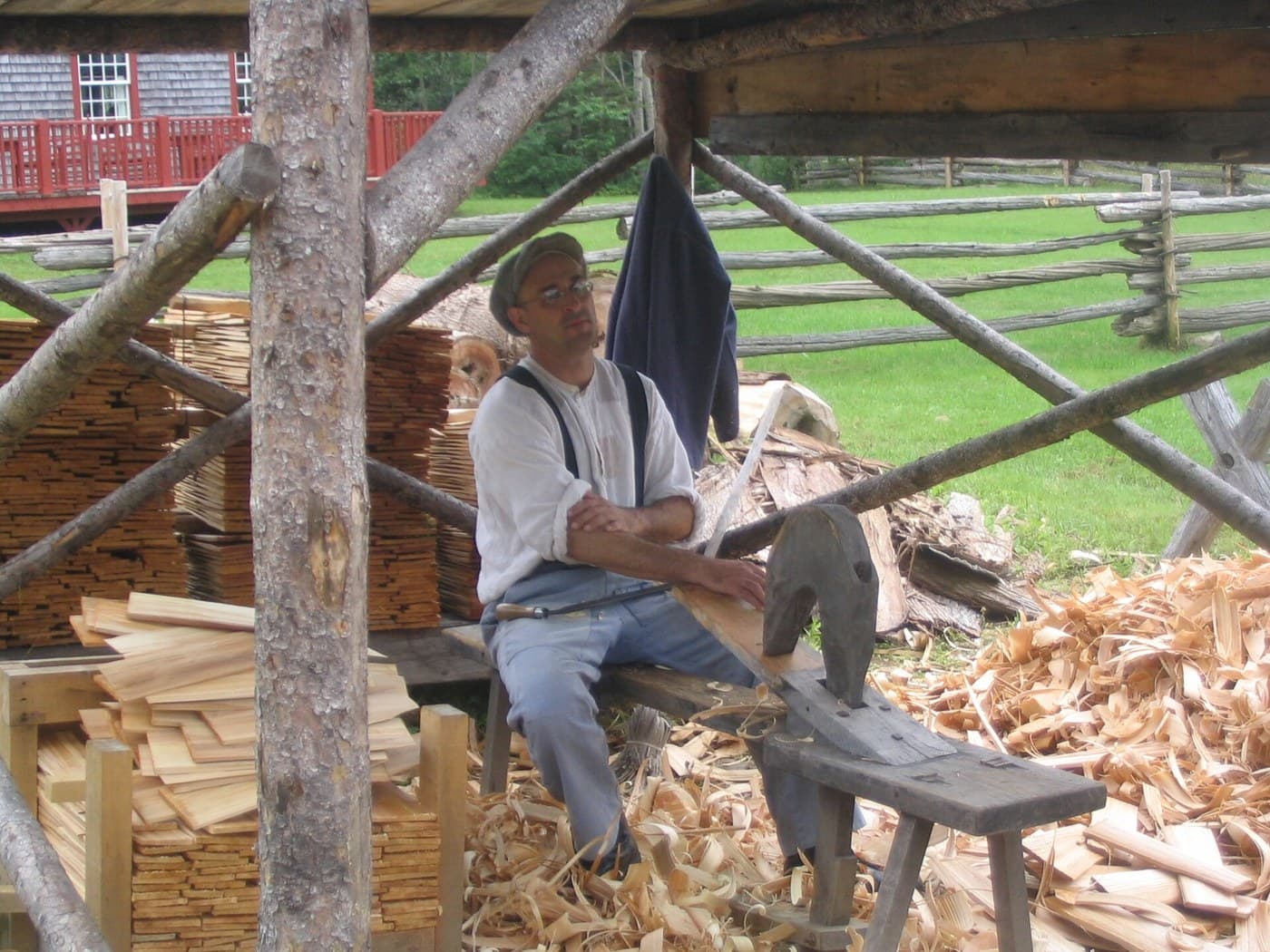
Shaving horses are documented across Europe from the medieval period and appear in many regional forms — the English dumbhead, with a solid pivoting block, and the continental bodger's horse with a forked arm being the two main families. They belong to the world of green woodworking, where wood is worked wet and shaped before it seasons.
The bodgers of the Chilterns are the best-documented users: itinerant chair-leg turners who worked in the beech woods, felling, riving, shaving and pole-lathe turning on the spot, and selling legs and stretchers by the gross to the chair factories at High Wycombe. The horse and the pole lathe were the whole workshop, and both were built from whatever was to hand.
Why it is not simply a primitive vice: a modern vice applies a fixed force chosen in advance, and it takes time to change. The horse applies a variable force controlled continuously by the operator with no attention at all, and releases instantly. For repetitive shaping where the piece is constantly reoriented, it is faster than any powered clamp — which is why chairmakers still build them today rather than treating them as museum pieces.
The idea generalises. A clamp whose holding force rises with the disturbing force appears in cam cleats on boats, in wedge-action self-locking devices, and in the mitre gates of a canal lock in this catalogue — the harder the water pushes, the tighter the seal. Making the load do the holding is a recurring and elegant answer.
Bahan
3- 1 boardPemegang Tempat
- 1 boardPemegang Tempat
- 1 setPemegang Tempat
Alatan Diperlukan
1- Pemegang Tempat
Blueprint ini membuat

Blueprint berkaitan
Blueprint ini berkongsi pengetahuan — teknik, bahan atau prinsip
CC0 Domain Awam
Blueprint ini dikeluarkan di bawah CC0. Anda bebas menyalin, mengubah, mengedar, dan menggunakan karya ini untuk sebarang tujuan, tanpa meminta kebenaran.
Sokong Pembuat dengan membeli produk melalui Blueprint mereka di mana mereka memperoleh Komisen Pembuat ditetapkan oleh Penjual, atau cipta iterasi baru Blueprint ini dan sertakan ia sebagai sambungan dalam Blueprint anda sendiri untuk berkongsi hasil.