

Automatic Screw Machine
A lathe with a skilled operator makes one good part at a time. The automatic screw machine makes the same part all day without one — because the sequence itself has been built into a rotating drum of cams. The machine does not need to be told what to do next; its shape is the instruction.
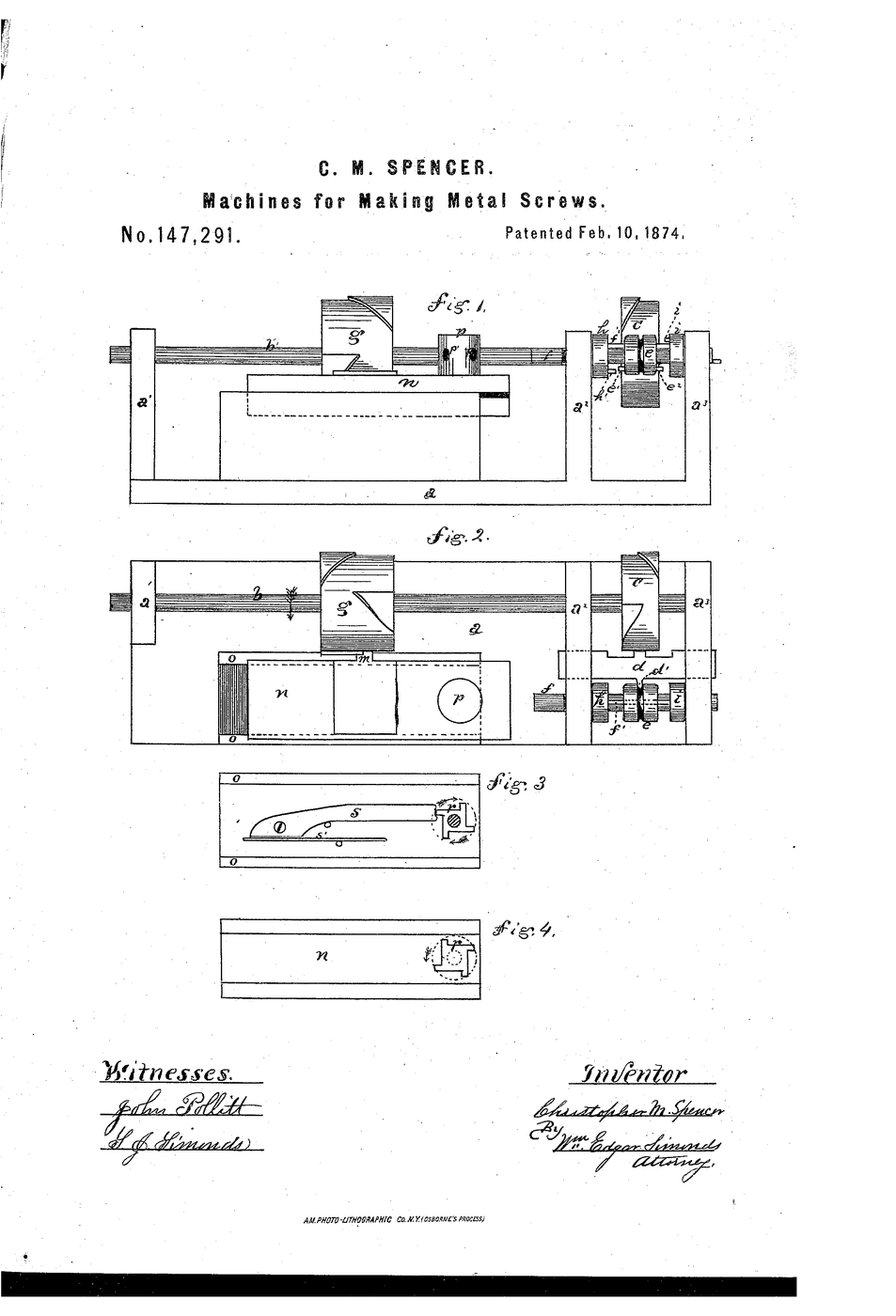
US 147,291, “Improvement in Machines for Making Metal Screws”, Christopher M. Spencer of Hartford, Connecticut, filed 17 December 1873 and granted 10 February 1874. The claim is automatic reversal: a clutch drum shifts between two pulleys turning opposite ways, so the cutting dies engage and disengage on their own instead of an operator shifting a belt by hand at every cycle.
Precision about what this patent is. Spencer is also credited with the “brain wheel” — the cam drum that carries a whole machining sequence — on his 1873 Hartford turret lathe. That is a different mechanism from the one claimed here, and this blueprint keeps them apart. Spencer's fame before either was the Spencer repeating rifle of 1860.
Arahan
Write the sequence you want repeated
Write the sequence you want repeated
List, in order, the operations to turn one part: feed stock, turn to diameter, form the head, cut the thread, part off. Five actions, always the same order.
Cut a cam disc from plywood
Cut a cam disc from plywood
Cut a 150 mm disc of plywood. Mark its centre and drill it to fit the dowel rod.
Bahan untuk langkah ini:
 Kepingan papan lapis1 helaian
Alatan diperlukan:
 Pisau Kraf
 Pembaris
Divide the disc into the cycle
Divide the disc into the cycle
With the protractor, divide the rim into five sectors sized to your five operations — not equal, but proportional to how long each one takes.
Bahan untuk langkah ini:
Kepingan papan lapis1 helaianAlatan diperlukan:
 Protraktor
 Penanda Kekal
Cut the profile
Cut the profile
Cut the rim away in each sector to the depth that action needs. The rim height is now a graph of the cycle.
Bahan untuk langkah ini:
Kepingan papan lapis1 helaianAlatan diperlukan:
Pisau Kraf Set Kikir
Mount the cam on an axle
Mount the cam on an axle
Push the dowel rod through the centre hole and rest the ends in two notched blocks so the cam turns freely.
Bahan untuk langkah ini:
 Rod Pasak Kayu1 keping
 Papan Kayu Rata1 keping
Alatan diperlukan:
 Gam Kayu
Add a follower
Add a follower
Pivot a card-stock lever so its tip rides on the cam rim. The lever is your cutting slide.
Bahan untuk langkah ini:
 Kertas Kad1 helaian
 Skru mesin #6-321 keping
Alatan diperlukan:
 Gunting
Turn one full cycle by hand
Turn one full cycle by hand
Rotate the cam once slowly. Watch the follower run through all five positions and return to the start.
Measure the follower travel at each sector
Measure the follower travel at each sector
Record the follower's height at the centre of each sector with the steel rule. Those five numbers are the program.
Bahan untuk langkah ini:
 Kertas Graf1 helaian
Alatan diperlukan:
PembarisChange the part by changing the cam
Change the part by changing the cam
File one sector 3 mm deeper. Turn the cycle again and record the new travel. You have just reprogrammed the machine without touching the machine.
Bahan untuk langkah ini:
Kepingan papan lapis1 helaianAlatan diperlukan:
Set KikirPembarisAdd the reversing idea
Add the reversing idea
Wrap string around the dowel in two opposite directions and pull each in turn. Spencer's claim replaces your two hands with a clutch that picks one of two counter-rotating pulleys.
Bahan untuk langkah ini:
 Tali Kapas Dapur1 meter
Time ten cycles
Time ten cycles
Turn the cam ten times at a steady rate and time it. Divide by ten for the cycle time — the number a shop actually buys.
Bahan untuk langkah ini:
Kertas Graf1 helaianCompare against doing it by hand
Compare against doing it by hand
Now perform your five operations as five separate hand movements, reading the list each time. Time ten of those. The ratio is the machine's real argument.
Bahan untuk langkah ini:
Kertas Graf1 helaianInspect a real three-jaw chuck's repeatability
Inspect a real three-jaw chuck's repeatability
Clamp the brass rod in the lathe chuck, mark it, release and re-clamp five times, checking run-out each time with the dial indicator. Automation is worthless if holding is not repeatable.
Bahan untuk langkah ini:
 Bar Loyang1 keping
Alatan diperlukan:
 Cuk pelarik 3 rahang
 Tolok Dail
History & Context
History & Context
US 147,291, “Improvement in Machines for Making Metal Screws”, Christopher Miner Spencer (1833-1922), Hartford, Connecticut. Filed 17 December 1873, granted 10 February 1874. The claim is a clutch drum that shifts drive between two oppositely rotating pulleys, reversing the screw rod automatically so the dies engage and withdraw without a hand on a belt.
What this patent is not. Spencer's celebrated “brain wheel” is a cam drum carrying an entire machining sequence, fitted to the automatic turret lathe he built in Hartford in 1873. Popular accounts fold the two into one invention. They are separate mechanisms and only one of them is the subject of this document. Where sources merge them, the document wins.
Why the screw came first. Screws are small, are needed in enormous numbers, and each one requires an identical multi-step sequence — the ideal first case for automation. The class of machine Spencer's work founded is still called a screw machine even when it is making something else entirely, and its descendants are today's CNC lathes with bar feeders.
The deeper idea. A cam is a physical program: a shape that stores a sequence and replays it exactly, forever, with no memory and no operator. Every argument later made about numerical control — that the instruction should be separable from the machine and cheap to change — is already visible here, where changing the part means filing a new cam.
Spencer before machine tools. He patented the Spencer repeating rifle in 1860; several hundred thousand were made during the American Civil War. The interchangeable-parts discipline he learned in armouries is exactly what he brought to the screw machine.
Bahan
8- 1 helaianPemegang Tempat
- 1 kepingPemegang Tempat
- 1 kepingPemegang Tempat
- 1 helaianPemegang Tempat
- 1 kepingPemegang Tempat
- 1 helaianPemegang Tempat
- 1 meterPemegang Tempat
- 1 kepingPemegang Tempat
Bahan Blueprint Bersambung


Blueprint berkaitan
Blueprint ini berkongsi pengetahuan — teknik, bahan atau prinsip

CC0 Domain Awam
Blueprint ini dikeluarkan di bawah CC0. Anda bebas menyalin, mengubah, mengedar, dan menggunakan karya ini untuk sebarang tujuan, tanpa meminta kebenaran.
Sokong Pembuat dengan membeli produk melalui Blueprint mereka di mana mereka memperoleh Komisen Pembuat ditetapkan oleh Penjual, atau cipta iterasi baru Blueprint ini dan sertakan ia sebagai sambungan dalam Blueprint anda sendiri untuk berkongsi hasil.