SENI
KECANTIKAN & KESEJAHTERAAN
KRAFTANGAN
BUDAYA & SEJARAH
HIBURAN
ALAM SEKITAR
MAKANAN & MINUMAN
KEJURUTERAAN TERBALIK
SAINS
SUKAN
TEKNOLOGI
BOLEH PAKAI
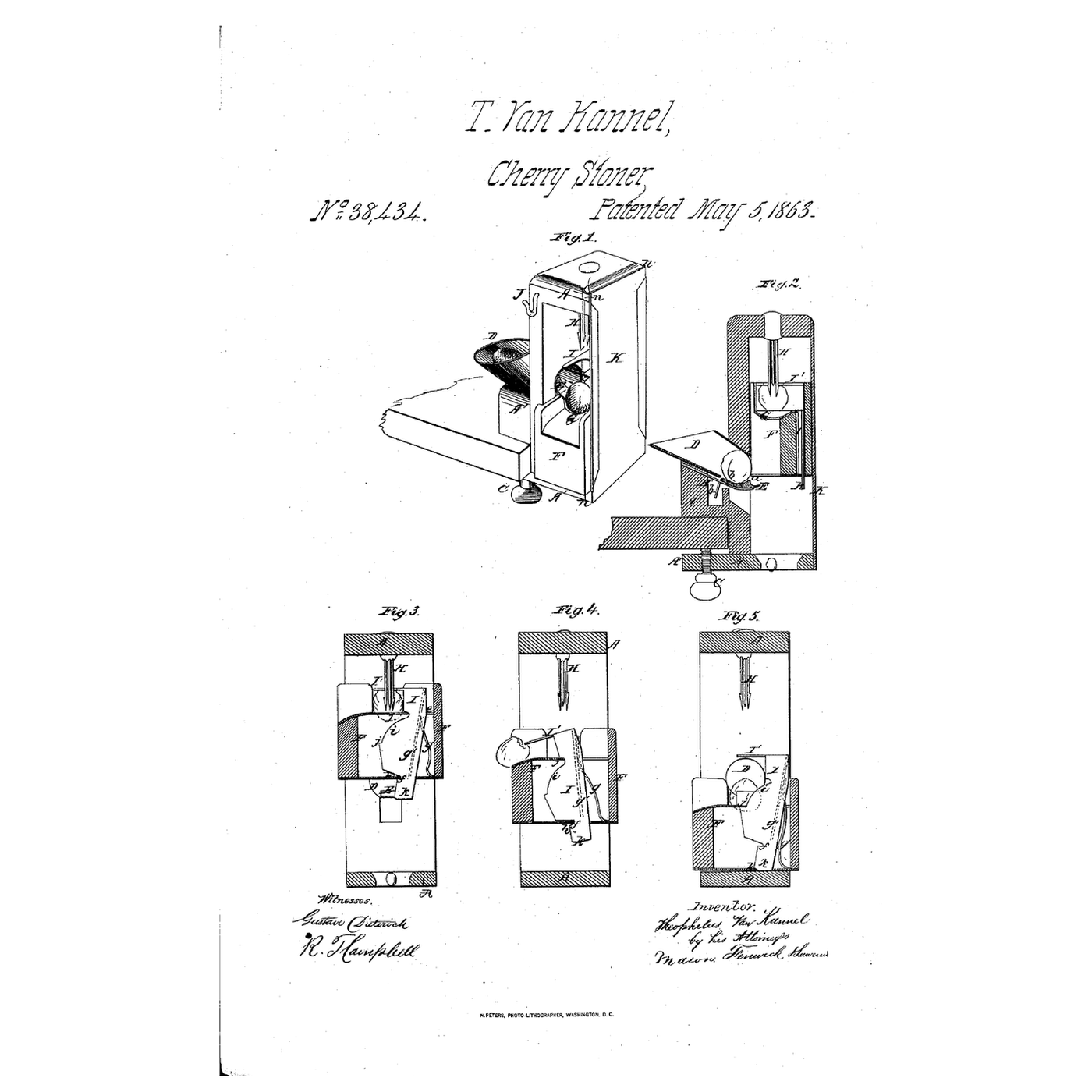


The Cherry Stoner: A Hopper, a Basin and a Fork of Needles
Cherries for pies, jam and bottling have to be stoned, one at a time, and a season's fruit is thousands of them.
Theophilus Van Kannel of Chester, Illinois, received US 38,434, dated 5 May 1863, for an "Automatic Cherry-Stoner" that improved on his own patent of 14 October 1862. Clamped to a table, it has a hopper that a rocking feeder lets out one cherry at a time into a basin on a sliding box. On the up-stroke a fork of barbed needles pushes the stone through the cherry and out through a hole in the basin; on the down-stroke a spring claw strips the stoned cherry off the fork and throws it out of the machine.
This rung works out the throughput and times stoning by machine and by hand.
Pemula
About 2 hours
Arahan
1
1
Strokes, cherries and minutes
Strokes, cherries and minutes
Memuatkan buku nota Jupyter…
2
2
Why so many cherries needed stoning
Why so many cherries needed stoning
Bottling fruit made a season's harvest worth preparing in bulk. The embedded blueprint shows the method.
3
3
Read US 38,434
Read US 38,434
Van Kannel's object is "to stone cherries by machinery adapted to this purpose, which is automatic in its operation, requiring no further manipulation than to put the cherries into a hopper and to keep the machine in motion". His earlier machine (patent of 14 October 1862) removed the cherries from the "barbed needles" with a spring finger-piece worked by the hand; now that piece, "which I now term a 'claw,' operates automatically".
A box A with jaws and a clamping screw holds the machine upright on a table edge. A conical-mouthed hopper D feeds a sliding box F; a curved rocking feeder E with a ridge and tongue lets out "only one cherry to be discharged at a time." Box F has a basin G with a hole in its bottom. The fork H "is made of five (or more or less) needles", fixed above in line with the hole, so as the basin rises "the fork H will thrust the stone through the cherry and through the basin, leaving the stoned cherry above or on the basin". The fork is barbed to hold the cherry, and the spring-claw I "separates the stoned cherry from the barbed fork H, and thrusts this cherry out of the machine in the downward stroke".
4
4
One stroke of the stoner
One stroke of the stoner
Ruang Kerja Blockly
Loading Blockly workspace...
5
5
Stone a kilo two ways
Stone a kilo two ways
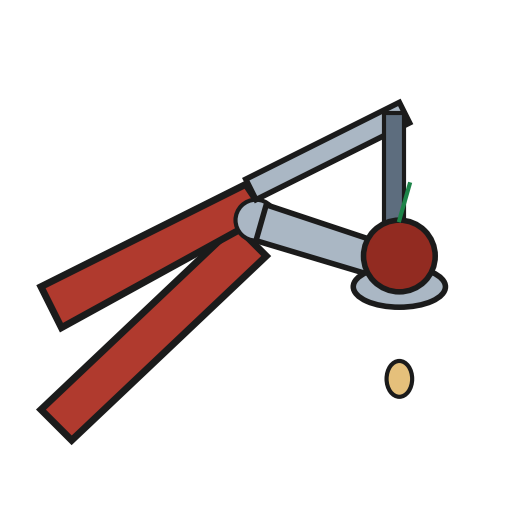
Weigh out two 500 g lots of cherries. Stone one lot by hand with a paper-clip loop or the tip of a knife, timing it with the stopwatch; stone the other with a cherry pitter, timing it too. Weigh the stones and the stoned fruit from each lot to see how much flesh each method loses, and count any cherries where the stone was missed.
Bahan untuk langkah ini:
 Ceri1 keping
Alatan diperlukan:
 Alat pembuang biji ceri
 Penimbang Dapur Digital
 Jam Randik
 Baldi
Baldi6
6
A cherry pitter that misses
A cherry pitter that misses
Cherry pitter troubleshooting.
Flow
Loading...
7
7
History and honest limits
History and honest limits
**Theophilus Van Kannel** of Chester, Illinois, received US 38,434, dated 5 May 1863. His claims cover the curved spring-rocker feeding cherries one at a time, the automatic claw that discharges the stoned cherries, and the claw's sliding and vibrating action.
**Honest limits.** Cherry weight and stoning rates in the notebook are examples.
Alatan Diperlukan
4- Pemegang Tempat
- Pemegang Tempat
- Pemegang Tempat
- Pemegang Tempat
Blueprint berkaitan
Blueprint ini berkongsi pengetahuan — teknik, bahan atau prinsip





CC0 Domain Awam
Blueprint ini dikeluarkan di bawah CC0. Anda bebas menyalin, mengubah, mengedar, dan menggunakan karya ini untuk sebarang tujuan, tanpa meminta kebenaran.
Sokong Pembuat dengan membeli produk melalui Blueprint mereka di mana mereka memperoleh Komisen Pembuat ditetapkan oleh Penjual, atau cipta iterasi baru Blueprint ini dan sertakan ia sebagai sambungan dalam Blueprint anda sendiri untuk berkongsi hasil.