
The Cloud Chamber
Right now, several particles a minute are passing through your head at close to the speed of light. They are muons, made when cosmic rays from beyond the solar system smash into the upper atmosphere, and they have been arriving your whole life. You have never seen one.
A cloud chamber makes them visible — not the particle itself, but its wake. The trick is to create a layer of air supersaturated with alcohol vapour: air holding more vapour than it should be able to, poised to condense but with nothing to condense onto. When a charged particle rips through, it strips electrons from the molecules along its path and leaves a thin trail of ions. Those ions are exactly the seeds the vapour was waiting for, and a line of droplets condenses along the track.
You are seeing a contrail, microseconds old, left by something you cannot see and that has already gone.
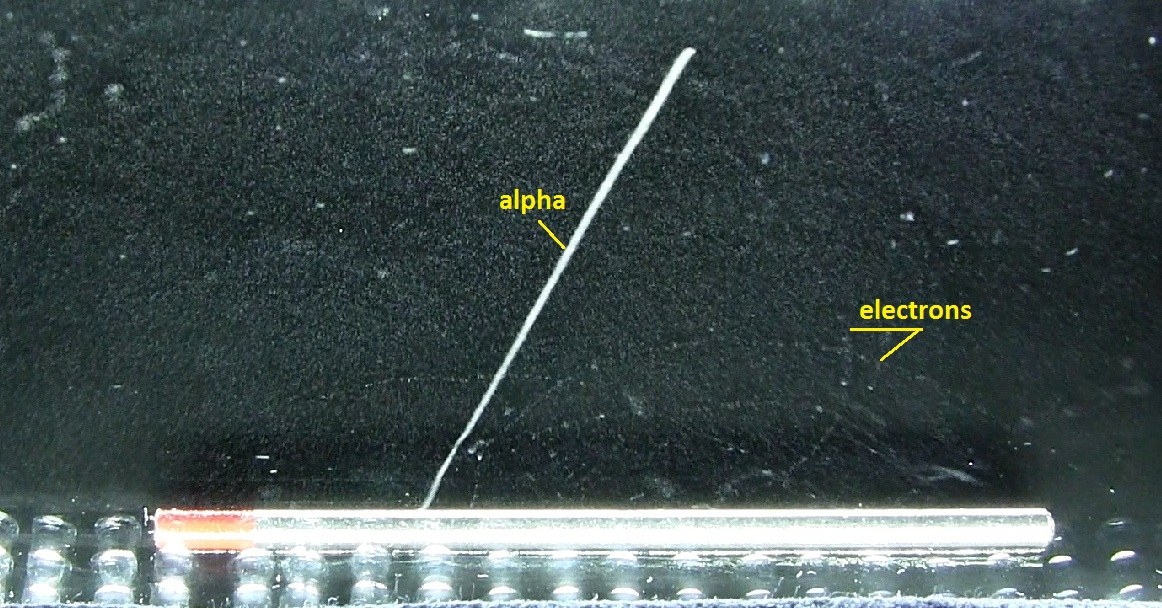
The tracks come in kinds, and you can tell them apart. Alphas are short, fat and straight — heavy and highly ionising, they stop fast. Betas are thin and wandering, because a light electron gets knocked about. Muons are long, straight and thin, crossing the whole chamber without deviating, because they are heavy, fast, and barely interact.
C.T.R. Wilson built the first one in 1911 and won the 1927 Nobel Prize for it. The always-on version you will build — a warm alcohol reservoir over a plate chilled with dry ice — is Alexander Langsdorf's diffusion chamber of 1936.
Arahan
Build the chamber body
Build the chamber body
Take a clear-sided container — a small tank or a deep clear box — and line the inside of the base with black material so tracks show against it.
Fix a strip of felt around the inside of the walls near the top.
The felt is the vapour reservoir. It must be near the top, not the bottom: the whole device depends on warm vapour above and a cold floor below.
Bahan untuk langkah ini:
 Alas meja kain kempa1 keping
 Kerajang Aluminium1 gulung
Charge the felt with alcohol
Charge the felt with alcohol
Soak the felt strip with 99 % isopropyl alcohol until it is saturated but not dripping. Pour off any pooled liquid.
Close the chamber with a clear lid.
Use the highest-purity alcohol you can get. Water content raises the freezing point and the mixture ices up on the cold plate instead of staying as vapour — the commonest reason a home chamber shows nothing.
Alatan diperlukan:
 Alkohol Isopropil 99 %
Make the temperature gradient
Make the temperature gradient
Sit the chamber base on a slab of dry ice, with a sheet of foil between for good thermal contact. Leave the top at room temperature.
Wait 10-15 minutes.
The floor needs to reach roughly -30 °C or colder. Alcohol vapour diffuses down from the warm felt, and in the last centimetre above the cold floor it becomes supersaturated. That thin layer — not the whole chamber — is where tracks form.
Alatan diperlukan:
 Termometer
Light it from the side, in the dark
Light it from the side, in the dark
Darken the room. Shine a bright torch across the chamber, grazing just above the floor — never down through the lid.
Get your eye low, level with the illuminated layer, and wait a full minute for your eyes to adapt.
Expect faint white threads appearing and fading over a second or two.
Side lighting is not a nicety. Droplets scatter light sideways; lit from above they are invisible, and most people who see nothing have simply lit it wrongly.
Alatan diperlukan:
 Lampu suluh LED pemeriksaan
Classify what you see and count it
Classify what you see and count it
Watch for 10 minutes and tally tracks by type: short and thick (alpha), thin and kinked (beta/electron), long, straight and thin, crossing the whole chamber (muon).
Record the count per minute for each.
Expect a handful per minute in total, mostly thin ones.
The shape of a track is a measurement of the particle's mass and charge — a heavy, doubly-charged alpha ionises hard and stops in centimetres; a light electron is deflected by every atom it passes.
Alatan diperlukan:
 Jam Randik
 Kertas Graf
Change one thing and watch the rate change
Change one thing and watch the rate change
Hold a lump of granite or a lantern mantle near the chamber and re-count. Then shield the top with a thick book and re-count. Then compare counts at ground level with counts several storeys up, if you can.
Expect the rock to raise the alpha count, a book to barely change the long straight tracks, and altitude to raise them.
Muons pass through a book because they pass through metres of rock. That penetrating power is why they reach the ground at all — and why their arrival rate is a genuine measurement of what is above you.
Compendium — what you are actually seeing
Compendium — what you are actually seeing
Wilson was a meteorologist, not a particle physicist. He began building expansion chambers in the 1890s to study cloud formation and optical effects he had seen on Ben Nevis, and he wanted to know whether clouds could form on ions. By 1911 he had a chamber good enough to photograph the tracks of individual alpha and beta particles — the first time anyone had seen the path of a single subatomic particle. He shared the 1927 Nobel Prize in Physics with Arthur Compton. The instrument that opened particle physics was designed to study the weather.
Wilson's chamber was pulsed; Langsdorf's is continuous. The original worked by suddenly expanding a gas with a piston, cooling it and producing a brief moment of supersaturation — you had to trigger it and catch the instant. Alexander Langsdorf's diffusion chamber (1936) replaced the piston with a permanent temperature gradient: warm vapour at the top, a floor below about -26 °C, and a thin supersaturated layer that is always there. That is why the alcohol-and-dry-ice design is the one in every classroom — it never needs triggering, so you can simply sit and watch.
What the cloud chamber found. Between 1932 and 1947 it produced an extraordinary run of discoveries: Carl Anderson's positron in 1932, the first antimatter ever observed, identified from the curvature of a track in a magnetic field; the muon in 1936, a particle nobody had asked for — "who ordered that?" — and the kaon in 1947. Adding a magnetic field bends the tracks, and the direction of the bend gives the sign of the charge while the radius gives the momentum. A photograph of a curved line was, for a while, the best particle detector in the world.
Where your muons come from. A cosmic-ray proton, often from outside the solar system, hits a nucleus high in the atmosphere and produces a shower of pions. Charged pions decay into muons. A muon's own lifetime is only about 2.2 microseconds — far too short to reach the ground at any speed — and it arrives anyway because it is travelling near light speed and time dilation stretches its clock relative to ours. Every long straight track in your box is a direct, visible consequence of special relativity.
Safe practice, stated plainly. Dry ice is -78 °C: handle it with gloves and tongs only, never bare skin, and never seal it in an airtight container — sublimating CO₂ builds pressure and can burst it. Use it in a ventilated room: CO₂ is heavier than air, is not toxic but displaces oxygen, and pools at floor level, so never use it in a cellar, a car or a small unventilated space. Isopropyl alcohol is flammable — no flames, no sparks, no hot torch bulbs near the chamber, and keep the quantity small. Nothing here is radioactive beyond ordinary background, and the blueprint deliberately uses no added source.
Bahan
2- 1 kepingPemegang Tempat
- 1 gulungPemegang Tempat
Alatan Diperlukan
5- Pemegang Tempat
- Pemegang Tempat
- Pemegang Tempat
- Pemegang Tempat
- Pemegang Tempat
Bahan Blueprint Bersambung

Blueprint ini membuat

CC0 Domain Awam
Blueprint ini dikeluarkan di bawah CC0. Anda bebas menyalin, mengubah, mengedar, dan menggunakan karya ini untuk sebarang tujuan, tanpa meminta kebenaran.
Sokong Pembuat dengan membeli produk melalui Blueprint mereka di mana mereka memperoleh Komisen Pembuat ditetapkan oleh Penjual, atau cipta iterasi baru Blueprint ini dan sertakan ia sebagai sambungan dalam Blueprint anda sendiri untuk berkongsi hasil.