SENI
KECANTIKAN & KESEJAHTERAAN
KRAFTANGAN
BUDAYA & SEJARAH
HIBURAN
ALAM SEKITAR
MAKANAN & MINUMAN
KEJURUTERAAN TERBALIK
SAINS
SUKAN
TEKNOLOGI
BOLEH PAKAI

The Sad Iron: Keeping the Heat in the Face, Not the Hand
Before electricity, clothes were pressed with solid irons — 'sad' meant heavy — heated on the stove and swapped as they cooled. They burned the hand through a hot handle, sent heat up into the ironer's face, and cooled fastest at the point.
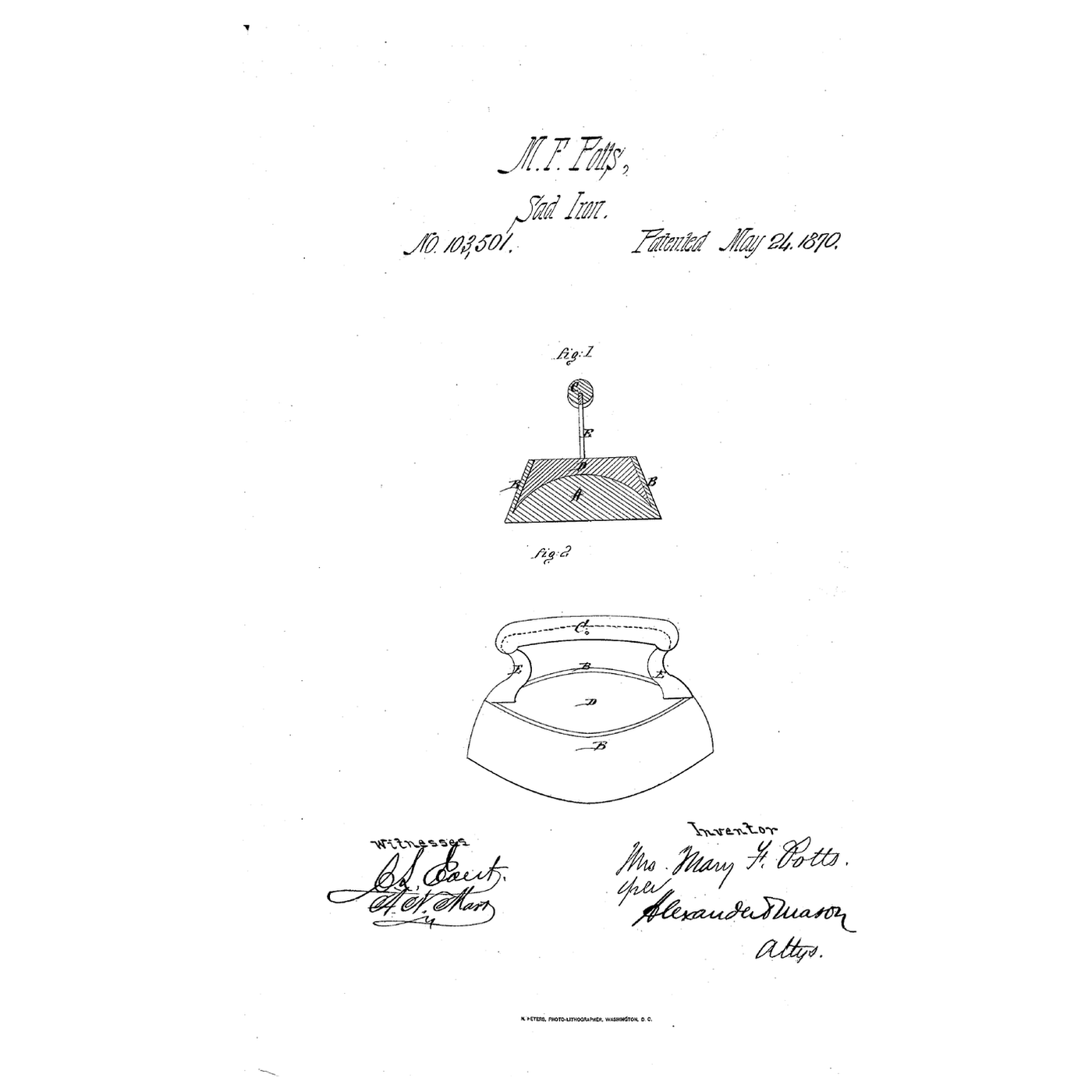
Mary Florence Potts of Ottumwa, Iowa, patented two answers. US 103,501, dated 24 May 1870, makes the iron a metal shell filled on top and sides with a non-conductor such as plaster of Paris, pointed at both ends, with a wooden handle covering the metal one. US 113,448, dated 4 April 1871, adds a detachable semicircular handle that clips onto any of several hot irons, so the user keeps one cool handle and the wrist stays in line "as a person pushes a plane".
This rung models the stored heat and where it leaks, and tests an insulated block against a bare one.
Pemula
About 3 hours
Arahan
1
1
Stored heat and the insulated top
Stored heat and the insulated top
Memuatkan buku nota Jupyter…
2
2
Read the two patents
Read the two patents
**US 103,501 (1870):** body A flat below, rounded on top and sides, with two pointed ends; the hollow filled with a non-conductor D "flush with all the sides" that "prevents radiation of heat from every part of said iron except the bottom or face"; a wooden handle C whose ends turn down over the iron uprights E so the hand cannot touch hot metal.
**US 113,448 (1871):** a curved, semicircular handle A on a metal plate B; a latch C whose lip D passes under a cross-bar d cast inside the iron, held by a spring f so it cannot fall out when the iron is turned over; recesses h at each end that stop the handle moving sideways. The iron itself is now hollowed from the middle, with the metal made thicker at the ends, "where most heat is needed".
3
3
The filling she used
The filling she used
Potts filled her irons with plaster of Paris among other non-conductors. The embedded blueprint covers how plaster sets and what it is made of.
4
4
Test an insulated block against a bare one
Test an insulated block against a bare one
Take two identical steel blocks or cast-iron weights of about 1 kg. Leave one bare. On the other, build a 10 mm jacket of plaster of Paris over the top and sides, leaving the base clean, and let it dry for two days.
Heat both in an oven to about 200 °C (check with the infrared thermometer), then set each on a folded damp cotton towel on a board — the 'cloth'. Every two minutes read the base temperature through the towel's edge and the top surface. The insulated block's base stays hot longer and its top stays cool enough to hold near. Use oven gloves throughout.
Bahan untuk langkah ini:
 Bar keluli mentah2 keping
 Plaster Paris1 kilogram
 Kain kasa kapas1 keping
 Kepingan papan lapis1 keping
 Air1 liter
Alatan diperlukan:
 Termometer Inframerah
 Jam Randik
 Sarung Tangan Kerja Kulit
 Penimbang Dapur Digital
5
5
Ironing with a stove-heated iron
Ironing with a stove-heated iron
What went wrong with sad irons and why.
Flow
Loading...
6
6
History and honest limits
History and honest limits
**Mary Florence Potts** of Ottumwa, Iowa, was granted **US 103,501** (24 May 1870) and **US 113,448** (4 April 1871). Her detachable-handle irons were made in large numbers and are now common collectors' pieces; the electric iron replaced them in the twentieth century.
**Honest limits.** The heat-transfer coefficients in the notebook are illustrative and the model treats the iron as one uniform temperature. Plaster sheds water when first heated; dry the jacket fully and heat slowly.
Bahan
5- 2 kepingPemegang Tempat
- 1 kilogramPemegang Tempat
- 1 kepingPemegang Tempat
- 1 kepingPemegang Tempat
- 1 literPemegang Tempat
Alatan Diperlukan
4- Pemegang Tempat
- Pemegang Tempat
- Pemegang Tempat
- Pemegang Tempat
Blueprint berkaitan
Blueprint ini berkongsi pengetahuan — teknik, bahan atau prinsip


CC0 Domain Awam
Blueprint ini dikeluarkan di bawah CC0. Anda bebas menyalin, mengubah, mengedar, dan menggunakan karya ini untuk sebarang tujuan, tanpa meminta kebenaran.
Sokong Pembuat dengan membeli produk melalui Blueprint mereka di mana mereka memperoleh Komisen Pembuat ditetapkan oleh Penjual, atau cipta iterasi baru Blueprint ini dan sertakan ia sebagai sambungan dalam Blueprint anda sendiri untuk berkongsi hasil.