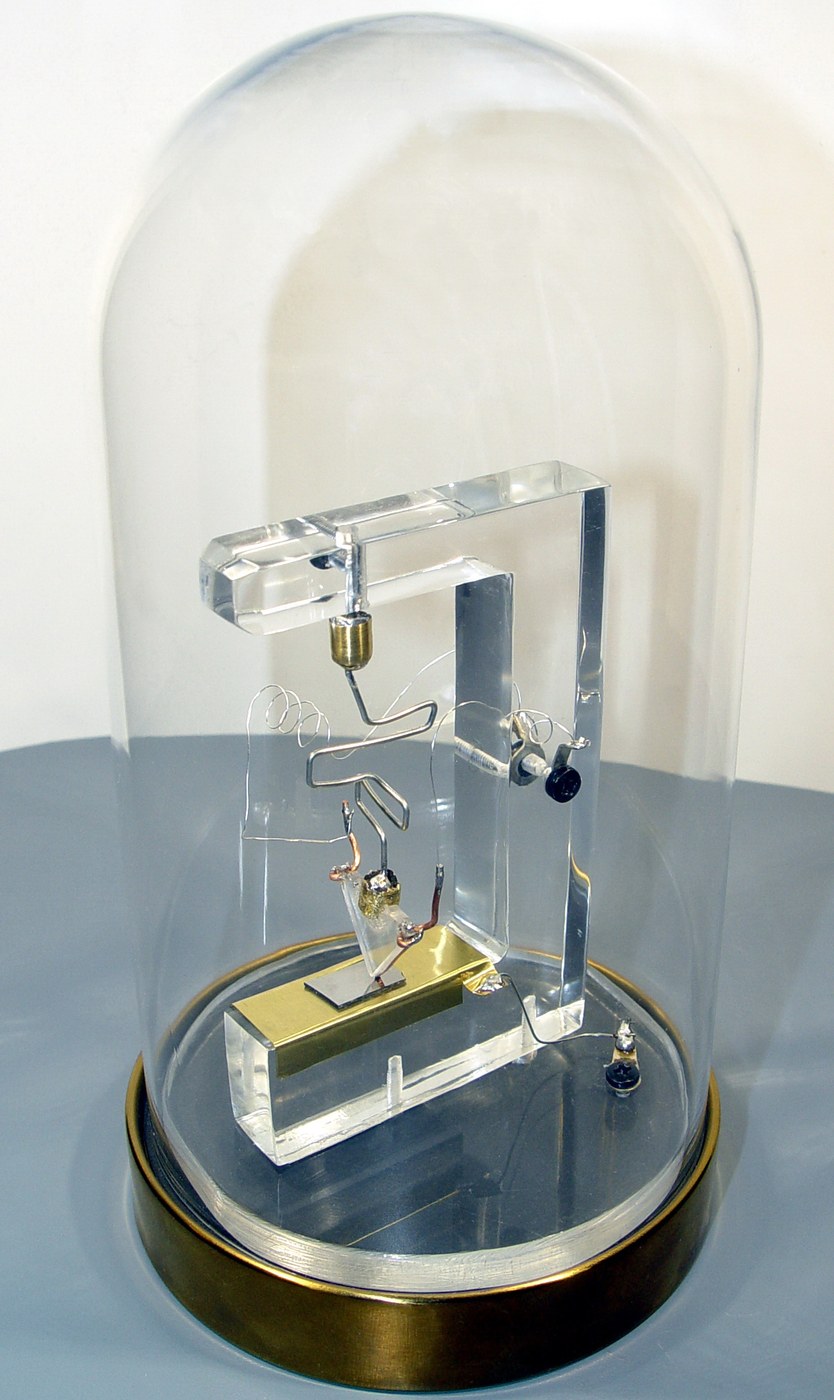


Transistor
A vacuum tube amplifies beautifully and is a small heater with a filament that eventually burns out. A machine with eighteen thousand of them fails somewhere every few minutes and consumes the power of a small factory. Electronics in 1947 was limited by the physical properties of hot metal in a glass bottle.
The transistor does the same job in a piece of cold solid. No filament, no vacuum, no warm-up, nothing to burn out — a crystal in which a small current at one terminal controls a much larger current between two others. The energy that was heating a cathode simply is not needed.
US Patent 2,524,035, "Three-electrode circuit element utilizing semiconductive materials", filed 17 June 1948 and granted 3 October 1950 to John Bardeen and Walter H. Brattain. This blueprint builds a point-contact detector and a working crystal radio, then measures why the third contact changes everything.
Arahan
Read US 2,524,035 and note the word 'semiconductive'
Read US 2,524,035 and note the word 'semiconductive'
Bardeen and Brattain claim a three-electrode element in a semiconductive body. Three electrodes, like the Audion — but in a solid, and that is the whole difference.
Count the cost of doing it with tubes
Count the cost of doing it with tubes
Work out the heater power for 18,000 tubes at a few watts each. That is tens of kilowatts before any computing happens, and a failure every few minutes.
Build a cat's whisker detector first
Build a cat's whisker detector first
Press a fine springy wire onto a galena or silicon crystal. Probe around: some spots rectify well, most do nothing. This is a two-electrode semiconductor device.
Bahan untuk langkah ini:
 Hablur galena1 keping
 Dawai keluli1 meter
Measure it in both directions
Measure it in both directions
Check resistance forward and reverse. A good contact conducts one way and blocks the other — rectification, from a point touching a crystal.
Alatan diperlukan:
 Multimeter
Build a crystal radio around it
Build a crystal radio around it
Add an aerial, a tuned coil and a high-impedance earpiece. It works with no power supply at all — but it cannot be made louder, because there is no gain anywhere in it.
Bahan untuk langkah ini:
 Dawai Kuprum Bersalut Enamel30 meter
State the limitation precisely
State the limitation precisely
A two-terminal device can only pass or block. You need a third terminal to CONTROL — this is the same conclusion De Forest reached about the vacuum diode in 1906.
Prepare a clean germanium or silicon surface
Prepare a clean germanium or silicon surface
Polish and clean the crystal face carefully. Surface contamination dominates point-contact behaviour, and Bardeen's insight about surface states is what unlocked the whole thing.
Alatan diperlukan:
 Kertas Pasir
Bring TWO fine contacts down very close together
Bring TWO fine contacts down very close together
Place two springy wires on the surface a fraction of a millimetre apart, with a third connection to the base. Brattain used gold foil on a plastic wedge split with a razor.
Bahan untuk langkah ini:
 Dawai Tembaga1 meter
Understand why the spacing is critical
Understand why the spacing is critical
Charge carriers injected at one contact must reach the other before recombining. Too far apart and nothing happens — the separation must be smaller than the diffusion length.
Alatan diperlukan:
 Kanta Pembesar
Bias one contact forward and the other reverse
Bias one contact forward and the other reverse
Set the emitter slightly forward-biased and the collector reverse-biased against the base. This asymmetry is the operating condition, not an arbitrary choice.
Vary the emitter current and watch the collector
Vary the emitter current and watch the collector
Change the small emitter current and measure the collector current. A small change at one terminal produces a much larger change at the other — that ratio is the gain.
Confirm the output exceeds the input
Confirm the output exceeds the input
Compare input and output power. Greater than unity is the moment solid-state electronics begins, and Bell Labs saw it on 16 December 1947.
Note how fragile the point-contact device is
Note how fragile the point-contact device is
Nudge it and the operating point moves. Point contacts are mechanically delicate and irreproducible — which is why they were superseded within a few years.
Compare against a modern bipolar transistor
Compare against a modern bipolar transistor
Put a commercial small-signal transistor in the same test circuit. Same three terminals, same behaviour, vastly better consistency — the physics is identical, the manufacturing is not.
Compendium — the third contact, in a solid
Compendium — the third contact, in a solid
The patent. US 2,524,035, "Three-electrode circuit element utilizing semiconductive materials", filed 17 June 1948 and granted 3 October 1950 to John Bardeen and Walter H. Brattain of Bell Telephone Laboratories. The working demonstration was on 16 December 1947. William Shockley led the group and is not on this patent — a genuine and lasting sore point. Shockley, working separately and partly out of irritation at being excluded, devised the junction transistor within a few weeks, and it is HIS device, not the point-contact one, that industry actually built. All three shared the 1956 Nobel Prize in Physics.
What the crystal detector already did, and what it could not. Point-contact rectifiers were old technology by 1947 — cat's whisker detectors ran radio from the 1900s, and silicon and germanium point-contact diodes were mass-produced for wartime radar. What none of them had was a control terminal. A two-terminal device can only pass or block; the entire step from detection to amplification is the addition of a third electrode, which is precisely the same conceptual move De Forest made in the vacuum tube forty years earlier.
Why the contacts must be close. Current injected at the emitter enters the semiconductor as minority carriers, which diffuse through the material and are collected by the reverse-biased collector — but only if they arrive before recombining. The permitted separation is set by the carrier diffusion length, which is why Brattain's contacts had to be within roughly a tenth of a millimetre and why the assembly used gold foil split with a razor blade on a plastic wedge. Bardeen's theoretical contribution was recognising that surface states were pinning the semiconductor's behaviour and finding a way past them.
Why it mattered so much more than it looked. A vacuum tube needs a heated cathode, and heat means power, warm-up time, bulk and eventual failure. A transistor is a cold solid with none of those. That difference alone would have been significant; what made it transformative is that solid devices can be made photolithographically, many at once, on a single wafer — which the integrated circuit exploited a decade later. Bell Labs licensed the technology broadly and cheaply, including to a small Japanese firm that became Sony. The point-contact transistor itself was obsolete within five years; the principle it proved is in every device you own.
Bahan
4- 1 kepingPemegang Tempat
- 1 meterPemegang Tempat
- 30 meterPemegang Tempat
- 1 meterPemegang Tempat
Alatan Diperlukan
3- Pemegang Tempat
- Pemegang Tempat
- Pemegang Tempat
Blueprint berkaitan
Blueprint ini berkongsi pengetahuan — teknik, bahan atau prinsip

CC0 Domain Awam
Blueprint ini dikeluarkan di bawah CC0. Anda bebas menyalin, mengubah, mengedar, dan menggunakan karya ini untuk sebarang tujuan, tanpa meminta kebenaran.
Sokong Pembuat dengan membeli produk melalui Blueprint mereka di mana mereka memperoleh Komisen Pembuat ditetapkan oleh Penjual, atau cipta iterasi baru Blueprint ini dan sertakan ia sebagai sambungan dalam Blueprint anda sendiri untuk berkongsi hasil.