IṢẸ́ ỌNÀ
ẸWÀ ÀTI ÌLERA
IṢẸ́ ỌWỌ́
ÀṢÀ ÀTI ÌTÀN
ÌṢERÉ
ÀYÍKÁ
OÚNJẸ ÀTI OHUN MÍMU
REVERSE ENGINEERING
SÁYẸ́ǸSÌ
ERÉ ÌDÁRAYÁ
ÌMỌ̀-Ẹ̀RỌ
ÀWỌN OHUN WÍWỌ̀
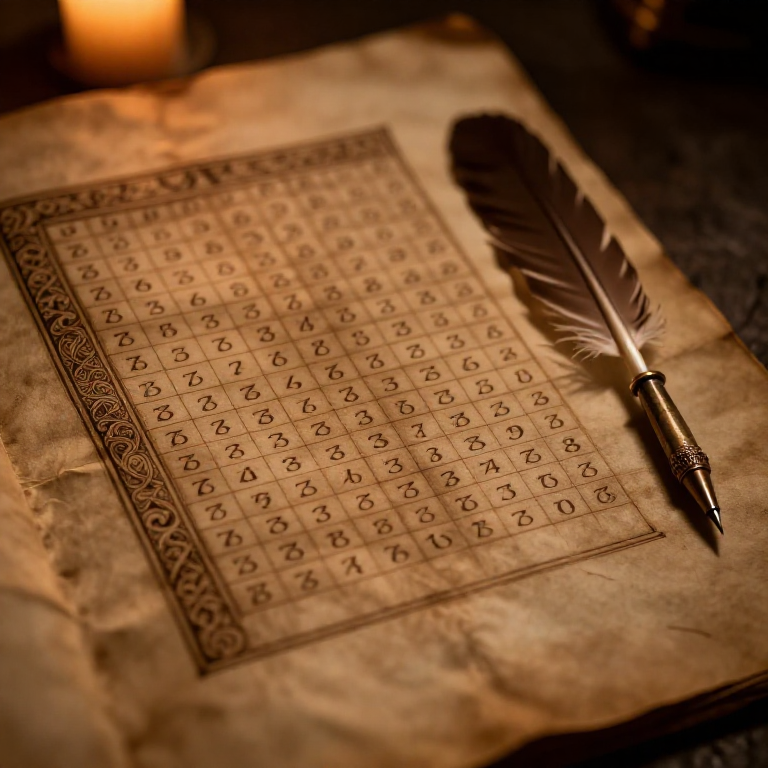


Magic Squares — Arrange Numbers So Every Line Adds the Same
A hands-on maths puzzle: cut number tiles 1 to 9 and arrange them in a 3 by 3 square so every row, column and diagonal adds to 15. A Python cell checks any square you make, and a compendium reveals the maths (and the artist Durer) hidden inside these ancient number patterns.
Olùbẹ̀rẹ̀
30 minutes
Ìlànà
1
1
Numbers that balance
Numbers that balance
A magic square is a grid where every row, every column and both diagonals add up to the same total. The oldest, the Chinese Lo Shu, is thousands of years old. You will build one with your hands.
2
2
Make your number tiles
Make your number tiles
Cut nine small squares of card and write the numbers 1 to 9, one on each tile. Draw an empty 3 by 3 grid to place them in.
Àwọn ohun èlò fún ìgbésẹ̀ yìí:
 Àkópọ̀ Bébà Líle Aláwọ̀1 ẹyọ
Àwọn irinṣẹ́ tí a nílò:
 Ìṣẹ́ná
 Àkójọ Pénsùlù Gíráfáìtì
3
3
Solve the puzzle
Solve the puzzle
Arrange the nine tiles in the grid so that every row, every column and both diagonals add up to 15. Hint: the numbers 1 to 9 add to 45, and 45 divided by 3 rows is 15, so 15 is the target. Another hint: 5 belongs in the middle. Keep swapping tiles until every line makes 15.
4
4
Check your square
Check your square
Ń ṣí ìwé Jupyter…
Àwọn irinṣẹ́ tí a nílò:
 Kọ̀ǹpútà Tábìlì
5
5
Compendium: the maths inside
Compendium: the maths inside
What you discovered. (1) For a square of side n using 1 to n-squared, the magic total is always n times (n-squared plus 1) over 2 -- 15 for a 3x3, 34 for a 4x4. (2) There is really only ONE 3x3 magic square; every solution you find is just that one rotated or flipped. (3) Bigger squares have their own tricks -- odd sizes can be filled by the 'always step up and to the right' Siamese method. (4) In 1514 the artist Albrecht Durer hid a 4x4 magic square in his engraving Melencolia I, with the year 1514 tucked into its bottom row -- proof that mathematicians and artists have loved these balanced numbers for centuries.
Àwọn ohun-èlò
2- Àyè
- 1 ewéÀyè
Àwọn irinṣẹ́ tó nílò
3- Àyè
Blueprint tó jọra
Àwọn blueprint wọ̀nyí pín ìmọ̀ — ọ̀nà, ohun-èlò tàbí ìlànà
CC0 Àgbègbè Gbogbogbò
Blueprint yìí ti jáde lábẹ́ CC0. O lè ṣe àdàkọ, yí padà, pín, àti lò láìsí ìyọ̀ǹda.
Ṣàtìlẹ́yìn Olùṣẹ́dá nípa rírà àwọn ọjà nipasẹ̀ Blueprint wọn Ẹ̀san Olùṣẹ́dá tí àwọn Olùtajà gbé kalẹ̀, tàbí ṣẹ̀dá àtúnṣe tuntun ti Blueprint yìí kí o sì fi sínú Blueprint rẹ gẹ́gẹ́ bí ìsopọ̀ láti pín owó-wíwọlé.