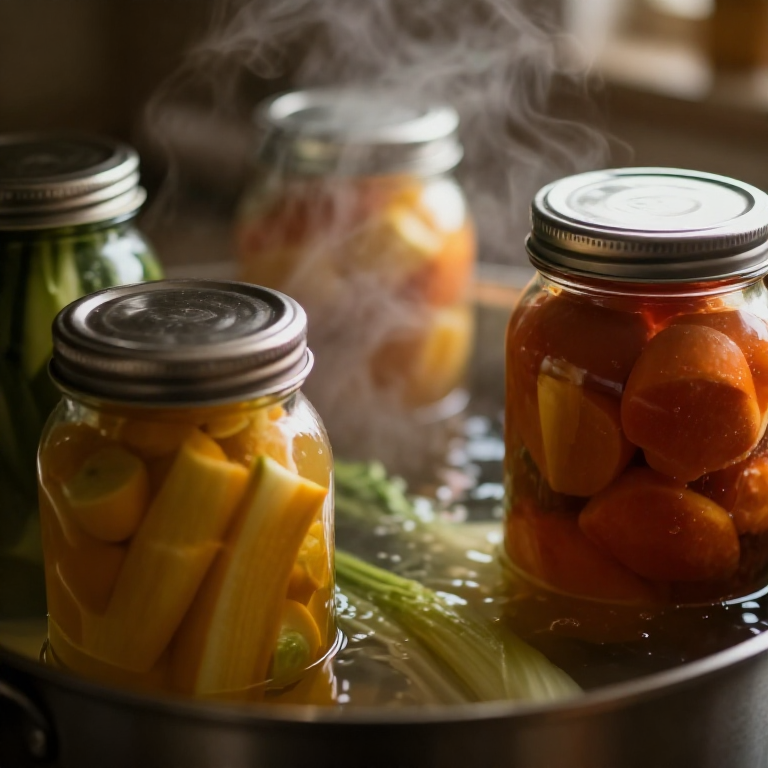


Preserving Food by Canning — Appert's Heat-and-Seal Method That Fed Armies
In 1810 a French confectioner named Nicolas Appert won a prize from Napoleon's government for solving a problem that had plagued every army and navy in history: how to keep food from spoiling. His answer was deceptively simple — pack food in a sealed container and heat it thoroughly. Food preserved this way kept for months, even years, and the modern canning industry was born.
Appert did not know why it worked; it would take Louis Pasteur, fifty years later, to show that heat kills the microbes that spoil food and the seal keeps new ones out. But the method worked perfectly without that knowledge. Soon glass jars gave way to soldered tin cans — lighter, unbreakable, and ideal for soldiers and sailors — and canned food spread around the world.
Canning sits alongside salting, drying, and smoking as one of humanity's great preservation methods, but it was the first to keep food fresh-tasting and the first born of the industrial age. One caution it shares with all low-acid preserving: ordinary boiling does not destroy the spores of botulism, so low-acid foods must be acidified or pressure-canned — a lesson learned long after Appert.
Ìlànà
Understand the principle
Understand the principle
Choose and prepare the food
Choose and prepare the food
Àwọn ohun èlò fún ìgbésẹ̀ yìí:
 Ọjà oko tuntun2 kg
Prepare the jars
Prepare the jars
Àwọn ohun èlò fún ìgbésẹ̀ yìí:
 Ìgò Gílásì6 ẹyọ
Pack the jars
Pack the jars
Àwọn ohun èlò fún ìgbésẹ̀ yìí:
 Iyọ̀ tábìlì50 g
Seal the jars
Seal the jars
Àwọn ohun èlò fún ìgbésẹ̀ yìí:
 Èròjà Ìdí Oyin100 g
Heat in a boiling water bath
Heat in a boiling water bath
Àwọn ohun èlò fún ìgbésẹ̀ yìí:
 Omi8 lítà
Àwọn irinṣẹ́ tí a nílò:
 Ìkòkò Ọbẹ̀ Ńlá
Time by the food
Time by the food
Àwọn irinṣẹ́ tí a nílò:
 Ìwọ̀n Ooru Yàrá
Cool and check the seal
Cool and check the seal
Àwọn irinṣẹ́ tí a nílò:
 Ìdì ìgò
Reject any failures
Reject any failures
Store cool and dark
Store cool and dark
Move to the tin can
Move to the tin can
Àwọn ohun èlò fún ìgbésẹ̀ yìí:
 Ìgò irin6 ẹyọ
Respect the botulism rule
Respect the botulism rule
Àwọn ohun-èlò
6- 2 kgÀyè
- 6 ẹyọÀyè
- 50 gÀyè
- 100 gÀyè
- 8 lítàÀyè
- 6 ẹyọÀyè
Àwọn irinṣẹ́ tó nílò
3- Àyè
Blueprint tó jọra
Àwọn blueprint wọ̀nyí pín ìmọ̀ — ọ̀nà, ohun-èlò tàbí ìlànà



CC0 Àgbègbè Gbogbogbò
Blueprint yìí ti jáde lábẹ́ CC0. O lè ṣe àdàkọ, yí padà, pín, àti lò láìsí ìyọ̀ǹda.
Ṣàtìlẹ́yìn Olùṣẹ́dá nípa rírà àwọn ọjà nipasẹ̀ Blueprint wọn Ẹ̀san Olùṣẹ́dá tí àwọn Olùtajà gbé kalẹ̀, tàbí ṣẹ̀dá àtúnṣe tuntun ti Blueprint yìí kí o sì fi sínú Blueprint rẹ gẹ́gẹ́ bí ìsopọ̀ láti pín owó-wíwọlé.