IṢẸ́ ỌNÀ
ẸWÀ ÀTI ÌLERA
IṢẸ́ ỌWỌ́
ÀṢÀ ÀTI ÌTÀN
ÌṢERÉ
ÀYÍKÁ
OÚNJẸ ÀTI OHUN MÍMU
REVERSE ENGINEERING
SÁYẸ́ǸSÌ
ERÉ ÌDÁRAYÁ
ÌMỌ̀-Ẹ̀RỌ
ÀWỌN OHUN WÍWỌ̀
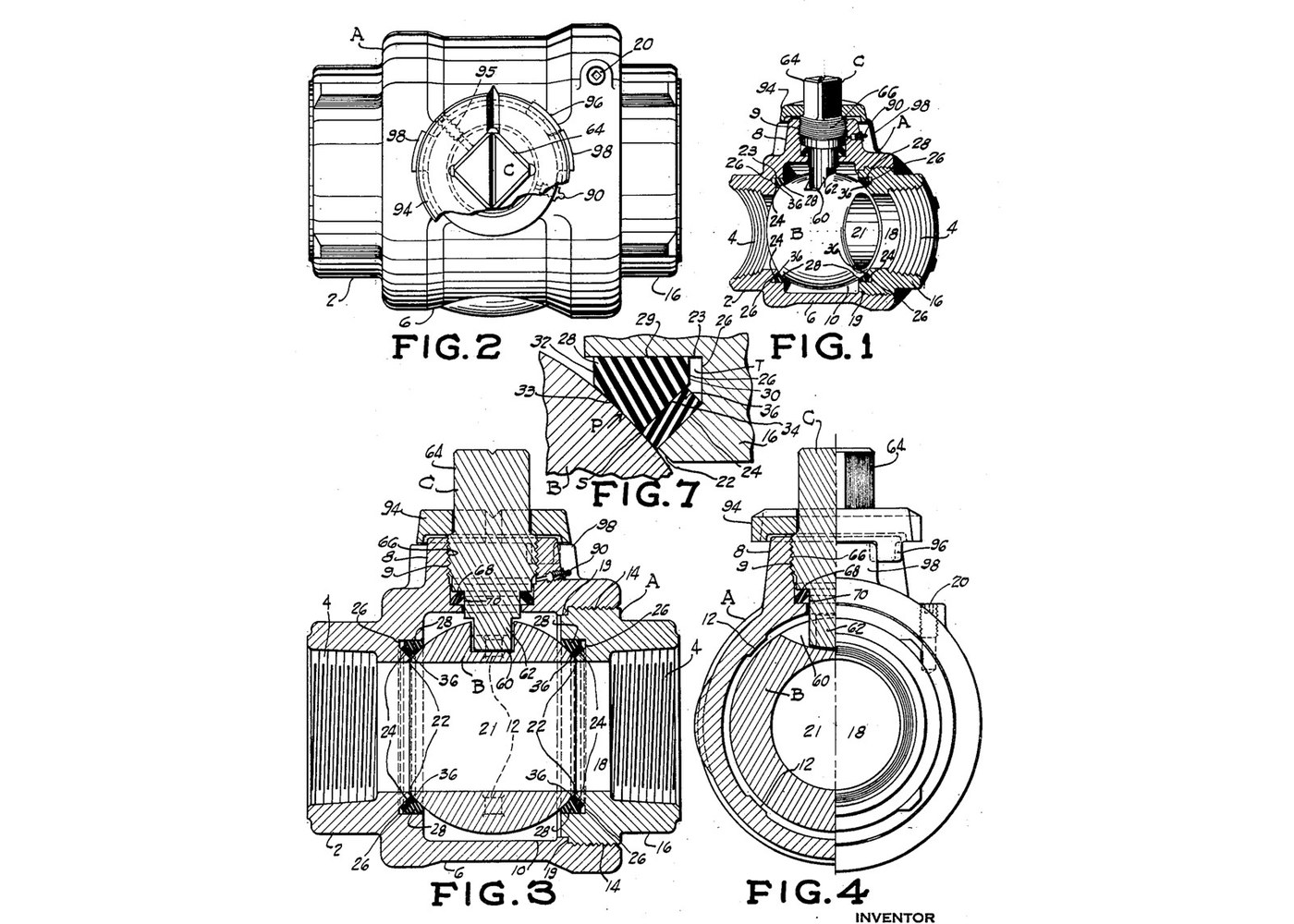


Ball Valve: Floating PTFE Seat and Seal Rings on a Stainless Ball (Clade 1956)
A ball with a hole through it, turned a quarter turn, opens or shuts a pipe. Clade's valve seals it with PTFE. A seating ring rests on the ball, and behind it sits a flat PTFE ring twisted into a cone. PTFE remembers its shape, so the ring keeps pressing on the ball, and line pressure only presses it harder. The metal never touches the ball, so body and ball can be stainless steel.
Source: R. Clade (W-K-M Manufacturing), US 2,762,601 (1956). Unknown: the dimensions. The patent gives the design and a 45° seat angle, but no sizes, so they are linked to an unknown head. Stainless rod as stock and the machining tools are ours. Picture: the patent's sheet 1.
Ògbóǹtarìgì
3 days
Ìlànà
1
1
Make the two-part body
Make the two-part body
Turn the cup: a base threaded inside for the pipe, an enlarged cavity with small bosses that lightly support the ball, a boss on top bored and threaded for the stem, and the mouth threaded inside for the closure, with a shoulder below the threads. Turn the closure: threaded outside to screw into the cup, threaded inside for the other pipe. Bore a through passage in both. Unknown: all the dimensions.
Àwọn ohun èlò fún ìgbésẹ̀ yìí:
 Ọ̀pá irin tí kò ń yá1 as required
Àwọn irinṣẹ́ tí a nílò:
 Ẹ̀rọ Ìyí Irin
 Àpò ohun èlò lathe (HSS)
 Ọ̀pá gígé inú ihò
 Ìtò irinṣẹ́ ìgé ihá
 Kálípà Fáníà
 Ìwọ̀n tí a kò mọ̀
2
2
Cut the 45° seats and their V grooves
Cut the 45° seats and their V grooves
On the closure and on the ledge inside the cup next to the base, machine a conical seat at about 45° to the passage axis, so it would touch the ball at 45°. Interrupt each seat with a groove of truncated V section: its outer wall parallel to the axis, its inner wall parallel to the 45° line, its bottom square to the axis.
Àwọn irinṣẹ́ tí a nílò:
Ẹ̀rọ Ìyí IrinÀpò ohun èlò lathe (HSS)Kálípà FáníàÌwọ̀n tí a kò mọ̀3
3
Make the ball and the stem
Make the ball and the stem
Turn the ball as a true sphere and bore a passage through it. Round off the edges where the passage meets the surface, so they do not cut the rings. Mill a slot across the top for the stem. Turn the stem with a square operating end, a thread below it for the boss, a shoulder, and a lower end that fits the ball's slot.
Àwọn ohun èlò fún ìgbésẹ̀ yìí:
Ọ̀pá irin tí kò ń yá1 as requiredÀwọn irinṣẹ́ tí a nílò:
Ẹ̀rọ Ìyí IrinÀpò ohun èlò lathe (HSS) Ẹ̀rọ Ìgégé Irin
 Àkójọ ÌfáÌwọ̀n tí a kò mọ̀
4
4
Make the PTFE rings
Make the PTFE rings
For each seat, cut a seating ring with a face parallel to the 45° seat and a sliding fit in the groove. Then cut a sealing ring, flat and rectangular in section (or cut from PTFE tube). For the stem, cut a ring of parallelogram section. Ours: all cut from PTFE ring stock.
Àwọn ohun èlò fún ìgbésẹ̀ yìí:
 Òrùka PTFE5 ẹyọ
Àwọn irinṣẹ́ tí a nílò:
Ẹ̀rọ Ìyí IrinÀpò ohun èlò lathe (HSS)Ìwọ̀n tí a kò mọ̀5
5
Fit the rings and assemble the valve
Fit the rings and assemble the valve
Put each sealing ring into its V groove first, twisting the flat ring into a cone, then slide in the seating ring. The ball closes the gap left behind the seal ring, and PTFE's memory keeps the seal's corner pressed on the ball. Set the ball in the cup and screw the closure in hard against the shoulder. Drill and tap the cup for a locking stud that enters a hole drilled in the closure. Fit the stem with its PTFE ring between the stem and boss shoulders, and screw it down: the ring is squeezed into a seal. Drop the stop cap over the stem and lock it with a stud. Its projection meets the body stops, so the ball turns only 90°.
Àwọn irinṣẹ́ tí a nílò:
 Ẹ̀rọ Ìlùkòkò OnídúróÌtò irinṣẹ́ ìgé ihá
 Ìdìmú òpó
 Ìdìmú Tábìlì
 Gíláàsì ààbò
Àwọn ohun-èlò
2- 1 as requiredÀyè
- 5 ẹyọÀyè
Ìtọ́nisọ́nà yìí ń ṣe
Blueprint tó jọra
Àwọn blueprint wọ̀nyí pín ìmọ̀ — ọ̀nà, ohun-èlò tàbí ìlànà


CC0 Àgbègbè Gbogbogbò
Blueprint yìí ti jáde lábẹ́ CC0. O lè ṣe àdàkọ, yí padà, pín, àti lò láìsí ìyọ̀ǹda.
Ṣàtìlẹ́yìn Olùṣẹ́dá nípa rírà àwọn ọjà nipasẹ̀ Blueprint wọn Ẹ̀san Olùṣẹ́dá tí àwọn Olùtajà gbé kalẹ̀, tàbí ṣẹ̀dá àtúnṣe tuntun ti Blueprint yìí kí o sì fi sínú Blueprint rẹ gẹ́gẹ́ bí ìsopọ̀ láti pín owó-wíwọlé.