IṢẸ́ ỌNÀ
ẸWÀ ÀTI ÌLERA
IṢẸ́ ỌWỌ́
ÀṢÀ ÀTI ÌTÀN
ÌṢERÉ
ÀYÍKÁ
OÚNJẸ ÀTI OHUN MÍMU
REVERSE ENGINEERING
SÁYẸ́ǸSÌ
ERÉ ÌDÁRAYÁ
ÌMỌ̀-Ẹ̀RỌ
ÀWỌN OHUN WÍWỌ̀
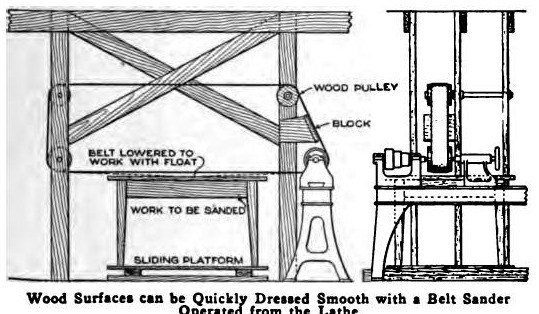


Belt Sander: a Lathe-Driven Garnet-Belt Sander (Shop Notes, 1919)
A shop belt sander for dressing wood surfaces: a 6 in garnet-paper belt running over four crowned wooden pulleys, one driven by the lathe, pressed down onto the work with a hand float.
Best belt speed about 2,500 ft per minute; leave about 1 in between work and belt.
Source: Popular Mechanics Shop Notes for 1919, p. 3235. Picture: the article's drawing.
Àárín
Unknown
Ìlànà
1
1
Turn the pulleys
Turn the pulleys
Build up four solid wood pulleys 10 in across with 8 in faces and turn them in the lathe with a very slight crown; too much crown harms the belt.
Àwọn ohun èlò fún ìgbésẹ̀ yìí:
 Pátákó Igi Líle4 built-up pulleys
Àwọn irinṣẹ́ tí a nílò:
 Ẹ̀rọ ìyí igi
2
2
Mount the pulleys
Mount the pulleys
Mount one pulley on a firmly held arbor in the lathe and the other three on iron-pipe shafts on a frame (drawing). Turn and file a true journal on each pipe, pour babbitt bushings in the pulleys, and cut oil grooves in the pipe or babbitt. Supporting the shafts on one side lets the belt slip off; supporting both sides is stronger.
Àwọn ohun èlò fún ìgbésẹ̀ yìí:
 Páìpù irin (ògiri nípọn, ẹnu oníhá)3 shafts
 Irin tí a kò mọ̀1 babbitt bushings
 Igi pine1 frame
Àwọn irinṣẹ́ tí a nílò:
 Ìfá Irin
 Ṣíbí oníhò
 Ayùn Ọwọ́
 Òòlù
3
3
Make the belt
Make the belt
Cut 6 in garnet paper (No. 1 1/2 for general work) so the ends just meet over the pulleys. Glue the smooth side at the joint, splice it with a strip of cloth about 1 in wide and then one about 3 in wide, cover each side with paper, and clamp between two small boards.
Àwọn ohun èlò fún ìgbésẹ̀ yìí:
 Bébà Ìfá1 6 in garnet paper
 Aṣọ Òwú1 ẹyọ
 Lẹ̀mọ́ ẹranko1 ẹyọ
Àwọn irinṣẹ́ tí a nílò:
 Ìdìmú onídàbí C
4
4
Set up and run
Set up and run
Run the belt at about 2,500 ft per minute using the lathe's cone pulley. Set the work about 1 in below the belt on a table or a low sliding platform (two sets of tongue-and-groove joints at right angles), start the machine and press the belt down with a float like a blackboard eraser, or a roller.
Àwọn ohun èlò fún ìgbésẹ̀ yìí:
Igi pine1 platform, floatÀwọn irinṣẹ́ tí a nílò:
Ẹ̀rọ ìyí igiÀwọn ohun-èlò
7- 4 built-up pulleysÀyè
- Àyè
- 1 babbitt bushingsÀyè
- 1 platform, floatÀyè
- 1 6 in garnet paperÀyè
- 1 ẹyọÀyè
- 1 ẹyọÀyè
Ìtọ́nisọ́nà yìí ń ṣe

CC0 Àgbègbè Gbogbogbò
Blueprint yìí ti jáde lábẹ́ CC0. O lè ṣe àdàkọ, yí padà, pín, àti lò láìsí ìyọ̀ǹda.
Ṣàtìlẹ́yìn Olùṣẹ́dá nípa rírà àwọn ọjà nipasẹ̀ Blueprint wọn Ẹ̀san Olùṣẹ́dá tí àwọn Olùtajà gbé kalẹ̀, tàbí ṣẹ̀dá àtúnṣe tuntun ti Blueprint yìí kí o sì fi sínú Blueprint rẹ gẹ́gẹ́ bí ìsopọ̀ láti pín owó-wíwọlé.