IṢẸ́ ỌNÀ
ẸWÀ ÀTI ÌLERA
IṢẸ́ ỌWỌ́
ÀṢÀ ÀTI ÌTÀN
ÌṢERÉ
ÀYÍKÁ
OÚNJẸ ÀTI OHUN MÍMU
REVERSE ENGINEERING
SÁYẸ́ǸSÌ
ERÉ ÌDÁRAYÁ
ÌMỌ̀-Ẹ̀RỌ
ÀWỌN OHUN WÍWỌ̀
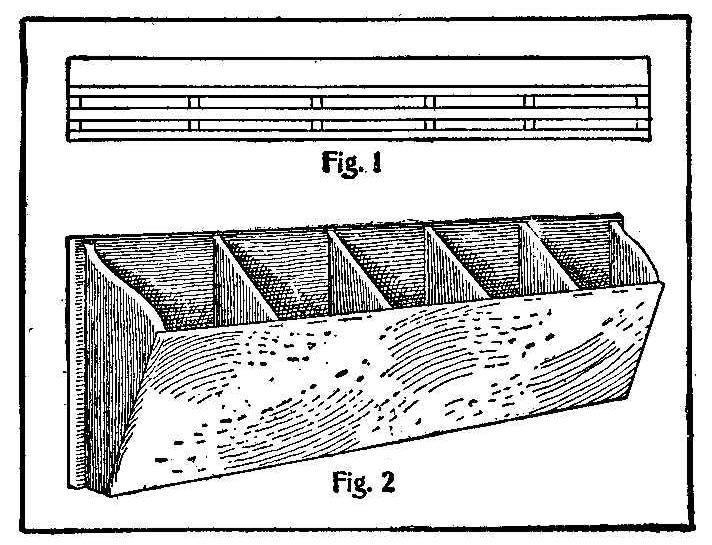


Closet Shoe Rack: Wedge-Shaped Pockets on the Wall With a Slatted Bottom for Dirt to Fall Through (Boy Mechanic, 1913)
A shoe rack "that can be placed on the wall in the clothes closet", from The Boy Mechanic (1913): two boards 9 in wide and about 3 ft long, held apart by six wedge-shaped partitions so the pockets open wider at the top, and a slatted bottom that lets the dirt fall through. Sizes are the book's.
Contributed to Popular Mechanics by Guy H. Harvey of Mill Valley, California.
Olùbẹ̀rẹ̀
About 2 hours
Ìlànà
1
1
The partitions
The partitions
Ń ṣí ìwé Jupyter…
2
2
Read The Boy Mechanic
Read The Boy Mechanic
"Two boards, 9 in. wide and about 3 ft. long, with six partitions between, as shown, will make pockets about 6 in. long. The width of the pockets at the bottom is 2 in. and at the top 5 in."
3
3
Cut the boards and partitions
Cut the boards and partitions
Cut two pine boards 9 in wide and about 3 ft long, the back and the front. Cut six partitions as wedges from the notebook, 9 in tall, 2 in deep at the bottom and 5 in at the top.
Àwọn ohun èlò fún ìgbésẹ̀ yìí:
 Pákó igi pine1 ẹyọ
Àwọn irinṣẹ́ tí a nílò:
 Okùn Ìdíwọ̀n
 Gègé
 Igun-òsùwọ̀n tí ó dúró
 Ayùn Ọwọ́
4
4
Assemble the pockets
Assemble the pockets
Nail the partitions to the back board, square to it, one at each end and the rest spaced about 6 in apart. Nail the front board to their sloping edges, so it leans out and the pockets open wider at the top.
Àwọn ohun èlò fún ìgbésẹ̀ yìí:
 Ìṣó1 ẹyọ
Àwọn irinṣẹ́ tí a nílò:
 Òòlù oníkànnì
5
5
Fit the slatted bottom
Fit the slatted bottom
Nail strips across the bottom of the pockets with gaps between them, as his Fig. 1, so the dirt from the shoes falls through.
Àwọn ohun èlò fún ìgbésẹ̀ yìí:
 Tẹ́ẹ́rẹ́ igi líle1 ẹyọÌṣó1 ẹyọ
Àwọn irinṣẹ́ tí a nílò:
Ayùn Ọwọ́Òòlù oníkànnì6
6
Hang it
Hang it
Screw the back board to the wall of the clothes closet (ours), and put a pair of shoes toe-down in each pocket.
Àwọn ohun èlò fún ìgbésẹ̀ yìí:
 Ìṣó igi1 ẹyọ
Àwọn irinṣẹ́ tí a nílò:
 Ìlù ọwọ́
 Ìṣù àwọn ohun ìyí skurú
7
7
Troubleshooting
Troubleshooting
Shoe rack troubleshooting.
Flow
Loading...
8
8
History and honest limits
History and honest limits
From **The Boy Mechanic, Volume 1**, edited by H. H. Windsor, Popular Mechanics, Chicago, 1913 (Project Gutenberg #12655), "Homemade Shoe Rack", contributed by Guy H. Harvey of Mill Valley, California. The board sizes, pocket sizes and six partitions are the book's; the wood, nails, slat sizes and hanging screws are ours.
Ìtọ́nisọ́nà yìí ń ṣe
Blueprint tó jọra
Àwọn blueprint wọ̀nyí pín ìmọ̀ — ọ̀nà, ohun-èlò tàbí ìlànà
CC0 Àgbègbè Gbogbogbò
Blueprint yìí ti jáde lábẹ́ CC0. O lè ṣe àdàkọ, yí padà, pín, àti lò láìsí ìyọ̀ǹda.
Ṣàtìlẹ́yìn Olùṣẹ́dá nípa rírà àwọn ọjà nipasẹ̀ Blueprint wọn Ẹ̀san Olùṣẹ́dá tí àwọn Olùtajà gbé kalẹ̀, tàbí ṣẹ̀dá àtúnṣe tuntun ti Blueprint yìí kí o sì fi sínú Blueprint rẹ gẹ́gẹ́ bí ìsopọ̀ láti pín owó-wíwọlé.