
IṢẸ́ ỌNÀ
ẸWÀ ÀTI ÌLERA
IṢẸ́ ỌWỌ́
ÀṢÀ ÀTI ÌTÀN
ÌṢERÉ
ÀYÍKÁ
OÚNJẸ ÀTI OHUN MÍMU
REVERSE ENGINEERING
SÁYẸ́ǸSÌ
ERÉ ÌDÁRAYÁ
ÌMỌ̀-Ẹ̀RỌ
ÀWỌN OHUN WÍWỌ̀
Four-Passenger Coasting Bobsled: Iron-Shod Ash Runners, Hinged Rear Sled and Hoop Steering Wheel (Boy Mechanic, 1915)
Woody

Ṣẹ́dá nipasẹ̀

Woody

13. Oṣù Kọkànlá 2026NO
8
0
0
0
0

Four-Passenger Coasting Bobsled: Iron-Shod Ash Runners, Hinged Rear Sled and Hoop Steering Wheel (Boy Mechanic, 1915)

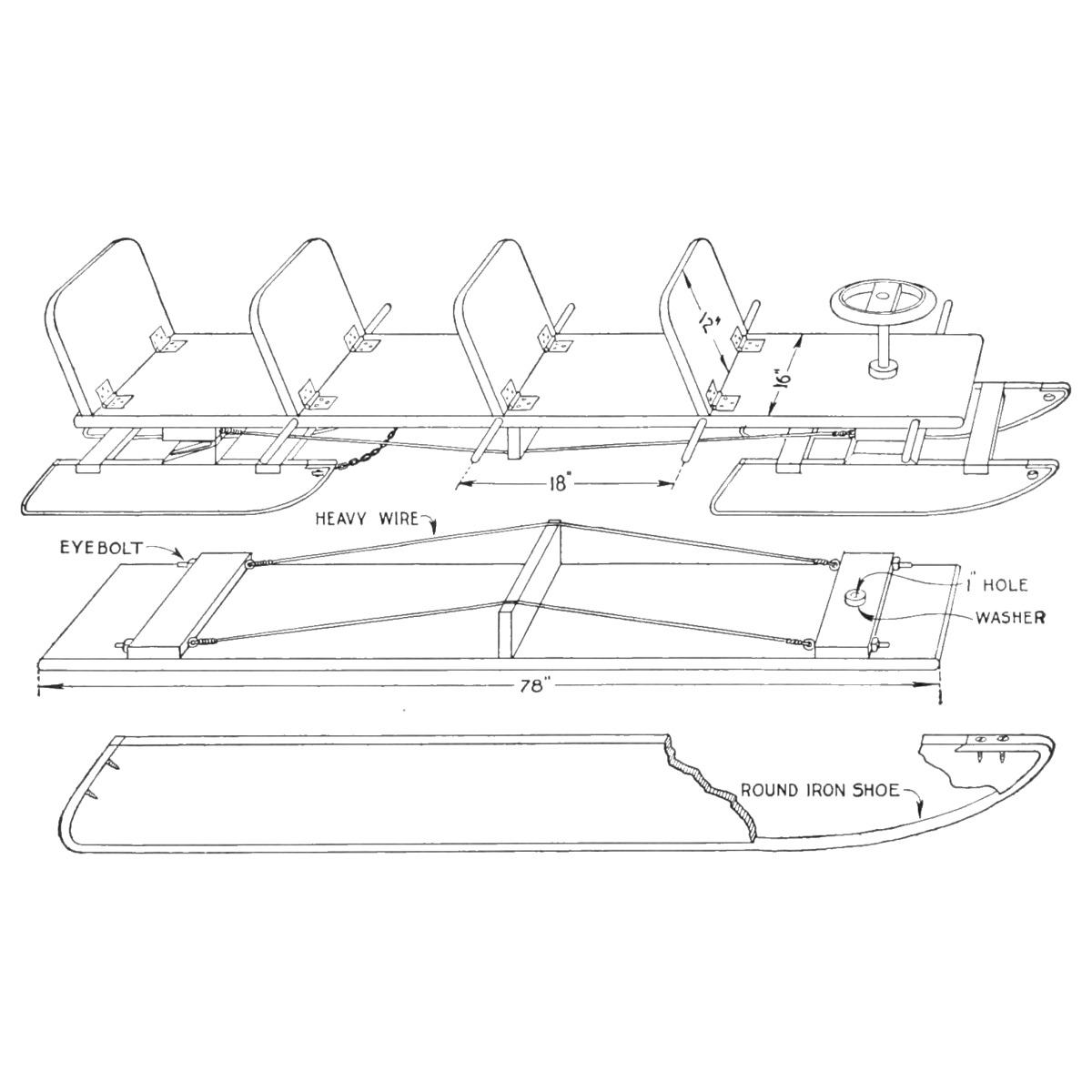
R. H. Allen's four-passenger coasting bob from The Boy Mechanic, Book 2 (1915): a 6-1/2 ft top board with four hinged seat backs, carried on two short sleds with ash runners shod in 5/8 in round iron. The rear sled rocks on a wedge and hinges to follow the ground; the front sled steers by a broom-handle post and a wheel made from a nail-keg hoop. Every size is his.
Àárín
About 3 days

Ìlànà

1

His list of materials in centimetres

Ń ṣí ìwé Jupyter…
2

Read The Boy Mechanic, Book 2

"Any wood may be used for the sled, except for the runners, which should be made of ash." His list of materials: 1 top 6-1/2 ft x 16 in x 1-1/4 in; 4 runners 22 x 4 x 1 in; 4 crosspieces 16 x 3 x 1 in; 3 pieces 16 x 5 x 2 in; 1 piece 16 x 5 x 1 in; 1 shore 16 x 3 x 1 in; 4 seat backs 12 x 16 x 1 in; 1 dowel 3 ft x 1 in; 4 rods 5/8 in x 30 in; 4 eyebolts 1/2 x 6 in; 3 hinges 5 in strap; 8 hinges 3 in strap.
3

Shape and shoe the runners

Cut one ash runner to shape and use it as the pattern for the other three. Cut a groove about 1/4 in deep along the under edge to take the curve of a 5/8 in round iron rod. Bend each rod to fit in the groove, up the back of the runner and over the top at the front; flatten the ends and drill two holes in each for wood screws (a blacksmith can flatten them, he says). Screw the irons on.

Àwọn ohun èlò fún ìgbésẹ̀ yìí:

Pátákó Igi LílePátákó Igi Líle1 ẹyọ
Ọ̀pá irin róbótóỌ̀pá irin róbótó4 ẹyọ
Ìṣó igiÌṣó igi1 ẹyọ

Àwọn irinṣẹ́ tí a nílò:

Ayùn Ọwọ́Ayùn Ọwọ́
Ayùn KópìngìAyùn Kópìngì
Àwọn ìgbẹ́ igiÀwọn ìgbẹ́ igi
Ilé àgbẹ̀dẹ èédú òkútaIlé àgbẹ̀dẹ èédú òkúta
Ìdí Alágbẹ̀dẹÌdí Alágbẹ̀dẹ
Òòlù alágbẹ̀dẹÒòlù alágbẹ̀dẹ
Ìdìmú TábìlìÌdìmú Tábìlì
Ìlù ọwọ́Ìlù ọwọ́
GègéGègé
4

Build the two sleds

Notch the top edges of each pair of runners for the 16 x 3 in crosspieces, near the ends, so the crosspieces lie flush with the runner tops and the notches of each pair line up. Fit them snugly, fasten with long, slim wood screws, and stiffen each joint inside with a small metal brace.

Àwọn ohun èlò fún ìgbésẹ̀ yìí:

Pákó igi pinePákó igi pine1 ẹyọ
Ìṣó igiÌṣó igi1 ẹyọ
Irin igunIrin igun8 ẹyọ

Àwọn irinṣẹ́ tí a nílò:

Ayùn Ọwọ́Ayùn Ọwọ́
Àwọn ìgbẹ́ igiÀwọn ìgbẹ́ igi
Ìlù ọwọ́Ìlù ọwọ́
5

Make the rocking rear joint

Cut a heavy 2 x 5 in crosspiece sloping across its width, from 2 in thick at one edge to a feather edge at the other. Fix the three large strap hinges to the sloping face, and fasten the piece solidly on the rear sled's runners with its centre 8 in from their front ends. This lets the rear sled rock but not turn sideways.

Àwọn ohun èlò fún ìgbésẹ̀ yìí:

Pákó igi pinePákó igi pine1 ẹyọ
Ìdìmú pẹpẹ irinÌdìmú pẹpẹ irin3 ẹyọ
Ìṣó igiÌṣó igi1 ẹyọ

Àwọn irinṣẹ́ tí a nílò:

Ayùn Ọwọ́Ayùn Ọwọ́
Ohun èlò ìfárí igi (pìlánì)Ohun èlò ìfárí igi (pìlánì)
Ìlù ọwọ́Ìlù ọwọ́
6

Mount the front sled crosspiece

Fasten the supporting crosspiece on top of the front sled's runners with its centre 11 in from their front ends.

Àwọn ohun èlò fún ìgbésẹ̀ yìí:

Pákó igi pinePákó igi pine1 ẹyọ
Ìṣó igiÌṣó igi1 ẹyọ

Àwọn irinṣẹ́ tí a nílò:

Ìlù ọwọ́Ìlù ọwọ́
Okùn Ìdíwọ̀nOkùn Ìdíwọ̀n
7

Brace the top board

Round both ends of the top board and plane it smooth. Underneath, fit two crosspieces, each with two 1/2 in holes bored through its width near the ends for the eyebolts: one with its centre 12 in from the rear end, the other 8 in from the front. Screw them on. Set the shore in the centre of the board, run wires over it between the eyebolts, and draw the eyebolts up until the wire is taut over the shore, so the long board cannot sag.

Àwọn ohun èlò fún ìgbésẹ̀ yìí:

Pákó igi pinePákó igi pine1 ẹyọ
Bọ́ọ̀lù oníyíkáBọ́ọ̀lù oníyíká4 ẹyọ
Wáyà irinWáyà irin1 ẹyọ
Ìṣó igiÌṣó igi1 ẹyọ

Àwọn irinṣẹ́ tí a nílò:

Ayùn Ọwọ́Ayùn Ọwọ́
Ohun èlò ìfárí igi (pìlánì)Ohun èlò ìfárí igi (pìlánì)
Ìlù ọwọ́ pẹ̀lú oríÌlù ọwọ́ pẹ̀lú orí
Okùn Ìdíwọ̀nOkùn Ìdíwọ̀n
8

Fit the seat backs and foot rests

Round the top corners of the four backs and cut the bottom ends at a slight angle for a slant. Hinge them to the top board with the small strap hinges every 18 in, starting at the rear. Bore 1 in holes about 1 in deep in the edges of the top board every 18 in, beginning about 5 in from the front, and drive in pins 4 in long cut from the dowel, as foot rests.

Àwọn ohun èlò fún ìgbésẹ̀ yìí:

Pákó igi pinePákó igi pine1 ẹyọ
Ìdìmú pẹpẹ irinÌdìmú pẹpẹ irin8 ẹyọ
Àwọn dowel igi líleÀwọn dowel igi líle1 ẹyọ
Ìṣó igiÌṣó igi1 ẹyọ

Àwọn irinṣẹ́ tí a nílò:

Ayùn Ọwọ́Ayùn Ọwọ́
Ìlù ọwọ́ pẹ̀lú oríÌlù ọwọ́ pẹ̀lú orí
Okùn Ìdíwọ̀nOkùn Ìdíwọ̀n
9

Make the steering

Cut a broom handle to 18 in and fasten one end in a hole bored centrally in the 5 in crosspiece of the front sled. Bore a hole in the top board through the centre of the crosspiece underneath; put two metal washers on the stick and run it up through the hole, then fasten a hardwood collar to it just above the board so the top cannot lift off the sled. For the wheel, fasten a piece of wood across a nail-keg hoop, cover the hoop with garden hose and wrap it with twine; bore the centre of the crosspiece to fit the broom handle and screw it on.

Àwọn ohun èlò fún ìgbésẹ̀ yìí:

Ìgbálẹ̀Ìgbálẹ̀1 ẹyọ
Wáṣà PẹrẹsẹWáṣà Pẹrẹsẹ2 ẹyọ
Pátákó Igi LílePátákó Igi Líle1 ẹyọ
Ìdìmọ́ irinÌdìmọ́ irin1 ẹyọ
Ọ̀pá-omi rọ́bà alágbáraỌ̀pá-omi rọ́bà alágbára1 ẹyọ
Okùn juteOkùn jute1 ẹyọ
Ìṣó igiÌṣó igi1 ẹyọ

Àwọn irinṣẹ́ tí a nílò:

Ayùn Ọwọ́Ayùn Ọwọ́
Ìlù ọwọ́ pẹ̀lú oríÌlù ọwọ́ pẹ̀lú orí
Ìlù ọwọ́Ìlù ọwọ́
10

Join the sleds and fit the ropes

Fasten the rear sled to the top board with screws through the free wings of the hinges into the crosspiece. Bore holes in the front ends of all runners and attach a chain or rope: the rear one's loop to the underside of the top board, the front one for drawing the sled.

Àwọn ohun èlò fún ìgbésẹ̀ yìí:

Ìṣó igiÌṣó igi1 ẹyọ
Ẹ̀wọ̀n irinẸ̀wọ̀n irin1 ẹyọ

Àwọn irinṣẹ́ tí a nílò:

Ìlù ọwọ́ pẹ̀lú oríÌlù ọwọ́ pẹ̀lú orí
Ìlù ọwọ́Ìlù ọwọ́
11

Troubleshooting

Bobsled troubleshooting.

Flow

Loading...
12

History and honest limits

From "Four-Passenger Coasting Bobsled" by R. H. Allen, in **The Boy Mechanic, Book 2**, Popular Mechanics, 1915 (Project Gutenberg 44585; checked on the archive.org scan boymechanicbook200chic2, pp. 24-26). The runner shape comes from his drawing, not from figures. The scan calls the steering collar a hardwood collar; the Gutenberg text drops "hardwood". The tools and metric figures are ours.

Àwọn ohun-èlò

15

Àwọn irinṣẹ́ tó nílò

12

Ìtọ́nisọ́nà yìí ń ṣe

Blueprint tó jọra

Àwọn blueprint wọ̀nyí pín ìmọ̀ — ọ̀nà, ohun-èlò tàbí ìlànà
CC0 Àgbègbè Gbogbogbò

Blueprint yìí ti jáde lábẹ́ CC0. O lè ṣe àdàkọ, yí padà, pín, àti lò láìsí ìyọ̀ǹda.

Ṣàtìlẹ́yìn Olùṣẹ́dá nípa rírà àwọn ọjà nipasẹ̀ Blueprint wọn Ẹ̀san Olùṣẹ́dá tí àwọn Olùtajà gbé kalẹ̀, tàbí ṣẹ̀dá àtúnṣe tuntun ti Blueprint yìí kí o sì fi sínú Blueprint rẹ gẹ́gẹ́ bí ìsopọ̀ láti pín owó-wíwọlé.

Ìfọ̀rọ̀wérọ̀

(0)

Wọlé láti dara pọ̀ mọ́ ìfọ̀rọ̀wérọ̀

Ń gbé àwọn ọ̀rọ̀ wọlé...