IṢẸ́ ỌNÀ
ẸWÀ ÀTI ÌLERA
IṢẸ́ ỌWỌ́
ÀṢÀ ÀTI ÌTÀN
ÌṢERÉ
ÀYÍKÁ
OÚNJẸ ÀTI OHUN MÍMU
REVERSE ENGINEERING
SÁYẸ́ǸSÌ
ERÉ ÌDÁRAYÁ
ÌMỌ̀-Ẹ̀RỌ
ÀWỌN OHUN WÍWỌ̀
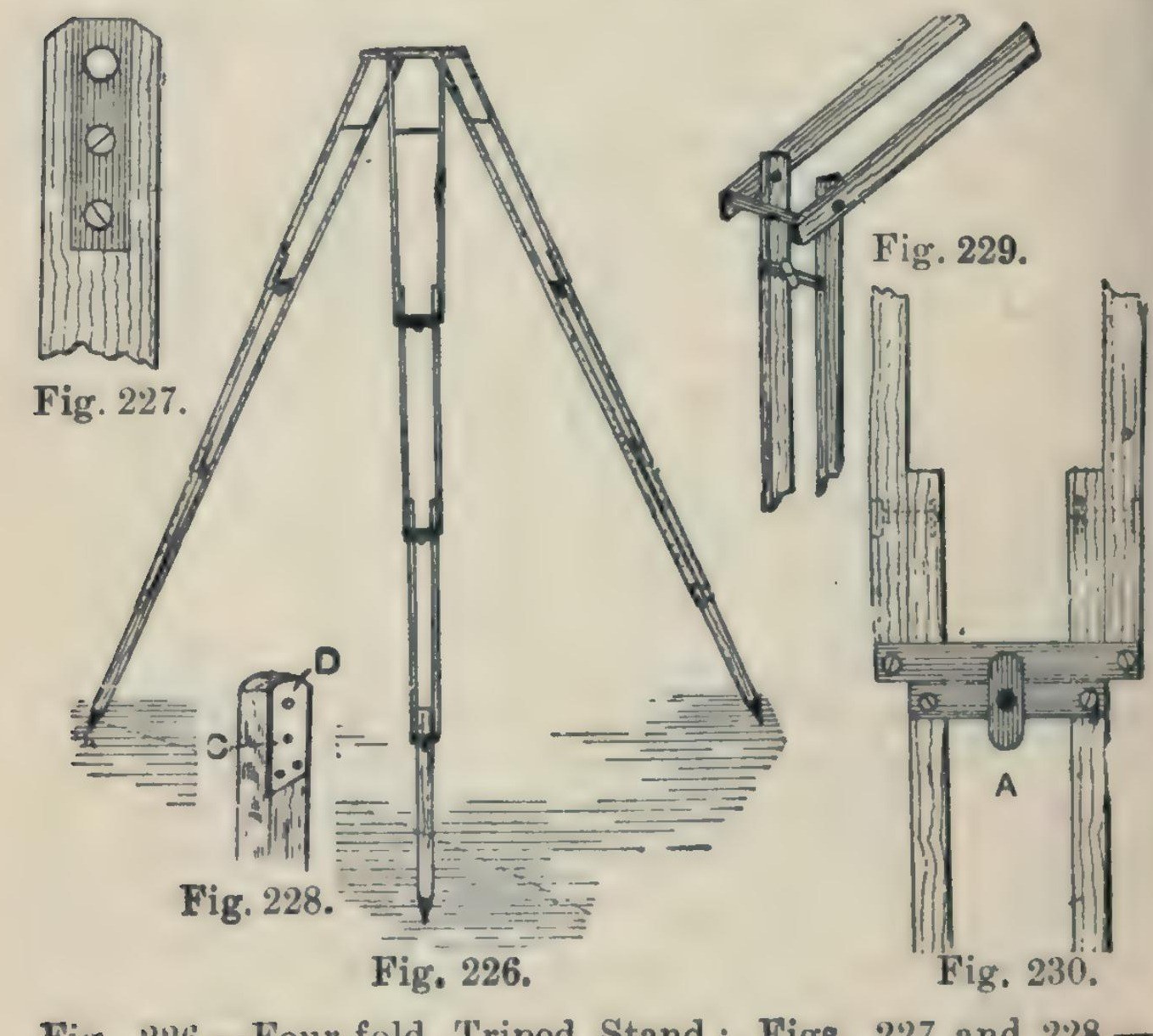


Camera Tripod: a Four-Fold Ash Tripod Stand (Hasluck, 1902)
A light, compact folding camera stand: three legs, each of seven ash laths riveted so it folds in four, locked open by brass buttons, on a triangular ash top with brass pins and a hole for the camera screw.
Hasluck says the same method makes stands that fold in three or two.
Source: Paul N. Hasluck, Photographic Cameras and Accessories (1902), pp. 153-157. Picture: Figs. 226-230 of the book.
Àárín
Unknown
Ìlànà
1
1
Cut the ash laths
Cut the ash laths
Cut laths of good ash, true and square or the stand won't be rigid, and round the edges slightly: six 17 1/4 x 5/8 x 3/8 in, six 16 x 5/8 x 3/8 in, six 15 1/2 x 5/8 x 3/8 in, and three 14 x 5/8 x 5/8 in.
Àwọn ohun èlò fún ìgbésẹ̀ yìí:
 Pátákó igi ash1 21 laths
Àwọn irinṣẹ́ tí a nílò:
 Ayùn ẹlẹ́yìn irin
 Ohun ìfá kékeré
2
2
Fit the top ends and stretcher
Fit the top ends and stretcher
On each 17 1/4 in lath let in flush a 1/16 in brass plate, 1 1/4 in long, with a 3/16 in hole 1/4 in from the top, held by two countersunk brass screws; bore the wood to match and take off the top corners. On one lath of each pair cut a groove inside, about 3/16 in deep and 3 1/2 in long, starting 2 in from the top, and hinge a 1/8 in brass rod stretcher in it on a pin. On the other lath cut a curved groove 1 1/2 in long, 3/16 in wide, with a small hole at the bottom where the rod catches.
Àwọn ohun èlò fún ìgbésẹ̀ yìí:
 Pẹlẹbẹ Bronse1 1/16 in plates
 Ìṣó igi1 small brass screws
 Ọ̀pá Bàbà Ofeefee1 1/8 in stretcher
Àwọn irinṣẹ́ tí a nílò:
 Férémù Ayùn Irin àti Abẹ
 Ìfá Irin
 Ìlù ọwọ́
 Àwọn ìgbẹ́ igi
 Ìlọ̀sí olójú pẹlẹbẹ
3
3
Bore and rivet the legs
Bore and rivet the legs
Bore the rivet holes: in the long laths 1 3/4 in from the lower end, counterbored so the copper rivet head sits flush, then 1/8 in through; in the 16 in and 15 1/2 in laths 1/2 in and 1 3/4 in from the ends; in each 14 in piece 1/2 in from one end, and taper its other end for a pointed iron shoe or a steel point and ferrule. Rivet the 21 laths into three legs with 1/8 in copper rivets and washers: a 16 in lath inside each 17 1/4 in one, a 15 1/2 in lath inside that, the 14 in foot between the last pair. Rivets flush, just tight enough to fold but not loose.
Àwọn ohun èlò fún ìgbésẹ̀ yìí:
 Ìṣó bàbà1 1/8 in, with washers
 Irin tí a kò mọ̀3 iron shoes or steel points
Àwọn irinṣẹ́ tí a nílò:
 Ìlù ọwọ́ pẹ̀lú oríÌlù ọwọ́
 Òòlù ìso
4
4
Add cross strips and lock buttons
Add cross strips and lock buttons
Screw 1/16 in brass strips across the bottom ends of each pair of laths (Fig. 229). Under them screw strips carrying a small brass button riveted at the centre; turned, the button hooks over the strip above and locks the joint open (Fig. 230).
Àwọn ohun èlò fún ìgbésẹ̀ yìí:
Pẹlẹbẹ Bronse1 cross strips, buttonsÌṣó igi1 ẹyọÀwọn irinṣẹ́ tí a nílò:
Férémù Ayùn Irin àti AbẹÌfá IrinÌlọ̀sí olójú pẹlẹbẹÒòlù ìso5
5
Make the top
Make the top
Plane ash to 1/2 in and draw an equilateral triangle with 8 1/2 in sides. Bisect the angles; 2 in from each corner draw a line at right angles, go 1/2 in in along the sides, and mark three rectangles 2 7/8 x 3/4 in; cut the outline (Fig. 231). Fix a 3/16 in brass rod, one end tapered, across each rectangle, bored 3/8 in from the outer edge and projecting about 1/2 in, for the legs to hang on. Bore a 1/4 in hole in the centre for the camera screw and glue felt on top.
Àwọn ohun èlò fún ìgbésẹ̀ yìí:
Pátákó igi ash1 topỌ̀pá Bàbà Ofeefee3 3/16 in pins Aṣọ irun àgùtàn tí a lẹ̀1 ẹyọ
 Lẹ̀mọ́ ẹranko1 ẹyọ
Àwọn irinṣẹ́ tí a nílò:
Ohun ìfá kékeréAyùn ẹlẹ́yìn irinÌlù ọwọ́ pẹ̀lú oríÌlù ọwọ́6
6
Finish
Finish
Glasspaper and varnish the wood, and lacquer the brass.
Àwọn ohun èlò fún ìgbésẹ̀ yìí:
 Fánníṣì sẹ́làkì1 varnish
 Ohun èlò tí a kò mọ̀1 brass lacquer
Àwọn irinṣẹ́ tí a nílò:
 Bébà Ìfá
Àwọn ohun-èlò
10- 1 topÀyè
- 1 cross strips, buttonsÀyè
- 1 ẹyọÀyè
- 3 3/16 in pinsÀyè
- 1 1/8 in, with washersÀyè
- 3 iron shoes or steel pointsÀyè
- Àyè
- 1 ẹyọÀyè
- 1 varnishÀyè
- 1 brass lacquerÀyè
Ìtọ́nisọ́nà yìí ń ṣe
CC0 Àgbègbè Gbogbogbò
Blueprint yìí ti jáde lábẹ́ CC0. O lè ṣe àdàkọ, yí padà, pín, àti lò láìsí ìyọ̀ǹda.
Ṣàtìlẹ́yìn Olùṣẹ́dá nípa rírà àwọn ọjà nipasẹ̀ Blueprint wọn Ẹ̀san Olùṣẹ́dá tí àwọn Olùtajà gbé kalẹ̀, tàbí ṣẹ̀dá àtúnṣe tuntun ti Blueprint yìí kí o sì fi sínú Blueprint rẹ gẹ́gẹ́ bí ìsopọ̀ láti pín owó-wíwọlé.