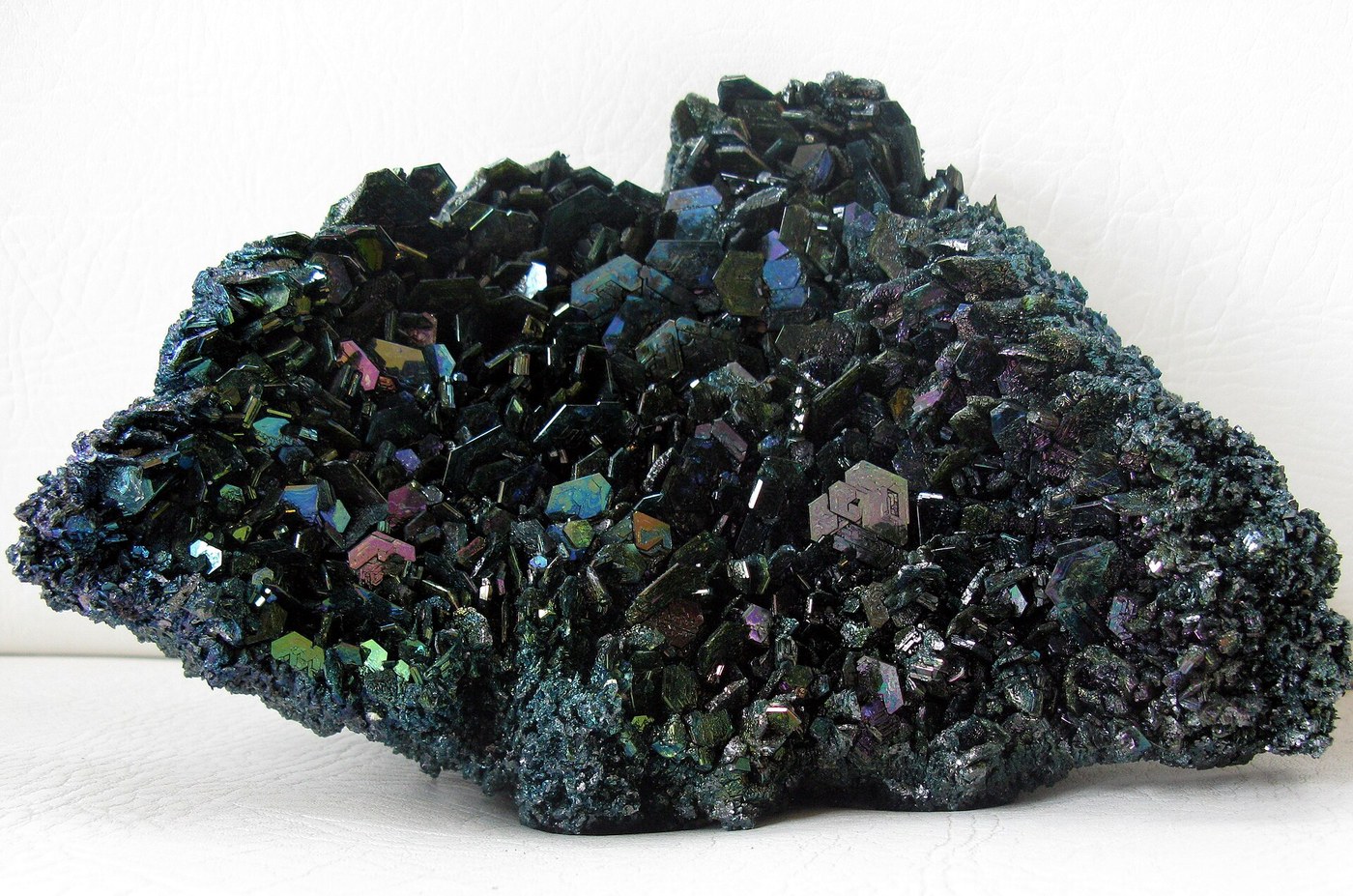


Carborundum — Silicon Carbide
For all of history there were two hard abrasives: natural corundum, and diamond. Both were dug out of the ground, both were scarce, and the price of grinding anything was set by geology.
Edward Acheson made a third one in a furnace. Sand and coke, packed round a carbon core, heated by an electric current until the mixture reacts — and what forms is silicon carbide, harder than corundum, second only to diamond, and made from two of the cheapest materials on Earth.
He thought he had made a compound of carbon and corundum and named it carborundum. He was wrong about the chemistry — it is SiC, silicon and carbon, no aluminium anywhere — and the wrong name stuck so thoroughly that it is still the trade name. US Patent 492,767, granted 28 February 1893.
Ìlànà
Understand the two real hazards before you start
Understand the two real hazards before you start
This process runs at electric-furnace temperatures and it liberates carbon monoxide. Work outdoors or under forced extraction, never in a closed shop. Full face shield and dry gloves for anything near the electrodes.
Read US 492,767 and note the title
Read US 492,767 and note the title
Acheson called it "Production of Artificial Crystalline Carbonaceous Materials". He believed he was making a carbon compound — the title records a genuine misunderstanding, preserved in law.
Weigh out silica sand and petroleum coke
Weigh out silica sand and petroleum coke
The charge is quartz sand and carbon. Roughly equal parts by weight is a working start; the reaction wants carbon in excess of the strict stoichiometry.
Àwọn ohun èlò fún ìgbésẹ̀ yìí:
 Iyanrìn Kuátsì2 kg
 Èédú epo-ilẹ̀2 kg
Add a little sawdust and salt to the mix
Add a little sawdust and salt to the mix
Sawdust burns out and leaves porosity so gas can escape; a little salt helps volatilise metallic impurities. Both are in the original practice and both matter.
Àwọn ohun èlò fún ìgbésẹ̀ yìí:
 Iyọ̀ tábìlì100 g
Mix the charge thoroughly and keep it dry
Mix the charge thoroughly and keep it dry
Blend until uniform. Damp charge turns to steam at temperature and can throw material out of the furnace violently.
Build a refractory trough with two electrodes
Build a refractory trough with two electrodes
Line a trough with firebrick and set a carbon electrode entering from each end. This is a resistance furnace, not an arc furnace — the charge itself is the heating element.
Àwọn ohun èlò fún ìgbésẹ̀ yìí:
 Bíríkì Tí Ń Kojú Iná20 ẹyọ
Lay a granular carbon core between the electrodes
Lay a granular carbon core between the electrodes
Run a spine of coarse graphite or coke from one electrode to the other. The core carries the current and becomes the hot zone — everything grows outward from it.
Pack the charge around the core
Pack the charge around the core
Heap the sand-and-coke mixture over and around the core, burying it completely. The outer charge insulates the reaction as well as feeding it.
Bring the current up gradually
Bring the current up gradually
Raise power slowly. The core resistance falls as it heats, so a fast ramp overshoots and can blow the charge apart.
Hold well above 1700 °C and vent the gas
Hold well above 1700 °C and vent the gas
The reaction needs roughly 1700-2500 °C. Blue flames playing over the heap are burning carbon monoxide — expected, and the reason for the ventilation rule.
Let the whole furnace cool before opening it
Let the whole furnace cool before opening it
Cool for many hours. Opening hot exposes incandescent material to air and destroys the crystal faces you are trying to grow.
Break out the ingot and read its layers
Break out the ingot and read its layers
You will find zones: unreacted charge outside, then a shell of crystals, then graphite at the core. The best silicon carbide sits in a band at a specific distance from the core.
Look at the crystals
Look at the crystals
Iridescent black or green plates and needles. The colour is impurity, not chemistry — pure silicon carbide is nearly colourless, and the green and black grades differ by trace nitrogen and aluminium.
Àwọn irinṣẹ́ tí a nílò:
 Dígí Ìgbéga
Test the hardness against corundum
Test the hardness against corundum
Try to scratch a corundum abrasive with your crystals and then the reverse. Silicon carbide wins — Mohs 9.5 against corundum's 9, and that half point was worth an industry.
Compendium — the wrong name for the right material
Compendium — the wrong name for the right material
The patent. Edward Goodrich Acheson was granted US 492,767, "Production of Artificial Crystalline Carbonaceous Materials", on 28 February 1893. Acheson had worked for Edison and was trying to make artificial diamonds by heating clay and coke. He got hard iridescent crystals instead, assumed they were a compound of carbon and corundum, and coined carborundum from those two words. The material is in fact silicon carbide, SiC — no aluminium in it at all. The name survived because the Carborundum Company made it a trademark, and a chemically wrong word became the standard trade name for a material now made by the megatonne.
The chemistry, correctly. SiO₂ + 3 C → SiC + 2 CO, at roughly 1700-2500 °C. The carbon monoxide is why ventilation is not optional, and why blue flames dance over an operating furnace. The Acheson process is a resistance furnace: current passes through a granular carbon core buried in the charge, and the core is the heating element. Because heat radiates outward from that core, the ingot forms in concentric zones — graphite nearest the core where SiC has decomposed again, the best crystals in a band further out, unreacted charge at the edge. Industrial practice recycles the outer material into the next run.
Why half a point on the Mohs scale mattered. Silicon carbide is about 9.5 where corundum is 9 and diamond is 10, but Mohs is a ranking, not a scale — the absolute gaps are enormous. Practically, SiC cuts materials corundum merely polishes, it can be made in quantity from sand and coke rather than mined, and its grain fractures to keep exposing fresh edges. Grinding wheels, cutting discs, wet-and-dry paper and lapping compounds all changed within a decade, which meant everything made by grinding got cheaper — including the precision machine parts that the next generation of industry depended on.
Where it went afterwards. Acheson's furnace also gave him artificial graphite, patented separately, when he noticed SiC decomposing near the core. Silicon carbide later turned out to be a wide-bandgap semiconductor: it holds up at voltages and temperatures that destroy silicon, and SiC power devices are now standard in electric-vehicle inverters and solar converters. A material invented as a substitute for diamond dust, named after a mineral it does not contain, ended up in the power electronics of the twenty-first century.
Àwọn ohun-èlò
4- 2 kgÀyè
- 2 kgÀyè
- 100 gÀyè
- 20 ẹyọÀyè
Àwọn irinṣẹ́ tó nílò
1- Àyè
Ìtọ́nisọ́nà yìí ń ṣe

Blueprint tó jọra
Àwọn blueprint wọ̀nyí pín ìmọ̀ — ọ̀nà, ohun-èlò tàbí ìlànà

CC0 Àgbègbè Gbogbogbò
Blueprint yìí ti jáde lábẹ́ CC0. O lè ṣe àdàkọ, yí padà, pín, àti lò láìsí ìyọ̀ǹda.
Ṣàtìlẹ́yìn Olùṣẹ́dá nípa rírà àwọn ọjà nipasẹ̀ Blueprint wọn Ẹ̀san Olùṣẹ́dá tí àwọn Olùtajà gbé kalẹ̀, tàbí ṣẹ̀dá àtúnṣe tuntun ti Blueprint yìí kí o sì fi sínú Blueprint rẹ gẹ́gẹ́ bí ìsopọ̀ láti pín owó-wíwọlé.