

Cash Register
James Ritty ran a saloon in Dayton and was losing money he could not account for. The problem was not arithmetic — it was that a transaction between a customer and an employee left no trace. Money went into a drawer and the only record was whatever the person at the drawer chose to remember.
The cash register does not count money. It creates evidence. Pressing a key rings a bell the customer hears, raises a flag the customer sees, and advances an internal tally the employee cannot reach. Recording the sale becomes a condition of opening the drawer, and the customer is enlisted as the auditor.
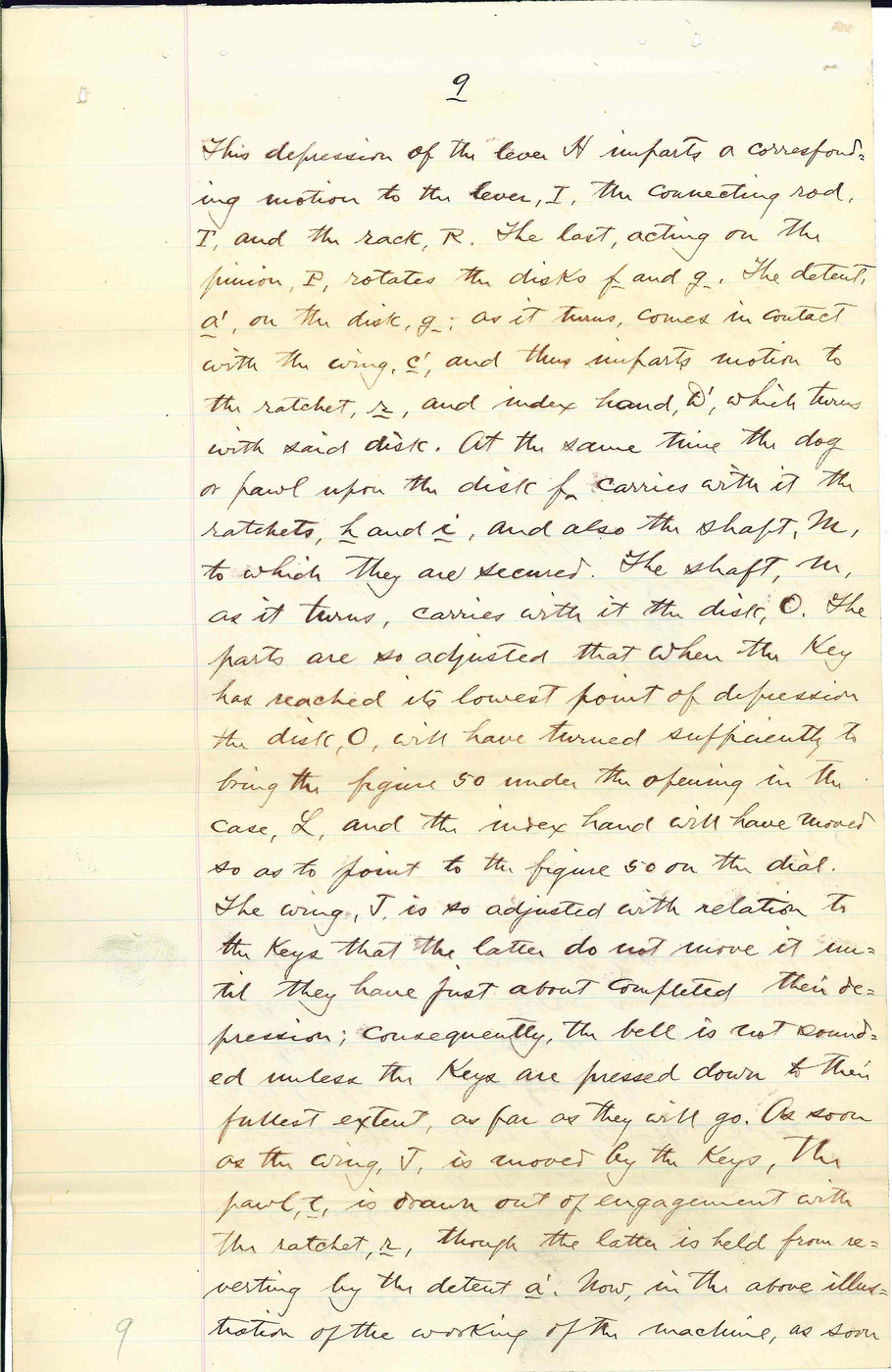
Ritty is said to have taken the idea from a mechanism counting propeller revolutions on a steamship. US Patent 221,360, granted 4 November 1879 to James Ritty and John Ritty of Dayton, Ohio — two brothers, not one inventor.
Ìlànà
Read US 221,360 and note both inventors
Read US 221,360 and note both inventors
The patent names James Ritty AND John Ritty. James is usually credited alone; his brother John is on the document.
State the problem as a trust problem, not a maths problem
State the problem as a trust problem, not a maths problem
Write down what an owner can verify at day's end without a register. Almost nothing — and that, not arithmetic, is what the machine addresses.
Build a single counting wheel first
Build a single counting wheel first
Make one disc with ten positions and a pawl that advances it by exactly one. Everything else is copies of this.
Àwọn ohun èlò fún ìgbésẹ̀ yìí:
 Pátákó Igi Líle1 ẹyọ
Àwọn irinṣẹ́ tí a nílò:
 Ayùn Ọwọ́
Fit a detent so it cannot rest between digits
Fit a detent so it cannot rest between digits
Add a spring-loaded pawl into notches. A wheel that stops half way is unreadable, and an ambiguous total is worse than no total.
Àwọn ohun èlò fún ìgbésẹ̀ yìí:
 Àkójọ Ìsúnkì Ìtẹ̀1 ẹyọ
Add a second wheel and a carry tooth
Add a second wheel and a carry tooth
Fit a single long tooth on the units wheel that engages the tens wheel once per revolution. That one tooth is the carry, mechanised.
Test the carry across 9 to 10 repeatedly
Test the carry across 9 to 10 repeatedly
Cycle the units wheel through zero fifty times. Carry is where every mechanical counter fails, and it fails intermittently — so test it a lot.
Handle the 99 to 100 double carry
Handle the 99 to 100 double carry
Two wheels must advance from one key press. Either allow enough travel for a cascade or fit a spring-loaded carry that stores and releases — this is the hardest mechanism in the build.
Give each key a lever of different throw
Give each key a lever of different throw
Make the amount key move the wheel a proportional number of steps. A five-cent key advances five; the key IS the number.
Àwọn ohun èlò fún ìgbésẹ̀ yìí:
 Ọ̀pá Róbótó Irin Rírọ̀1 ẹyọ
Add the pop-up indicator flags
Add the pop-up indicator flags
Link each key to a numbered flag that rises where the customer can see it. Ritty's first machine had no drawer and no receipt — the display was the audit.
Àwọn ohun èlò fún ìgbésẹ̀ yìí:
 Àkópọ̀ Bébà Líle Aláwọ̀2 ewé
Fit the bell
Fit the bell
Trip a striker on every registered sale. The sound tells everyone in the room that a transaction was recorded — a public, unfakeable signal.
Interlock the drawer to the mechanism
Interlock the drawer to the mechanism
Make the drawer release only when a key completes its stroke. This is the enforcement: no recording, no money.
Lock the running total away from the operator
Lock the running total away from the operator
Put the cumulative counter behind a locked cover the clerk cannot open. An adjustable total defeats the entire purpose.
Make it ratchet in one direction only
Make it ratchet in one direction only
The tally must not run backwards. A one-way pawl is what turns a counter into a record.
Run a hundred mock sales and reconcile
Run a hundred mock sales and reconcile
Ring up a known sequence, then compare the locked total against the cash. Any mismatch is a mechanism fault — find it before trusting the machine.
Compendium — a machine that manufactures evidence
Compendium — a machine that manufactures evidence
The patent. US 221,360, "Improvement in Cash Register and Indicator", granted 4 November 1879 to James Ritty and John Ritty of Dayton, Ohio. James ran a saloon and was losing takings to employee theft. The widely repeated account is that on a steamship voyage he saw a mechanism counting the revolutions of the propeller and realised the same idea could count sales. The brothers' first machine was nicknamed "Ritty's Incorruptible Cashier".
The first version had no drawer. It rang a bell, raised numbered flags the customer could read, and advanced a locked internal tally. Money still went into an ordinary till. The register did not physically guard the cash — it produced a record the clerk could not alter and a public signal the customer could not miss. Linking the drawer to the key stroke came later and is the enforcement half of the same idea. Framing it as a counting machine misses the point: it is an accountability device, and the customer is deliberately recruited as the witness.
The carry is the hard part. Any wheel-based counter is straightforward until a digit rolls past nine. Then one key press must advance two wheels, and at 999 it must advance four, all from a single finger's energy. Mechanical calculators solved this with cascading pawls or with spring-loaded stored carries released in sequence. It is the same problem Pascal and Leibniz faced two centuries earlier, and the reason mechanical adding machines stayed expensive and heavy right up to electronics.
What became of it. Ritty found running a saloon and a factory at once too much and sold the business in 1881. It was bought in 1884 by John H. Patterson, who renamed it the National Cash Register Company. NCR's real innovation was commercial — an aggressively trained direct sales force, sales quotas and territories — and its training methods shaped twentieth-century selling; Thomas J. Watson learned his trade there before leading IBM. The receipt-printing register followed, adding a copy for the customer, and the audit trail became something both parties held. Everything after that, up to the point-of-sale terminal on a modern counter, is the same idea with better storage.
Àwọn ohun-èlò
4- 1 ẹyọÀyè
- 1 ẹyọÀyè
- Àyè
- Àyè
Blueprint tó jọra
Àwọn blueprint wọ̀nyí pín ìmọ̀ — ọ̀nà, ohun-èlò tàbí ìlànà


CC0 Àgbègbè Gbogbogbò
Blueprint yìí ti jáde lábẹ́ CC0. O lè ṣe àdàkọ, yí padà, pín, àti lò láìsí ìyọ̀ǹda.
Ṣàtìlẹ́yìn Olùṣẹ́dá nípa rírà àwọn ọjà nipasẹ̀ Blueprint wọn Ẹ̀san Olùṣẹ́dá tí àwọn Olùtajà gbé kalẹ̀, tàbí ṣẹ̀dá àtúnṣe tuntun ti Blueprint yìí kí o sì fi sínú Blueprint rẹ gẹ́gẹ́ bí ìsopọ̀ láti pín owó-wíwọlé.