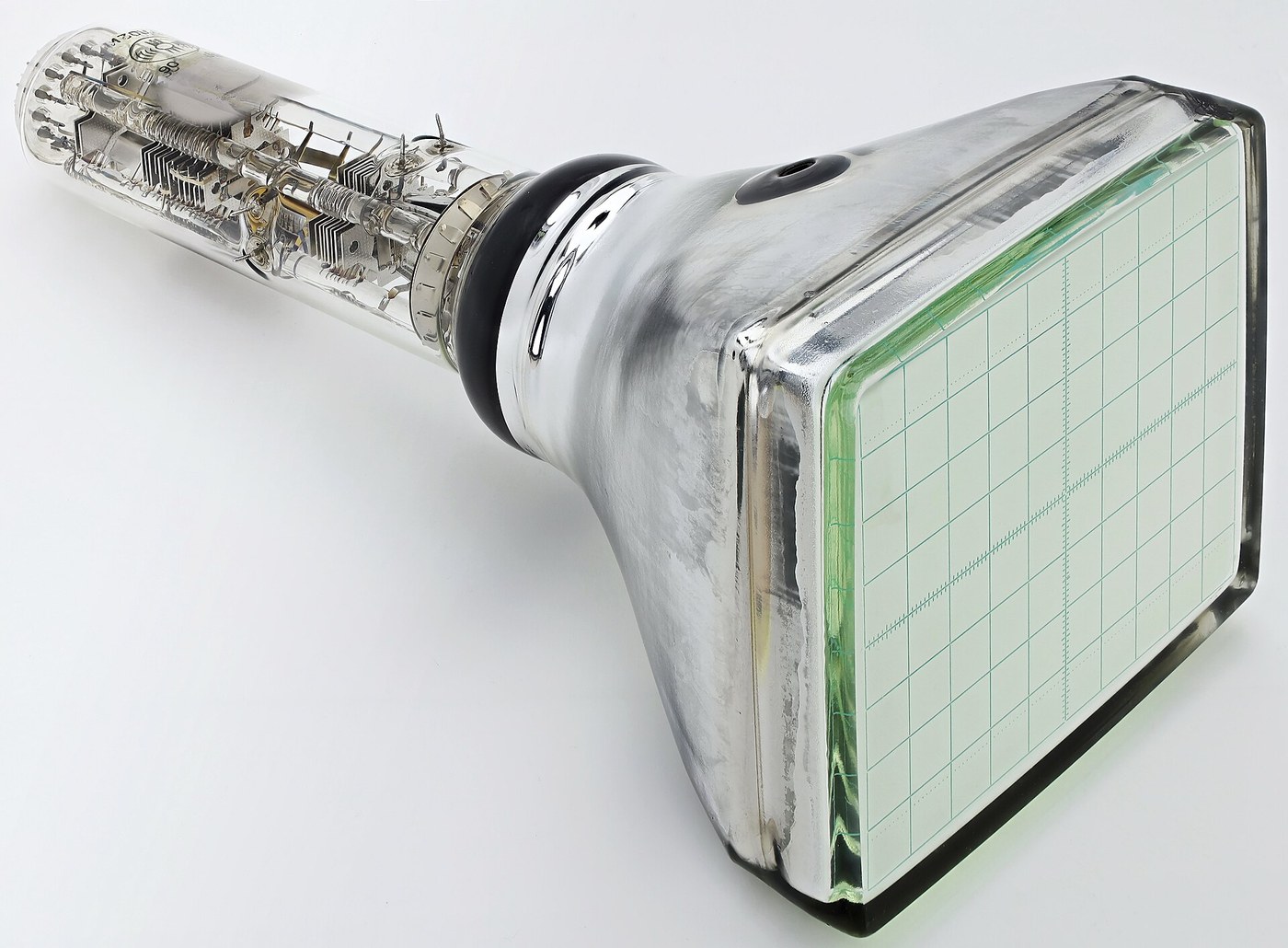

The Cathode-Ray Tube
Ìlànà
Read the two hazards, which are unrelated to each other
Read the two hazards, which are unrelated to each other
A CRT is dangerous in two independent ways and neither protects you from the other.
- Implosion. The envelope holds a hard vacuum against full atmospheric pressure. A break does not throw glass outward, it collapses inward and then sprays fragments in every direction. Wear a face shield whenever a tube is exposed, handle it by the body and never by the neck, and never scratch or knock the glass.
- High voltage. The anode runs at several kilovolts, and the tube’s own internal capacitance stores that charge for a long time after power is removed. Always short the anode connection to chassis with an insulated lead before touching anything.
- Work with one hand behind your back, and never alone.
The stored-charge hazard is the one that catches people, because the set is switched off and everything looks safe. The aquadag coating on the tube and its earthed counterpart form a capacitor of a few nanofarads at several kilovolts, which is a genuinely dangerous amount of energy.
If you cannot meet these conditions, follow this blueprint on paper or with a salvaged working tube in its original chassis. Every principle below can be demonstrated on an intact commercial tube without ever opening the envelope.Àwọn ohun èlò fún ìgbésẹ̀ yìí:
 Túùbù ìtànṣán cathode (tí a gbà là, kékeré)1 ẹyọ
 Okùn ìtúsílẹ̀ agbára gíga1 ẹyọ
Àwọn irinṣẹ́ tí a nílò:
 Ààbò Ojú Gbogbo
 Gílásì Ààbò Tí Ó Mọ́
 Ìwádìí osiloskopu onífólítì gíga
 Òṣùwọ̀n Oníṣirò Díjítà Ìpele Yàrá Ìwádìí
Make a beam and prove it is made of particles
Make a beam and prove it is made of particles
Establish what the beam actually is before steering it.
- Using a demonstration discharge tube, apply high voltage between cathode and anode and observe the glow.
- Place an object in the beam path and look for its shadow on the far wall.
- Bring a magnet near the tube and watch the beam bend.
- Note which way it bends relative to the field.
The sharp shadow proves the rays travel in straight lines; the magnetic deflection proves they are charged and moving; and the direction of the bend shows the charge is NEGATIVE. These three observations are exactly how the electron was identified, and you can reproduce all of them in an afternoon.
Historically this settled a genuine argument. Some physicists held that cathode rays were waves in the aether; the magnetic deflection is very hard to explain that way. J. J. Thomson went further in 1897 and measured the charge-to-mass ratio by balancing electric against magnetic deflection, finding a particle about two thousand times lighter than a hydrogen atom — the first subatomic particle anyone had found.Àwọn ohun èlò fún ìgbésẹ̀ yìí:
Túùbù ìtànṣán cathode (tí a gbà là, kékeré)1 ẹyọ Ìdìpọ̀ òòfà neodimium1 ìtò
Àwọn irinṣẹ́ tí a nílò:
 Orísun Iná Tábìlì Tí A Lè ṢàtúnṣeÌwádìí osiloskopu onífólítì gígaÒṣùwọ̀n Oníṣirò Díjítà Ìpele Yàrá ÌwádìíÀàbò Ojú GbogboGílásì Ààbò Tí Ó Mọ́
Focus the beam with an electrostatic lens
Focus the beam with an electrostatic lens
A beam that spreads is useless. Focusing it uses optics made of voltage.
- Identify the electrode structure in the tube neck: cathode, control grid, and two or more anodes at different potentials.
- Vary the first anode voltage and watch the spot size on the screen.
- Find the setting that gives the smallest, sharpest spot.
- Now vary the control grid voltage and watch the BRIGHTNESS instead.
The region between two electrodes at different potentials bends electron paths exactly as a glass lens bends light, and the focal length depends on the voltage ratio. Adjusting focus is therefore an electrical operation with no moving parts — which is why the focus control on an oscilloscope is just a potentiometer.
Note the clean separation of duties: the grid controls how MANY electrons pass, the anodes control where they CONVERGE. Brightness and focus are independent, which is what makes the tube usable.
Reverse-engineering note: television tubes generally use magnetic focus and deflection coils around the neck rather than internal plates, because magnetic deflection achieves much wider angles — necessary for a short tube with a big screen. Oscilloscopes use electrostatic plates because they respond far faster. Same tube, opposite choice, and the reason is entirely about what each instrument needs.Àwọn ohun èlò fún ìgbésẹ̀ yìí:
Túùbù ìtànṣán cathode (tí a gbà là, kékeré)1 ẹyọ Àkójọ Rẹsístà1 ohun èlò
 Potentiometer2 ẹyọ
Àwọn irinṣẹ́ tí a nílò:
Orísun Iná Tábìlì Tí A Lè ṢàtúnṣeÌwádìí osiloskopu onífólítì gígaÒṣùwọ̀n Oníṣirò Díjítà Ìpele Yàrá Ìwádìí ÒsílóskóòpùÀàbò Ojú GbogboGílásì Ààbò Tí Ó Mọ́
Deflect it in two axes and draw a Lissajous figure
Deflect it in two axes and draw a Lissajous figure
Two pairs of plates at right angles turn a spot into a display.
- Apply a slowly varying voltage to the horizontal plates and observe the spot sweep across.
- Apply a signal to the vertical plates and observe it move up and down.
- Now drive both from separate signal generators and vary their frequency ratio.
- Photograph the patterns at ratios of 1:1, 1:2 and 2:3.
Simple frequency ratios produce closed, stable figures; anything else produces a pattern that drifts and never closes. These are Lissajous figures, and before frequency counters existed they were the most precise way to compare two frequencies — you adjusted one until the figure stood still, and then you knew the ratio exactly.
This is a nice example of a measurement technique that vanished not because it was bad but because something cheaper arrived. A digital counter is more convenient; a Lissajous figure shows you phase as well as frequency, at a glance, with no numbers at all. Both are still true.Àwọn ohun èlò fún ìgbésẹ̀ yìí:
Àkójọ Rẹsístà1 ohun èlò Àkójọpọ̀ Capacitor1 ohun èlò
 Pátákó Aláwọ̀ / Pátákó Àpẹẹrẹ1 ẹyọ
 Okun ìsúdì 63/37 tí ó ní resini nínú1 reel
Àwọn irinṣẹ́ tí a nílò:
 Ẹ̀rọ Àmì
 Ẹ̀rọ Ìdá ÌgbìOrísun Iná Tábìlì Tí A Lè ṢàtúnṣeÒsílóskóòpùÌwádìí osiloskopu onífólítì gígaÒṣùwọ̀n Oníṣirò Díjítà Ìpele Yàrá ÌwádìíÀàbò Ojú GbogboGílásì Ààbò Tí Ó Mọ́
Add a timebase and make it an oscilloscope
Add a timebase and make it an oscilloscope
One specific horizontal waveform turns the tube into the most useful instrument in electronics.
- Build a sawtooth generator: a capacitor charged through a constant current and discharged abruptly.
- Drive the horizontal plates with it, so the spot sweeps steadily left to right and then flies back.
- Apply the signal under test to the vertical plates.
- Adjust the sawtooth frequency until the display stands still.
When the sweep period is an exact multiple of the signal period the trace repeats identically and appears frozen; otherwise it crawls across the screen. That is the whole idea — the horizontal axis has become TIME, and a voltage that varies too fast to imagine is now a stationary shape you can measure with a ruler.
Making the display stand still by hand is tiresome, and the fix is triggering: instead of running the sweep continuously, start it at the moment the input crosses a chosen level. Every sweep then begins at the same point on the waveform and the picture is stable regardless of frequency.
The flyback must be fast and blanked — the beam is switched off during the return, or you would see a bright line running backwards across every trace. That blanking pulse is why the control grid has its own connection, and it is the same mechanism television later used between lines and between frames.Àwọn ohun èlò fún ìgbésẹ̀ yìí:
Àkójọpọ̀ Capacitor1 ohun èlòÀkójọ Rẹsístà1 ohun èlò Onírúurú transistor1 ohun èlò
Àwọn irinṣẹ́ tí a nílò:
ÒsílóskóòpùẸ̀rọ ÀmìOrísun Iná Tábìlì Tí A Lè ṢàtúnṣeÒṣùwọ̀n Oníṣirò Díjítà Ìpele Yàrá Ìwádìí Ibùdó ÌtannáÌwádìí osiloskopu onífólítì gígaÀàbò Ojú GbogboGílásì Ààbò Tí Ó Mọ́
Àwọn ohun-èlò
9- Àyè
- Àyè
- Àyè
- Àyè
- 1 ohun èlòÀyè
- Àyè
- Àyè
- 1 ohun èlòÀyè
Blueprint tó jọra
Àwọn blueprint wọ̀nyí pín ìmọ̀ — ọ̀nà, ohun-èlò tàbí ìlànà


CC0 Àgbègbè Gbogbogbò
Blueprint yìí ti jáde lábẹ́ CC0. O lè ṣe àdàkọ, yí padà, pín, àti lò láìsí ìyọ̀ǹda.
Ṣàtìlẹ́yìn Olùṣẹ́dá nípa rírà àwọn ọjà nipasẹ̀ Blueprint wọn Ẹ̀san Olùṣẹ́dá tí àwọn Olùtajà gbé kalẹ̀, tàbí ṣẹ̀dá àtúnṣe tuntun ti Blueprint yìí kí o sì fi sínú Blueprint rẹ gẹ́gẹ́ bí ìsopọ̀ láti pín owó-wíwọlé.