IṢẸ́ ỌNÀ
ẸWÀ ÀTI ÌLERA
IṢẸ́ ỌWỌ́
ÀṢÀ ÀTI ÌTÀN
ÌṢERÉ
ÀYÍKÁ
OÚNJẸ ÀTI OHUN MÍMU
REVERSE ENGINEERING
SÁYẸ́ǸSÌ
ERÉ ÌDÁRAYÁ
ÌMỌ̀-Ẹ̀RỌ
ÀWỌN OHUN WÍWỌ̀
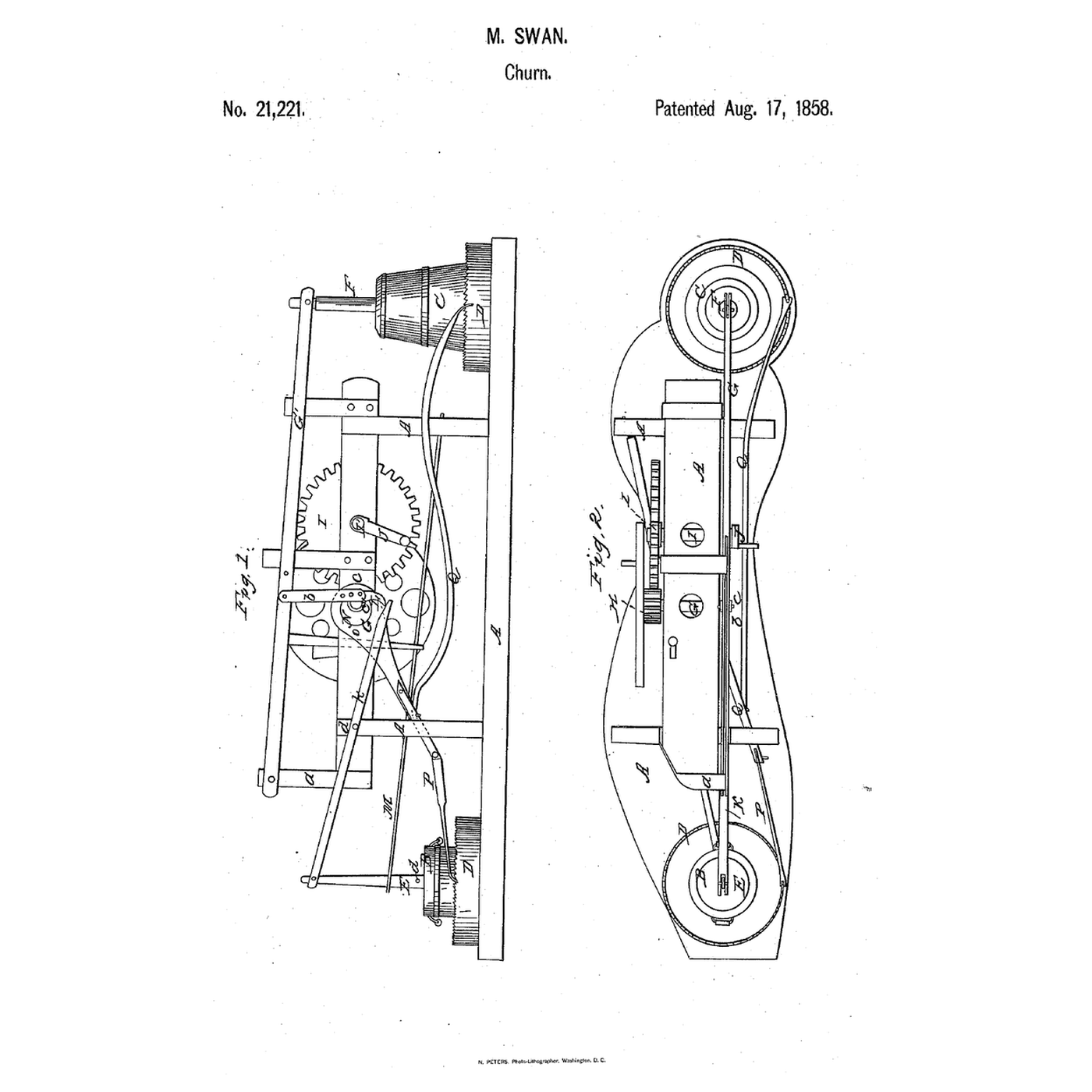


Churn-and-Washtub Mechanism: One Crank Works a Dasher and a Plunger and Turns Both Tubs
Moses Swan of Potter Hill, New York, received US 21,221, dated 17 August 1858, for one mechanism that works a churn and a washtub together: a crank and spur gears turn a shaft whose eccentric lifts the churn's dasher by a lever, whose cam lifts the washtub's plunger against a flat spring, and whose second eccentric drives pawls that turn both tubs a little at each stroke, so one person does both jobs.
This rung builds the base and posts in pine and prints the tubs, ratchet rims and gearing at tabletop scale.
Ilọsíwájú
About 9 hours, plus printing
Ìlànà
1
1
One crank, three motions
One crank, three motions
Ń ṣí ìwé Jupyter…
2
2
Lever-worked dashers, before it
Lever-worked dashers, before it
There a lever was swung by hand; Swan's is worked by an eccentric, which also works a washtub beside it.
3
3
Read US 21,221
Read US 21,221
"It is advantageous to rotate the tubs, for by so doing if churning is being performed, the whole body of the cream will be more perfectly subjected to the action of the dasher, and if washing is being performed, the plunger will be brought in contact with every portion of the clothes."
4
4
Print the parts
Print the parts
Print two ratchet rims (/uploads/blueprints/churn-and-washtub-mechanism-ratchet-rim.stl), the churn tub (/uploads/blueprints/churn-and-washtub-mechanism-churn-tub.stl), the washtub (/uploads/blueprints/churn-and-washtub-mechanism-washtub.stl), pinion H (/uploads/blueprints/churn-and-washtub-mechanism-pinion-h.stl), wheel I (/uploads/blueprints/churn-and-washtub-mechanism-wheel-i.stl), the eccentric c (/uploads/blueprints/churn-and-washtub-mechanism-eccentric-c.stl), the cam L (/uploads/blueprints/churn-and-washtub-mechanism-cam-l.stl), the eccentric N (/uploads/blueprints/churn-and-washtub-mechanism-eccentric-n.stl), the strap O (/uploads/blueprints/churn-and-washtub-mechanism-strap-o.stl), two pawls (/uploads/blueprints/churn-and-washtub-mechanism-pawl.stl), the link b (/uploads/blueprints/churn-and-washtub-mechanism-link-b.stl), the dash (/uploads/blueprints/churn-and-washtub-mechanism-dash.stl), the dasher head (/uploads/blueprints/churn-and-washtub-mechanism-dasher-head.stl), the plunger (/uploads/blueprints/churn-and-washtub-mechanism-plunger.stl) and the crank (/uploads/blueprints/churn-and-washtub-mechanism-crank.stl). The rims need a 220 mm print bed. Print in PETG at 0.2 mm layers, 30 % infill, 4 walls; wash before first use.
Àwọn ohun èlò fún ìgbésẹ̀ yìí:
 Okùn PETG1 ẹyọ
Àwọn irinṣẹ́ tí a nílò:
 Ẹ̀rọ ìtẹ̀ 3D oníwàyà (FDM)
5
5
Base and posts
Base and posts
Cut a pine base 560 by 240 mm. Glue and screw two posts 40 by 18 mm and 180 mm tall in its middle, 100 mm apart inside, with a block 30 mm thick on the front post's inner face; drill 10.5 mm holes through both posts 102 mm above the base for shaft G, and through the front post and its block 150 mm up for shaft I'. Stand an 18 mm square standard a 254 mm tall 55 mm left of the middle, a post d 122 mm tall behind it, and a post 232 mm tall at the back left for the spring. Screw an M6 screw up through the base 170 mm each side of the middle as the rims' pins.
Àwọn ohun èlò fún ìgbésẹ̀ yìí:
 Pákó igi pine1 ẹyọ
 Ìdìpọ̀ Igi1 ẹyọ
 Ìṣó igi1 ẹyọ
 Skurú ẹ̀rọ1 ẹyọ
Àwọn irinṣẹ́ tí a nílò:
 Ayùn Ọwọ́
 Ẹ̀rọ Ìlùkòkò Aláìlókùn
 Bébà Ìfá
 Ìṣù àwọn ohun ìyí skurú
 Okùn Ìdíwọ̀n
6
6
Shafts, gears and tubs
Shafts, gears and tubs
Drop a ratchet rim on each pin and stand the washtub on the left rim, the churn tub on the right. Cut 10 mm dowels 202 mm for shaft G and 148 mm for shaft I'. Thread G through the posts with pinion H, the eccentric c behind it, the cam L further back and the eccentric N on its front end; thread I' through the front post with wheel I on its inner end meshing H and the crank on its front end. Fix each with an M3 screw drilled through the dowel.
Àwọn ohun èlò fún ìgbésẹ̀ yìí:
 Àwọn dowel igi líle1 ẹyọSkurú ẹ̀rọ1 ẹyọ
Àwọn irinṣẹ́ tí a nílò:
Ayùn Ọwọ́Ẹ̀rọ Ìlùkòkò AláìlókùnÌṣù àwọn ohun ìyí skurú7
7
Dasher, plunger and pawls
Dasher, plunger and pawls
Pivot an 18 mm square pine lever G1, 243 mm long, on the standard a with an M6 screw, the link b from the eccentric's pin to its middle hole, and pin the dasher's head into its fork over the churn: a 10 mm dowel 155 mm long with the dash on its foot. Pivot the lever K on post d, its short end under the cam, and hang the plunger beside its long end on a 10 mm dowel 153 mm long, with an M3 screw through the dowel's top as the pin d. Screw a spring steel strip to the back left post, reaching over the pin. Hang the strap O on the eccentric N and pin both pawls to its foot with one M6 screw, resting on the rims' teeth at their front points.
Àwọn ohun èlò fún ìgbésẹ̀ yìí:
Pákó igi pine1 ẹyọÀwọn dowel igi líle1 ẹyọSkurú ẹ̀rọ1 ẹyọ Ẹ̀kù Ìdìmú Onínáílọ́ọ̀nù1 ẹyọ
 Wáṣà Pẹrẹsẹ1 ẹyọ
 Ọ̀pá irin orísun1 ẹyọ
Àwọn irinṣẹ́ tí a nílò:
Ayùn Ọwọ́Ẹ̀rọ Ìlùkòkò AláìlókùnÌṣù àwọn ohun ìyí skurú8
8
The build in 3D
The build in 3D
FreeCAD model of this build: the pine base and posts, the washtub and churn tub on their ratchet rims, the crank and spur gears, shaft G with its eccentric, cam and second eccentric, the lever G1 and dasher, the lever K, plunger and flat spring, and the strap and pawls on the rims.
9
9
Churn, or wash
Churn, or wash
Pour 1.2 litres of heavy cream at about 15 °C, checked with the thermometer, into the churn tub, and warm soapy water and a cloth into the washtub. Turn the crank steadily and time it with the stopwatch: the dasher and plunger rise and fall and both tubs creep round. When the butter comes, lift the dasher out, pour off the buttermilk, wash the butter in cold water until it runs clear, work in a pinch of salt and weigh it.
Àwọn ohun èlò fún ìgbésẹ̀ yìí:
 Ọ̀rá wàrà tó nípọn1.2 l
 Iyọ̀ Òkun Rúkèrúdò1 ẹyọ
 Omi1 ẹyọ
 Ọṣẹ pẹlẹbẹ1 ẹyọ
Àwọn irinṣẹ́ tí a nílò:
 Ẹ̀rọ ìwọ̀n ooru oníhun tí ó dúró sí inú
 Aago Ìdúró
 Òṣùwọ̀n Díjítà Ilé Ìdáná
 Àwo ìdàpọ̀ ńlá ti irin tí kò ń yá
10
10
Troubleshooting
Troubleshooting
Churn-and-washtub troubleshooting.
Flow
Loading...
11
11
History and honest limits
History and honest limits
**Moses Swan** of Potter Hill, Rensselaer County, New York, US 21,221, 17 August 1858, "Operating Churns, &c." He combined the two tubs so that neither two systems of gearing nor two persons are needed, and claimed the arrangement of mechanism that gives the plunger and dasher their up and down motion and both tubs their rotary motion. Our crown ratchets, sizes, pine frame and printed tubs are ours. FDM prints hold food in their layer lines, so wash well and replace when worn.
Àwọn ohun-èlò
13- 1 ẹyọÀyè
- 1 ẹyọÀyè
- 1 ẹyọÀyè
- 1 ẹyọÀyè
- 3 ẹyọÀyè
- 1 ẹyọÀyè
- Àyè
- 1 ẹyọÀyè
- 1 ẹyọÀyè
- 1.2 lÀyè
- 1 ẹyọÀyè
- 1 ẹyọÀyè
- 1 ẹyọÀyè
Àwọn irinṣẹ́ tó nílò
10- Àyè
- 1 vendor sell this, none ship to you yetÀyè
- Àyè
- 1 vendor sell this, none ship to you yetÀyè
- Àyè
Àwọn fáìlì àpẹrẹ
1Ìtọ́nisọ́nà yìí ń ṣe

Blueprint tó jọra
Àwọn blueprint wọ̀nyí pín ìmọ̀ — ọ̀nà, ohun-èlò tàbí ìlànà



CC0 Àgbègbè Gbogbogbò
Blueprint yìí ti jáde lábẹ́ CC0. O lè ṣe àdàkọ, yí padà, pín, àti lò láìsí ìyọ̀ǹda.
Ṣàtìlẹ́yìn Olùṣẹ́dá nípa rírà àwọn ọjà nipasẹ̀ Blueprint wọn Ẹ̀san Olùṣẹ́dá tí àwọn Olùtajà gbé kalẹ̀, tàbí ṣẹ̀dá àtúnṣe tuntun ti Blueprint yìí kí o sì fi sínú Blueprint rẹ gẹ́gẹ́ bí ìsopọ̀ láti pín owó-wíwọlé.