IṢẸ́ ỌNÀ
ẸWÀ ÀTI ÌLERA
IṢẸ́ ỌWỌ́
ÀṢÀ ÀTI ÌTÀN
ÌṢERÉ
ÀYÍKÁ
OÚNJẸ ÀTI OHUN MÍMU
REVERSE ENGINEERING
SÁYẸ́ǸSÌ
ERÉ ÌDÁRAYÁ
ÌMỌ̀-Ẹ̀RỌ
ÀWỌN OHUN WÍWỌ̀
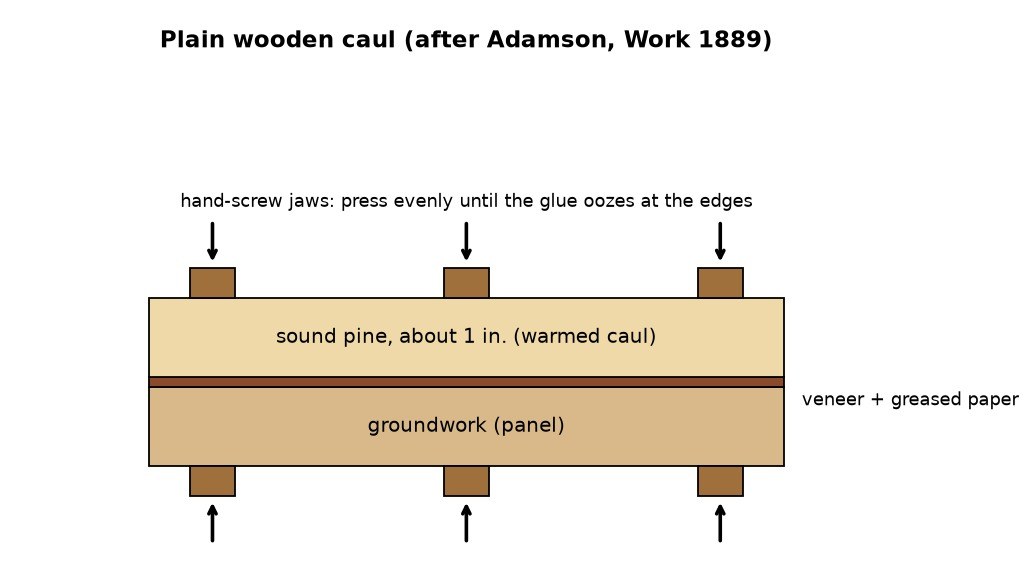


Clamping Caul: Plain Pine Board Shaped to the Work (Adamson, 1889)
A caul is a board laid over glued work so the clamps press evenly over the whole surface instead of only under their jaws. D. Adamson (1889) uses a piece of good sound pine about 1 in. thick, shaped exactly to fit the surface: flat for a flat panel, convex for a concave one.
For veneering he warms it first. Wood can warp or twist, and burns if overheated; a zinc-faced caul (separate blueprint) lasts longer.
Source: D. Adamson, "Practical Veneering", Work, 5 October 1889, pp. 453-455.
Olùbẹ̀rẹ̀
Unknown
Ìlànà
1
1
Read Adamson
Read Adamson
"The caul itself is either wood or metal, either of which must be shaped exactly to fit the surface to be veneered. Thus for a flat panel it must be flat, while for a concave surface it must be convex, and so on. ... For the material nothing is more suitable than good sound pine."
2
2
Cut the board
Cut the board
Cut a piece of good sound pine about 1 in. thick, large enough to cover the whole surface to be pressed. Thicker is no better, only waste. The length and width are set by the work (not given).
Àwọn ohun èlò fún ìgbésẹ̀ yìí:
 Pákó igi pine1 about 1 in. thick
Àwọn irinṣẹ́ tí a nílò:
 Ayùn gbẹ́nàgbẹ́nà
 Ìwọ̀n tí a kò mọ̀
3
3
Shape it to the work
Shape it to the work
Plane the face that meets the work to fit it exactly: flat for a flat panel, convex for a concave surface. A caul that is hollow in the middle presses only at the edges. How it is trued is not given (ours: plane, checked with a straightedge).
Àwọn irinṣẹ́ tí a nílò:
 Ohun èlò ìfárí igi (pìlánì)
 Etí tààrà
4
4
Use it
Use it
Warm the caul (not so hot that it cannot be comfortably handled), lay it over the veneer with a sheet of slightly greased paper between, and screw down the hand-screws evenly until the glue oozes out at the edges. Leave it until the caul is cold, an hour or two.
Àwọn irinṣẹ́ tí a nílò:
 Àwọn clamp
Àwọn ohun-èlò
1- 1 about 1 in. thickÀyè
Àwọn irinṣẹ́ tó nílò
5- Àyè
- Àyè
Ìtọ́nisọ́nà yìí ń ṣe
CC0 Àgbègbè Gbogbogbò
Blueprint yìí ti jáde lábẹ́ CC0. O lè ṣe àdàkọ, yí padà, pín, àti lò láìsí ìyọ̀ǹda.
Ṣàtìlẹ́yìn Olùṣẹ́dá nípa rírà àwọn ọjà nipasẹ̀ Blueprint wọn Ẹ̀san Olùṣẹ́dá tí àwọn Olùtajà gbé kalẹ̀, tàbí ṣẹ̀dá àtúnṣe tuntun ti Blueprint yìí kí o sì fi sínú Blueprint rẹ gẹ́gẹ́ bí ìsopọ̀ láti pín owó-wíwọlé.