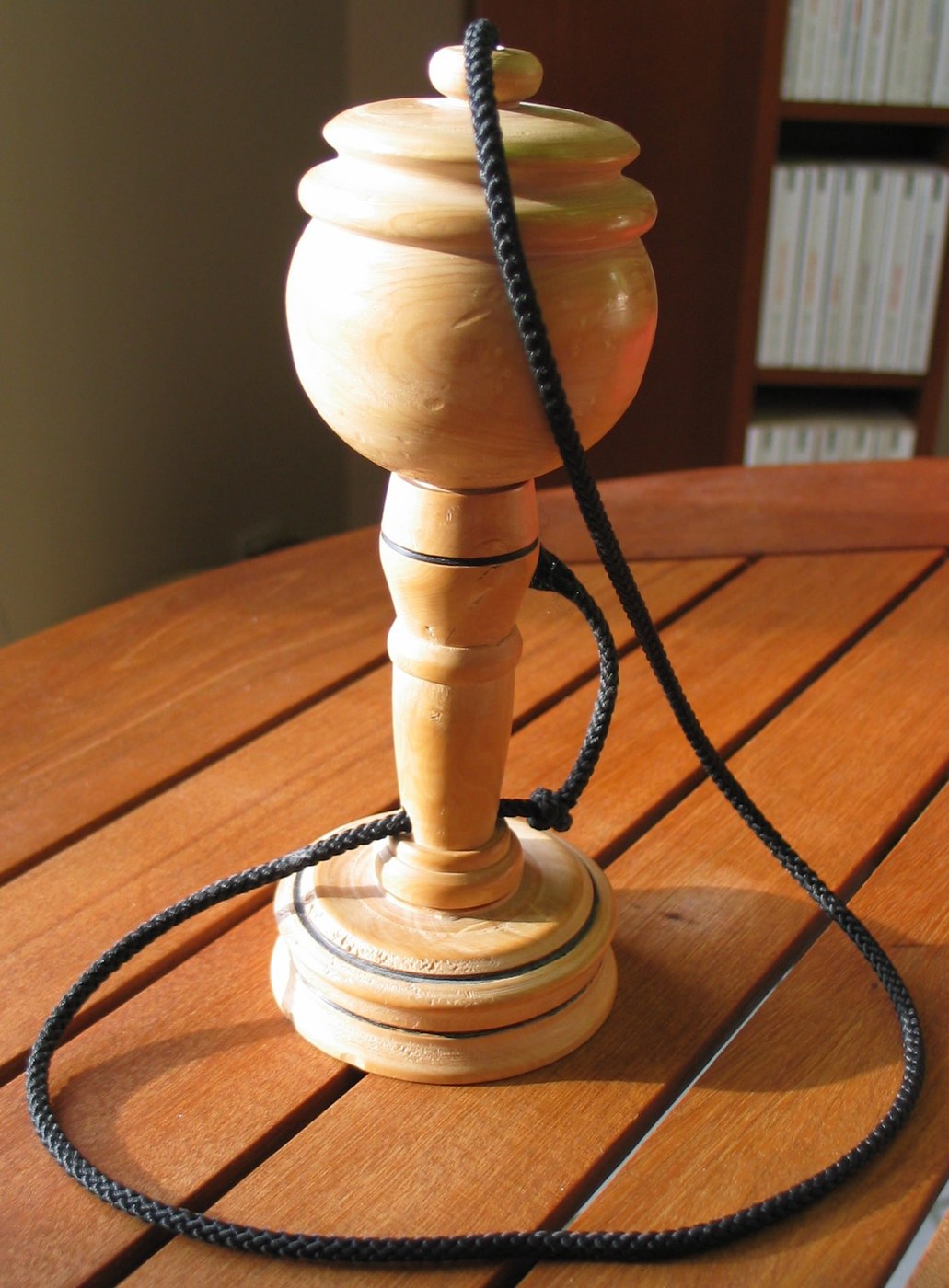


Cup-and-Ball
A ball on a string, a cup on a stick, and a skill that takes about an hour to acquire and a lifetime to lose. The cup-and-ball is one of the most widely distributed toys in the world, and the French version — the bilboquet — was played by kings.
The physics is a pendulum problem the player solves with their body. The ball swings on a fixed string length, so its period is set before you start; you cannot rush it. What you control is the launch and the catch — and the catch is done by dropping the cup away as the ball arrives, so it settles rather than bounces out.
Turned from one piece if you have a lathe, carved from two if you do not. The proportions matter more than the finish.
Ìlànà
Select a close-grained hardwood
Select a close-grained hardwood
Take a blank 50 x 50 x 200 mm in beech, maple or fruitwood. The cup rim ends up thin, and open-grained wood splits there.
Àwọn ohun èlò fún ìgbésẹ̀ yìí:
 Pátákó Igi Líle1 ẹyọ
Turn the handle first
Turn the handle first
Turn a handle about 120 mm long, sized to close comfortably in the hand. The handle is what aims the toy — too fat and the wrist cannot flick, too thin and it twists.
Turn the cup at one end
Turn the cup at one end
Turn a cup about 45 mm across the mouth and hollow it 25 mm deep. Deeper than a third of the diameter and the ball is trapped rather than caught; shallower and it bounces straight out.
Keep the rim thin but not sharp
Keep the rim thin but not sharp
Take the rim down to about 3 mm and round it. A thick rim deflects an almost-good throw; a knife edge splinters the first time it is dropped.
Shape a spike at the other end
Shape a spike at the other end
Turn the opposite end to a blunt point about 8 mm across at the tip. This is the harder target: the ball is spiked on it through a drilled hole rather than caught in a cup.
Blunt the spike deliberately
Blunt the spike deliberately
Round the point so it cannot puncture. This toy is swung near the face — a needle-sharp spike is the one genuinely dangerous thing you could put on it.
Àwọn irinṣẹ́ tí a nílò:
 Bébà Ìfá
Turn the ball
Turn the ball
Turn a ball 38 mm across, comfortably smaller than the cup mouth. A ball that only just fits turns every near miss into a rejection.
Drill the ball for the spike
Drill the ball for the spike
Drill a hole into the ball slightly larger than your spike tip and 15 mm deep. Drill it before the string hole so you can hold the ball securely.
Drill the string hole opposite
Drill the string hole opposite
Drill a fine hole on the far side of the ball from the spike hole. Anywhere else and the ball hangs at an angle and never presents the hole to the point.
Set the string length by measurement
Set the string length by measurement
Tie a cord so the ball hangs level with the bottom of the cup when the handle is held upright — typically 200-250 mm. Too long and you cannot control the swing; too short and there is no room to build momentum.
Àwọn ohun èlò fún ìgbésẹ̀ yìí:
 Òwú Ìrán1 mítà
Test the swing period
Test the swing period
Let the ball hang and swing gently, and time ten swings. That period is fixed by the string length alone and it sets the rhythm you have to play at — the toy is a pendulum with a target on it.
Àwọn irinṣẹ́ tí a nílò:
 Aago Ìdúró
Learn the catch — drop the cup
Learn the catch — drop the cup
Swing the ball up and, as it reaches the top of its arc, lower the cup slightly to meet it. Catching by lifting the cup is what bounces the ball out; dropping the cup away absorbs the impact and the ball stays in.
Then attempt the spike
Then attempt the spike
Now swing so the drilled hole faces down as the ball peaks, and bring the point up into it. Far harder, because it needs the ball's rotation as well as its position.
Adjust the string and compare
Adjust the string and compare
Shorten the string by 50 mm and try again. Faster swing, less margin, more difficult. Every cup-and-ball tradition has settled on its own length, and now you know why they differ.
History & Context
History & Context
A toy of the French court. The cup-and-ball was widely popular in France in the sixteenth and seventeenth centuries under the name bilboquet, played by nobles as well as everyone else, and King Henry III was among its enthusiastic players. The name is usually explained as bille, ball, plus bocquet, a small point or peg — and the two halves of the name are the two halves of the toy: the cup and the spike.
Everywhere, independently. Cup-and-ball toys are found across Europe, the Americas and Asia, and it is not a case of a single invention spreading. A ball on a string and something to catch it with is an idea that arrives wherever there is wood and cord. What differs is the proportions and which targets are counted.
The Japanese line. Records indicate the bilboquet reached Japan around 1777-78, in the middle of the Edo period. It stayed a simple cup-and-ball for well over a century. Then in 1919 Hamatsugu Ekusa, in the Kure area of Hiroshima, grafted two cups onto one crosspiece and revised the handle, giving the object its cross shape and a third cup in the base. That is the kendama, and it is a documented modern redesign of an imported toy rather than an ancient Japanese tradition — a distinction often lost.
Why it is a good measuring toy. The string length fixes the pendulum period, so the player cannot change the timing, only their own movement within it. That makes it an unusually clean example of a skill that is entirely about synchronising to an external rhythm — which is why it keeps turning up in studies of motor learning, and why the difficulty scales so precisely with a few centimetres of cord.
Ìtọ́nisọ́nà yìí ń ṣe
Blueprint tó jọra
Àwọn blueprint wọ̀nyí pín ìmọ̀ — ọ̀nà, ohun-èlò tàbí ìlànà
CC0 Àgbègbè Gbogbogbò
Blueprint yìí ti jáde lábẹ́ CC0. O lè ṣe àdàkọ, yí padà, pín, àti lò láìsí ìyọ̀ǹda.
Ṣàtìlẹ́yìn Olùṣẹ́dá nípa rírà àwọn ọjà nipasẹ̀ Blueprint wọn Ẹ̀san Olùṣẹ́dá tí àwọn Olùtajà gbé kalẹ̀, tàbí ṣẹ̀dá àtúnṣe tuntun ti Blueprint yìí kí o sì fi sínú Blueprint rẹ gẹ́gẹ́ bí ìsopọ̀ láti pín owó-wíwọlé.