IṢẸ́ ỌNÀ
ẸWÀ ÀTI ÌLERA
IṢẸ́ ỌWỌ́
ÀṢÀ ÀTI ÌTÀN
ÌṢERÉ
ÀYÍKÁ
OÚNJẸ ÀTI OHUN MÍMU
REVERSE ENGINEERING
SÁYẸ́ǸSÌ
ERÉ ÌDÁRAYÁ
ÌMỌ̀-Ẹ̀RỌ
ÀWỌN OHUN WÍWỌ̀
Youblob · CC0


Telephoto Lens
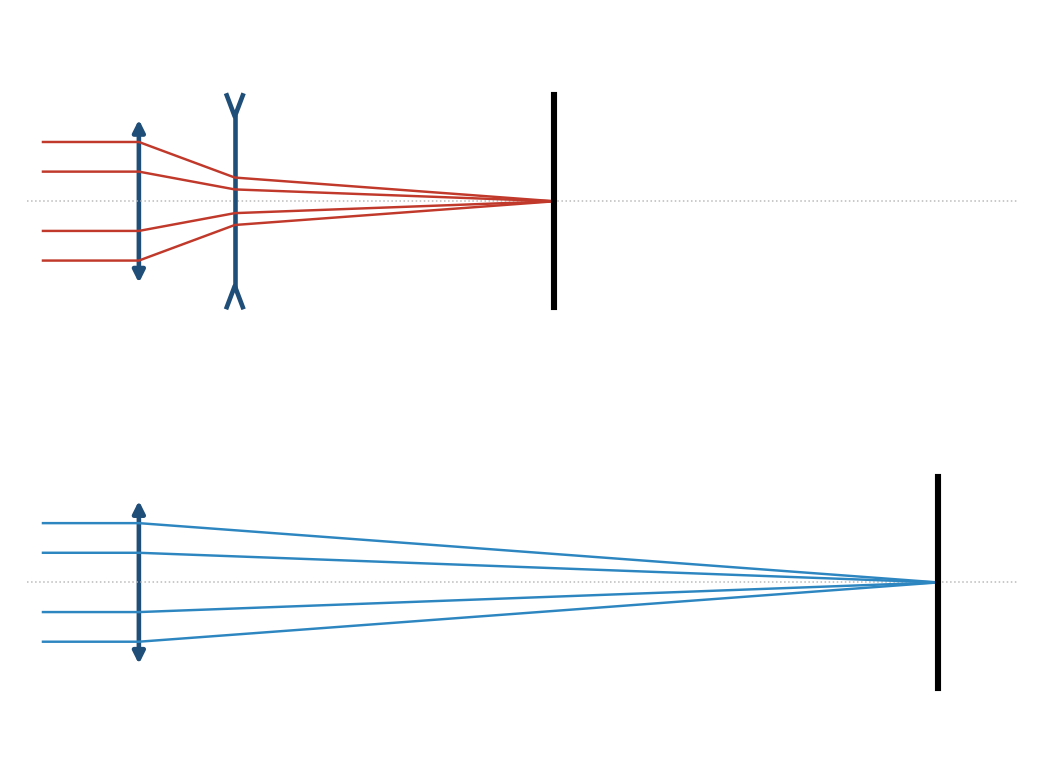
To photograph a distant subject large, you need a long focal length - and a long lens means a long camera. In 1891 Thomas Rudolphus Dallmeyer in London, and Adolf Miethe in Germany, independently put a negative lens behind a positive one. The pair acts like a single lens of much longer focal length, yet it is physically shorter than that focal length. That is what 'telephoto' means, and nearly every long camera lens since uses it.
**No patent number is cited here**: Dallmeyer patented it in Britain, and no US patent for his design was verified, so none is claimed.
**You build one on an optical bench**, measure its focal length from the size of a distant image, and let a ray-trace notebook redesign it.
Olùbẹ̀rẹ̀
90 minutes
Ìlànà
1
1
Know your lenses
Know your lenses
Focus a distant window onto paper with each convex lens; the lens-to-paper distance is its focal length. Pick one about 100 mm. Take a concave lens about half that (its label gives it; it will not focus alone).
Àwọn ohun èlò fún ìgbésẹ̀ yìí:
 Àkójọ ẹ̀rọ ìgbéhìn tí ó gbò1 ìtò
 Lẹ́ǹsì tí ó gbẹ̀gbẹ́1 ẹyọ
Àwọn irinṣẹ́ tí a nílò:
 Ìdíwọ̀n
2
2
Set up the bench
Set up the bench
Mount the convex lens in a holder at one end of the bench, pointing out of a window at something far away. Tape tracing paper to a holder as the screen.
Àwọn ohun èlò fún ìgbésẹ̀ yìí:
 Yíyíká bébà ìtọpa àwòṣe1 ewé
 Tépù ìbòmọ́lẹ̀1 ìyípo
Àwọn irinṣẹ́ tí a nílò:
 Tábìlì ìmọ̀ ìmọ́lẹ̀ àti ojú irin
 Ìṣètò ìdìmú lẹ́ńsì
3
3
Image with one lens
Image with one lens
Slide the screen until the far scene is sharp. Measure the height of one chosen feature on the screen - a window, a chimney.
Àwọn irinṣẹ́ tí a nílò:
Ìdíwọ̀n4
4
Add the negative lens
Add the negative lens
Put the concave lens 60 mm behind the convex one. The image is now far behind; move the screen back until it is sharp again and measure the same feature. Try 55 and 65 mm spacing too.
Àwọn irinṣẹ́ tí a nílò:
 Okùn Ìdíwọ̀n
5
5
Design it on paper
Design it on paper
Ń ṣí ìwé Jupyter…
6
6
History & Context
History & Context
**What the 1891 designs did:** a positive front group and a negative rear group, spaced so the system focal length exceeds its length. **Modern build (derived):** two stock lenses on a bench.
Early telephoto attachments screwed behind ordinary lenses; modern long lenses build the idea in. Its limits: spacing is critical, the negative group adds distortion (pincushion), and the image is dimmer at the same aperture diameter because the focal length grew.
Àwọn ohun-èlò
4- Àyè
- 1 ẹyọÀyè
- Àyè
- 1 ìyípoÀyè
Àwọn irinṣẹ́ tó nílò
4- Àyè
- 1 vendor sell this, none ship to you yetÀyè
Blueprint tó jọra
Àwọn blueprint wọ̀nyí pín ìmọ̀ — ọ̀nà, ohun-èlò tàbí ìlànà
CC0 Àgbègbè Gbogbogbò
Blueprint yìí ti jáde lábẹ́ CC0. O lè ṣe àdàkọ, yí padà, pín, àti lò láìsí ìyọ̀ǹda.
Ṣàtìlẹ́yìn Olùṣẹ́dá nípa rírà àwọn ọjà nipasẹ̀ Blueprint wọn Ẹ̀san Olùṣẹ́dá tí àwọn Olùtajà gbé kalẹ̀, tàbí ṣẹ̀dá àtúnṣe tuntun ti Blueprint yìí kí o sì fi sínú Blueprint rẹ gẹ́gẹ́ bí ìsopọ̀ láti pín owó-wíwọlé.