IṢẸ́ ỌNÀ
ẸWÀ ÀTI ÌLERA
IṢẸ́ ỌWỌ́
ÀṢÀ ÀTI ÌTÀN
ÌṢERÉ
ÀYÍKÁ
OÚNJẸ ÀTI OHUN MÍMU
REVERSE ENGINEERING
SÁYẸ́ǸSÌ
ERÉ ÌDÁRAYÁ
ÌMỌ̀-Ẹ̀RỌ
ÀWỌN OHUN WÍWỌ̀


Double-Swing Churn: Swing the Platform, the Toothed Pieces Work Both Dashers
Working a dash churn means lifting the dasher, again and again.
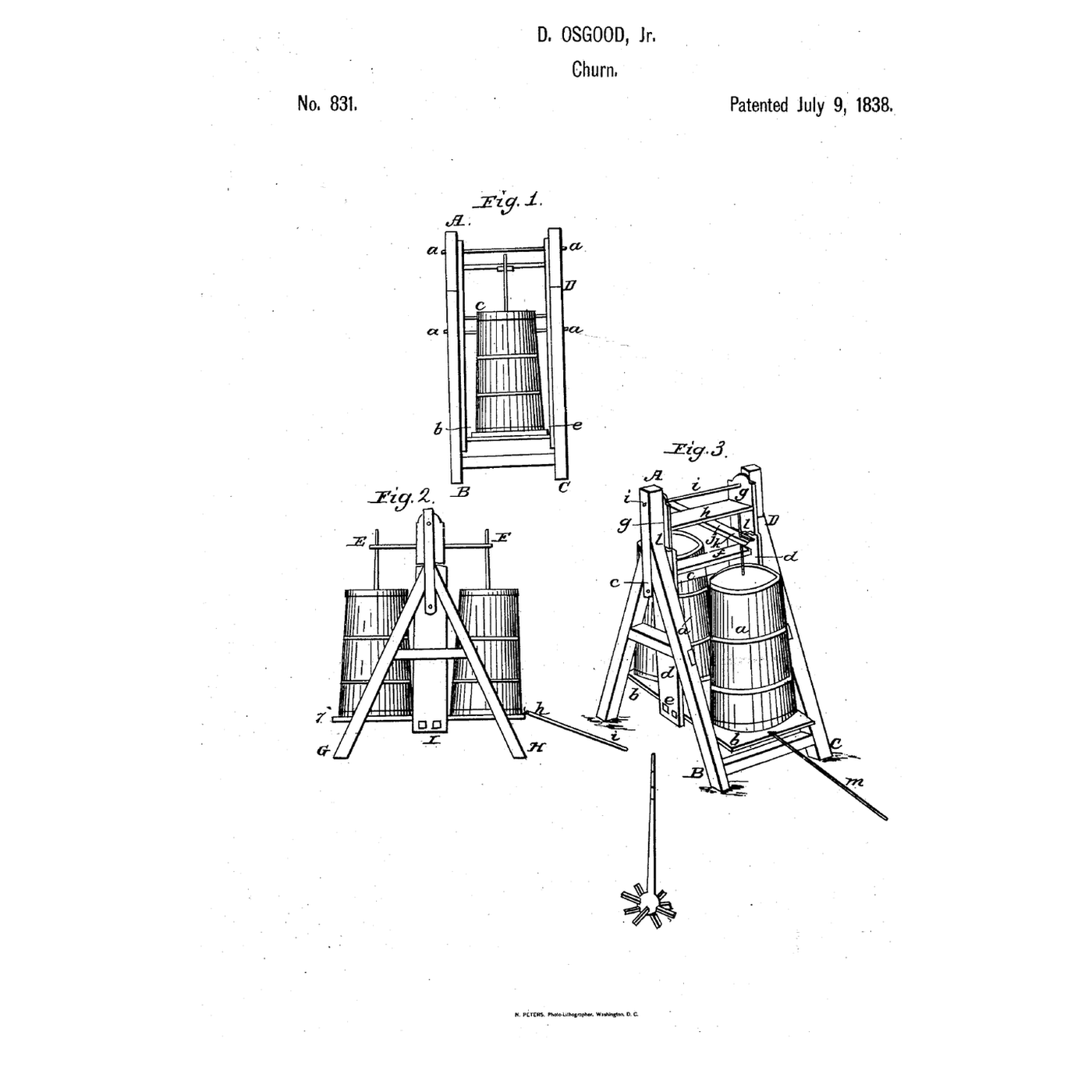
Daniel Osgood, Jr., of Bluehill, Maine, received US 831, dated 9 July 1838, for what he called "Osgood's Double-Swing Churn": two common churns on a platform swinging in a frame. The side pieces rising from the platform are cut into teeth that mesh with the teeth of two pieces hung above, so as the platform swings backward and forward a lever is alternately raised and depressed, "giving the downward and upward motion to the dashers." The power required, he wrote, "is nearly in proportion to the power required to draw a pendulum in its lateral motion compared with that of raising its weight."
This rung compares the swing of his platform and ours, then prints the toothed sectors, builds a tabletop frame for two jars, and makes butter.
Àárín
About 6 hours, plus printing
Ìlànà
1
1
Swing period and dasher stroke
Swing period and dasher stroke
Ń ṣí ìwé Jupyter…
2
2
One load balancing another on a lever
One load balancing another on a lever
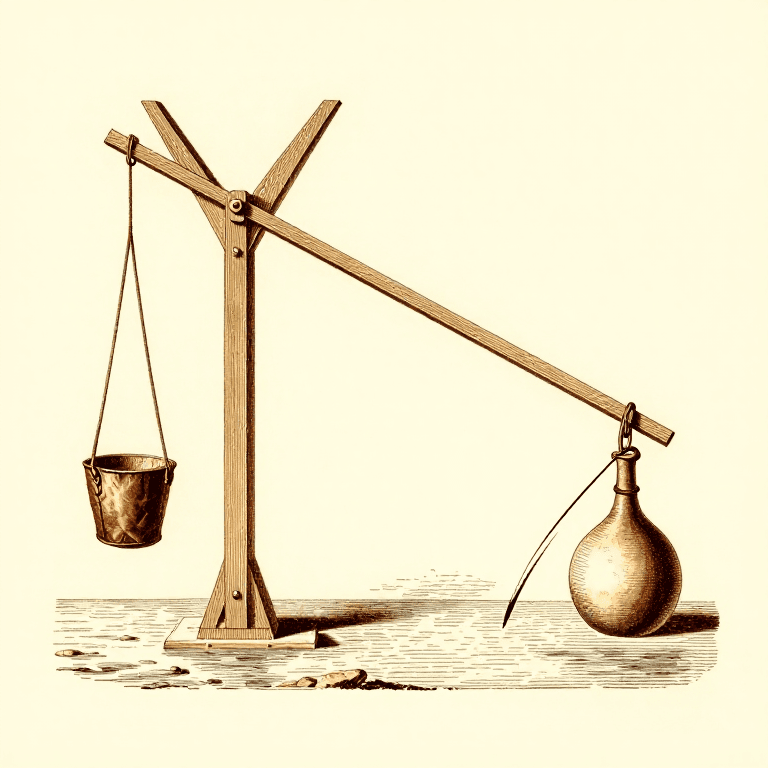
The embedded blueprint lifts water with a counterweighted beam. Osgood's beam balances one churn's dasher against the other's, and he says to balance a single churn with a weight.
3
3
Read US 831
Read US 831
"This saving of labor is acquired by placing two common churns, Figure 3 (a a) on a swinging platform (b). This platform is made to swing by being suspended in the frame A, B, C, D, by a rod passing through the frame and two pieces (d d) rising from the sides of the platform (b)... The ends of the side pieces (d, d,) and the corresponding upper, pieces (g, g,) are cut into teeth or cogs (l l,) and mesh into each other."
4
4
Print four toothed sectors
Print four toothed sectors
Print four identical sectors (/uploads/blueprints/double-swing-churn-sector.stl), flat. Each has a 6.6 mm pivot hole at the centre of its teeth and two screw holes in its tail. Print in PETG at 0.2 mm layers, 30 % infill, 4 walls; wash before first use.
Àwọn ohun èlò fún ìgbésẹ̀ yìí:
 Okùn PETG1 ẹyọ
Àwọn irinṣẹ́ tí a nílò:
 Ẹ̀rọ ìtẹ̀ 3D oníwàyà (FDM)
5
5
Build the frame and platform
Build the frame and platform
Make two A-frames of pine about 420 mm tall, joined at the top by a cross bar. Drill both for two 6 mm steel rods 60 mm apart, one above the other: the lower rod carries the platform and the upper carries the beam. Cut a plywood platform 280 × 130 mm. Screw an upright pine strip to each side of the platform, reaching up to the lower rod, and screw a sector to the top of each strip, teeth up and pivot on the rod.
Àwọn ohun èlò fún ìgbésẹ̀ yìí:
 Pákó igi pine1 ẹyọ
 Àwo igi tí a lẹ̀ pọ̀1 ẹyọ
 Ọ̀pá Róbótó Irin Rírọ̀1 ẹyọ
 Ìsúrù igi #8 x 1"1 ẹyọ
 Ìdìpọ̀ Igi1 ẹyọ
Àwọn irinṣẹ́ tí a nílò:
 Ayùn Ọwọ́
 Ayùn Irin
 Ẹ̀rọ Ìlùkòkò Aláìlókùn
 Àkójọ Orí Ìlùkòkò
 Àwọn clamp
 Okùn Ìdíwọ̀n
6
6
Hang the beam and dashers
Hang the beam and dashers
Screw the other two sectors to two short pine pieces hung on the upper rod, teeth down, meshing with the lower ones. Join the hung pieces with a cross bar and fix a beam across it at right angles, 200 mm long. Hang a dowel dasher with a plywood disc from each end on a loose screw, through a hole in each jar's lid. Fit a long handle to the platform.
Àwọn ohun èlò fún ìgbésẹ̀ yìí:
Pákó igi pine1 ẹyọ Àwọn dowel igi líle1 ẹyọÀwo igi tí a lẹ̀ pọ̀1 ẹyọ
 Ìgò Gílásì2 ẹyọÌsúrù igi #8 x 1"1 ẹyọ
Àwọn irinṣẹ́ tí a nílò:
Ayùn Ọwọ́Ẹ̀rọ Ìlùkòkò AláìlókùnÀkójọ Orí Ìlùkòkò Ìṣù àwọn ohun ìyí skurú
7
7
The patent drawing
The patent drawing
US 831 drawing sheet, public domain (expired patent).
8
8
Swing and make butter
Swing and make butter
Let the heavy cream stand until it reaches about 15 °C, checked with the thermometer. Pour half into each jar, no more than a third full, and fit the lids. Swing the platform steadily by the handle; the dashers rise and fall in turn. Time until the butter comes. Pour off the buttermilk, add cold water, churn a little and pour off again until it runs clear; work in a pinch of salt and weigh the butter.
Àwọn ohun èlò fún ìgbésẹ̀ yìí:
 Ọ̀rá wàrà tó nípọn500 ml
 Iyọ̀ Òkun Rúkèrúdò1 ẹyọ
 Omi1 ẹyọ
Àwọn irinṣẹ́ tí a nílò:
 Ẹ̀rọ ìwọ̀n ooru oníhun tí ó dúró sí inú
 Aago Ìdúró
 Òṣùwọ̀n Díjítà Ilé Ìdáná
 Àwo ìdàpọ̀ ńlá ti irin tí kò ń yá
9
9
Teeth that slip, a swing that dies
Teeth that slip, a swing that dies
Double-swing churn troubleshooting.
Flow
Loading...
10
10
History and honest limits
History and honest limits
**Daniel Osgood, Jr.** of Bluehill, Hancock County, Maine, received US 831, dated 9 July 1838. He gave the dimensions for common use: a frame 3 ft 1 in high, churns 1 ft 7 in high, 14 inches across at the bottom and 12 at the top, a platform 2 ft 6 in by 1 ft, and the pendulum 1 ft 4 in from its rod to the platform. "When but one churn is necessary, the other may be dispensed with by substituting any other weight in its stead to balance the one that is used." He claimed "the manner in which the dashers are worked by the pendulous motion of the churn."
**Honest limits.** Jars on a tabletop frame stand in for his two churns, and printed sectors for his wooden teeth. FDM prints hold food in their layer lines, so wash well and replace when worn. Your times and weights are the result.
Àwọn ohun-èlò
11- 1 ẹyọÀyè
- 1 ẹyọÀyè
- 1 ẹyọÀyè
- Àyè
- 2 ẹyọÀyè
- 1 ẹyọÀyè
- 1 ẹyọÀyè
- 2 ẹyọÀyè
- 500 mlÀyè
- 1 ẹyọÀyè
- 1 ẹyọÀyè
Àwọn irinṣẹ́ tó nílò
12- Àyè
- Àyè
- 1 vendor sell this, none ship to you yetÀyè
- Àyè
- 1 vendor sell this, none ship to you yetÀyè
- Àyè
Ìtọ́nisọ́nà yìí ń ṣe

Blueprint tó jọra
Àwọn blueprint wọ̀nyí pín ìmọ̀ — ọ̀nà, ohun-èlò tàbí ìlànà




CC0 Àgbègbè Gbogbogbò
Blueprint yìí ti jáde lábẹ́ CC0. O lè ṣe àdàkọ, yí padà, pín, àti lò láìsí ìyọ̀ǹda.
Ṣàtìlẹ́yìn Olùṣẹ́dá nípa rírà àwọn ọjà nipasẹ̀ Blueprint wọn Ẹ̀san Olùṣẹ́dá tí àwọn Olùtajà gbé kalẹ̀, tàbí ṣẹ̀dá àtúnṣe tuntun ti Blueprint yìí kí o sì fi sínú Blueprint rẹ gẹ́gẹ́ bí ìsopọ̀ láti pín owó-wíwọlé.