
Extracting Manganese from Pyrolusite — The Cave Painter's Black That Cleans Glass
Manganese (Mn, element 25) has been used unknowingly for over 17,000 years — Paleolithic cave painters at Lascaux and Altamira used manganese dioxide (pyrolusite, MnO₂) as a black pigment. Ancient Roman glassmakers called it sapo vitri ('glass soap') because adding small amounts of manganese dioxide to molten glass neutralized the green color caused by iron impurities, producing clear, colorless glass. This decolorizing trick was known for centuries before anyone realized manganese was a distinct element.
Swedish chemist Johan Gottlieb Gahn first isolated metallic manganese in 1774 by reducing pyrolusite (MnO₂) with charcoal in a crucible — the same year his colleague Carl Wilhelm Scheele identified chlorine by reacting pyrolusite with hydrochloric acid. Pyrolusite is the most common and most important manganese mineral, containing 63.2% manganese by mass.
The extraction is straightforward in principle: carbon reduces manganese dioxide at high temperature: MnO₂ + 2C → Mn + 2CO. However, manganese has a high melting point (1246 °C) and oxidizes rapidly in air, making it challenging to produce a coherent metal sample. The product is typically a brittle, grey-white metallic mass that tarnishes quickly.
HAZARD: Manganese dust is a serious neurotoxin. Chronic inhalation of manganese compounds causes manganism — a progressive, irreversible neurological disease with symptoms resembling Parkinson's disease. All work with manganese ore and dust requires effective respiratory protection (P100 filters). Work outdoors during roasting and reduction.
Ìlànà
Understand manganese chemistry and historical significance
Understand manganese chemistry and historical significance
Manganese (Mn, element 25) is a hard, brittle, silvery-grey transition metal with a density of 7.47 g/cm³, melting point of 1246 °C, and Mohs hardness of 6. It is the third most abundant transition metal in the Earth's crust (after iron and titanium) and is essential to life — the oxygen-evolving complex in photosynthesis uses a cluster of four manganese atoms to split water molecules and release oxygen.
Manganese's name derives from magnesia nigra ('black magnesia'), the ancient name for pyrolusite, which was confused with magnesia alba (magnesium carbonate) and with magnetic iron ore (magnetite). This confusion eventually gave rise to three separate element names: manganese, magnesium, and magnet — all from the same Greek root referring to the Magnesia region of Thessaly.
The element's most important historical application was in steelmaking. In 1856, Robert Mushet discovered that adding spiegeleisen (a manganese-iron alloy) to Bessemer converter steel removed excess sulfur and oxygen, transforming the process from unreliable to commercially viable. Without manganese, the Bessemer process — and the industrial revolution's steel age — would have failed. Today, over 90% of manganese production goes into steel alloys.
Identify pyrolusite and other manganese minerals
Identify pyrolusite and other manganese minerals
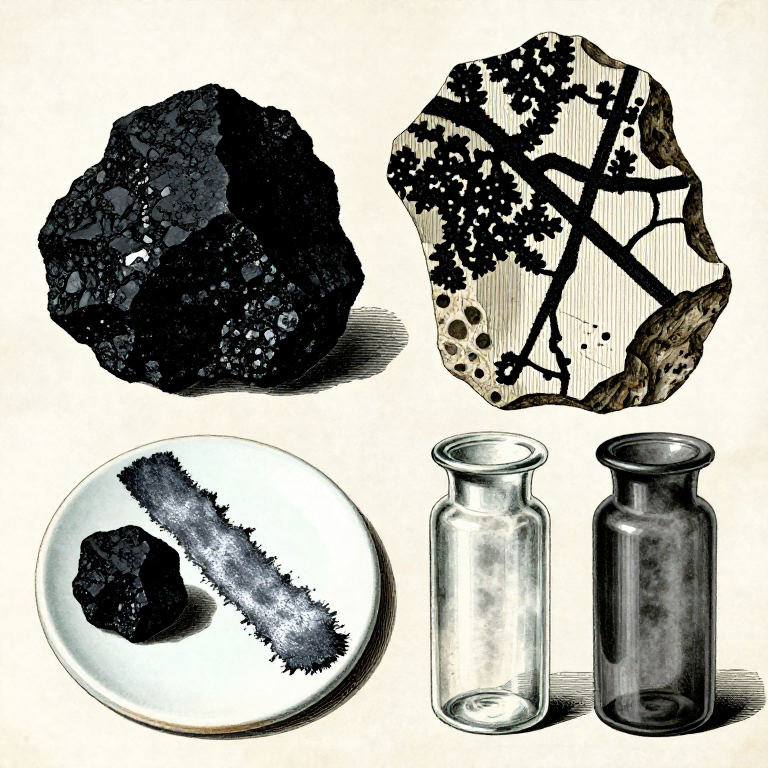
Pyrolusite (MnO₂, manganese dioxide) is a black to dark steel-grey mineral with a metallic to dull luster. Key identification features: Mohs hardness 6–6.5 when crystalline (but commonly occurs as soft, sooty masses with effective hardness 2–4), specific gravity 5.06, and a black streak that readily marks paper and skin. Pyrolusite is one of the few minerals that leaves visible black marks on a fingertip when rubbed — this property was exploited by cave painters thousands of years ago.
Pyrolusite commonly occurs as botryoidal (grape-like) or dendritic (branching, fern-like) formations. The striking dendritic patterns sometimes seen on limestone and sandstone surfaces — often mistaken for fossil ferns or moss — are actually thin films of pyrolusite crystallized along fracture surfaces. These dendrites are among the most commonly misidentified geological features.
Other manganese minerals include manganite (MnO(OH), dark steel-grey prismatic crystals), rhodochrosite (MnCO₃, beautiful pink banded mineral used as a gemstone), braunite (Mn²⁺Mn₃⁺₆SiO₁₂), and psilomelane (a group name for hard, black manganese oxide minerals). Pyrolusite is the most common and the easiest to process due to its high manganese content and simple chemistry.
Àwọn irinṣẹ́ tí a nílò:
 Òòlù Ẹ̀kọ́ Ilẹ̀
 Gílásì Ìgbéga Ọwọ́ 10x
 Àwo Ìlà (Pọ́sílénì Tí Kò Ní Ìtàn)
Crush and prepare the pyrolusite ore
Crush and prepare the pyrolusite ore
Crush pyrolusite specimens into fine fragments (under 3 mm) using a geological hammer. Crystalline pyrolusite is quite hard (Mohs 6), but the more common massive or sooty variety crushes easily. Wear a P100 respirator and gloves — manganese dust is a potent neurotoxin. Even brief high-concentration exposure can contribute to manganism risk. Do not allow manganese dust to become airborne; work on a damp surface if possible.
Hand-sort to remove gangue. Pyrolusite is distinctively black and heavy (SG 5.06) compared to most gangue minerals. Its tendency to mark skin and paper black makes it easy to identify by touch (wear gloves). Quartz and calcite gangue will be lighter in color and weight.
Weigh 300–500 grams of sorted ore. Pyrolusite (MnO₂) contains 63.2% manganese by mass (Mn = 54.94, O₂ = 32.00; MnO₂ = 86.94; 54.94 / 86.94 = 0.632). Raw ore quality varies widely — high-grade ore from deposits like those at Nikopol (Ukraine) or Groote Eylandt (Australia) can be nearly pure MnO₂.
Àwọn ohun èlò fún ìgbésẹ̀ yìí:
 Òkúta pyrolusite (dioxide manganese)500 grams
Àwọn irinṣẹ́ tí a nílò:
Òòlù Ẹ̀kọ́ Ilẹ̀ Ẹ̀rọ Ìmí P100
 Ìbọ̀wọ́ Rọ́bà Nítírílì
Reduce pyrolusite with carbon
Reduce pyrolusite with carbon
Mix the crushed pyrolusite with finely powdered charcoal at approximately 1:0.5 by weight (for every 100 grams of pyrolusite, add 50 grams of charcoal). The reduction reaction is: MnO₂ + 2C → Mn + 2CO. This is a direct carbon reduction — no roasting step is needed because pyrolusite is already an oxide.
However, the reduction must be carefully controlled. If too much carbon is used, manganese carbide (Mn₃C) forms instead of metallic manganese, producing a harder, more brittle product. If insufficient carbon is used, reduction is incomplete, leaving unreduced MnO₂ or partially reduced MnO in the product. The 1:0.5 ratio provides approximately 20% excess carbon over stoichiometric, which is appropriate.
Pack the mixture tightly into a deep clay or graphite crucible, filling no more than two-thirds full. A graphite crucible is preferred — the graphite walls contribute additional carbon and withstand the high temperatures required. Add a thin layer of charcoal powder on top as a protective blanket to reduce oxidation of the manganese as it forms.
Àwọn ohun èlò fún ìgbésẹ̀ yìí:
 Èédú Ìṣùu250 gramsÈédú Ìṣùu5 kg
Àwọn irinṣẹ́ tí a nílò:
 Ìkòkò Amọ̀ JíjìnẸ̀rọ Ìmí P100Ìbọ̀wọ́ Rọ́bà Nítírílì
Heat to extreme temperature for reduction
Heat to extreme temperature for reduction
OUTDOORS ONLY — produces carbon monoxide (CO), an odorless lethal gas. Place the crucible in a forced-air charcoal furnace and heat to the highest achievable temperature — ideally above 1300 °C. The reduction of MnO₂ by carbon begins at approximately 1100 °C and becomes rapid above 1200 °C. Sustained, vigorous bellows work and a deep charcoal bed are essential.
Manganese's melting point (1246 °C) is lower than iron's (1538 °C) but higher than copper's (1085 °C). If the furnace reaches above 1246 °C, the manganese melts and coalesces into a metal button at the crucible bottom. Below this temperature, the manganese forms as a sintered mass of metallic particles — still metallic, but not a single coherent button.
Maintain maximum temperature for 2–3 hours. Carbon monoxide bubbles through the charge and burns as a pale blue flame at the crucible top if it reaches air. This flame indicates the reduction is proceeding actively. When the flame diminishes, most of the reduction is complete. Allow the crucible to cool slowly — do not quench, as thermal shock shatters the crucible and the brittle manganese metal.
Àwọn irinṣẹ́ tí a nílò:
 Ààrò Èédú
 Ẹ̀rọ Ìfẹ́ Afẹ́fẹ́Ẹ̀rọ Ìmí P100
 Ìbọ̀wọ́ Awọ Apá Gígùn
 Gílásì Ààbò Tí Ó Sé
Extract and identify the manganese metal
Extract and identify the manganese metal
Break open the cooled crucible carefully. At the bottom, look for a grey-white metallic button or a sintered metallic mass. Manganese metal is silvery-white when freshly fractured, but tarnishes rapidly to a dull grey in air. It is hard (Mohs 6) and extremely brittle — it shatters when struck, with a granular, crystalline fracture surface.
Manganese is not magnetic at room temperature (it is paramagnetic, not ferromagnetic), which distinguishes it from iron, cobalt, and nickel. However, manganese-iron alloys may be weakly magnetic if significant iron is present as a contaminant. Test with a magnet — pure manganese shows no attraction.
The manganese tarnishes noticeably within hours of exposure to humid air, developing a dark brownish-black oxide coating. This rapid tarnishing is characteristic and distinguishes it from most other common metals. Freshly fractured manganese has a slightly pinkish tinge to its silver color — subtle but visible under good light.
Àwọn irinṣẹ́ tí a nílò:
Gílásì Ìgbéga Ọwọ́ 10x Magnẹ́ẹ̀tì Kékeré
 Ìgò Gílásì Àpẹẹrẹ
Demonstrate the glass-decolorizing effect
Demonstrate the glass-decolorizing effect
The most historically important application of manganese dioxide is decolorizing glass. To demonstrate this, prepare two small batches of glass: mix clean quartz sand (100 grams) with sodium carbonate flux (30 grams) and a trace of iron filings (0.5 grams) in each batch. The iron produces the typical green-tinted glass that plagued ancient glassmakers.
To one batch, add approximately 1 gram of powdered pyrolusite (MnO₂). Leave the other batch without manganese as a control. Melt both batches in small crucibles at 1200–1400 °C. When cooled, compare the glass: the batch without manganese will be distinctly green, while the manganese-treated batch should be clear or have a faint purple tint.
The chemistry: iron in glass exists as Fe²⁺ (green) and Fe³⁺ (pale yellow). Manganese dioxide oxidizes Fe²⁺ to Fe³⁺ (removing the green), while itself being reduced to Mn²⁺ (which is nearly colorless) and Mn³⁺ (which is purple). The purple of manganese and the pale yellow of Fe³⁺ are complementary colors — they cancel each other, producing visually clear glass. This is why the Romans called it sapo vitri, glass soap — it 'cleaned' the color.
Àwọn ohun èlò fún ìgbésẹ̀ yìí:
 Iyanrìn Kuátsì200 grams
 Kábónéètì Sódíọ̀mù (eérú sódà)60 grams
Àwọn irinṣẹ́ tí a nílò:
Ìkòkò Amọ̀ JíjìnClean up safely and document results
Clean up safely and document results
All surfaces contaminated with manganese dust must be cleaned with damp cloths. Never sweep manganese dust dry — this generates airborne particles that pose inhalation hazards. The risk of manganism (chronic manganese poisoning) is cumulative — every exposure adds to the total burden. Dispose of cleaning materials through appropriate waste channels.
The manganese metal itself can be stored in a sealed glass vial. It will tarnish progressively in air but does not degrade structurally. Coat with a thin layer of mineral oil to slow tarnishing if long-term preservation is desired.
Document the complete experiment: ore weight, charcoal ratio, furnace temperature and time, metal yield, and physical properties observed (color, hardness, magnetism, tarnishing rate). From 500 grams of pure pyrolusite, theoretical manganese yield is 316 grams (63.2%). Practical yield will be significantly less — expect 30–50% recovery at best due to incomplete reduction and oxidation losses. Gahn's original 1774 experiment produced a small metallic button sufficient to characterize the new element — even a few grams is a meaningful result. The glass-decolorizing demonstration connects your experiment to a tradition stretching back to Roman antiquity.
Àwọn ohun-èlò
4- 500 gramsÀyè
- 5 kgÀyè
- 200 gramsÀyè
- 60 gramsÀyè
Àwọn irinṣẹ́ tó nílò
14- Àyè
Àwọn Ohun Èlò Ìtọ́nisọ́nà Tí A So Pọ̀

Ìtọ́nisọ́nà yìí ń ṣe
CC0 Àgbègbè Gbogbogbò
Blueprint yìí ti jáde lábẹ́ CC0. O lè ṣe àdàkọ, yí padà, pín, àti lò láìsí ìyọ̀ǹda.
Ṣàtìlẹ́yìn Olùṣẹ́dá nípa rírà àwọn ọjà nipasẹ̀ Blueprint wọn Ẹ̀san Olùṣẹ́dá tí àwọn Olùtajà gbé kalẹ̀, tàbí ṣẹ̀dá àtúnṣe tuntun ti Blueprint yìí kí o sì fi sínú Blueprint rẹ gẹ́gẹ́ bí ìsopọ̀ láti pín owó-wíwọlé.