
Extracting Silver by Cupellation — Separating Noble Metal from Lead Ore
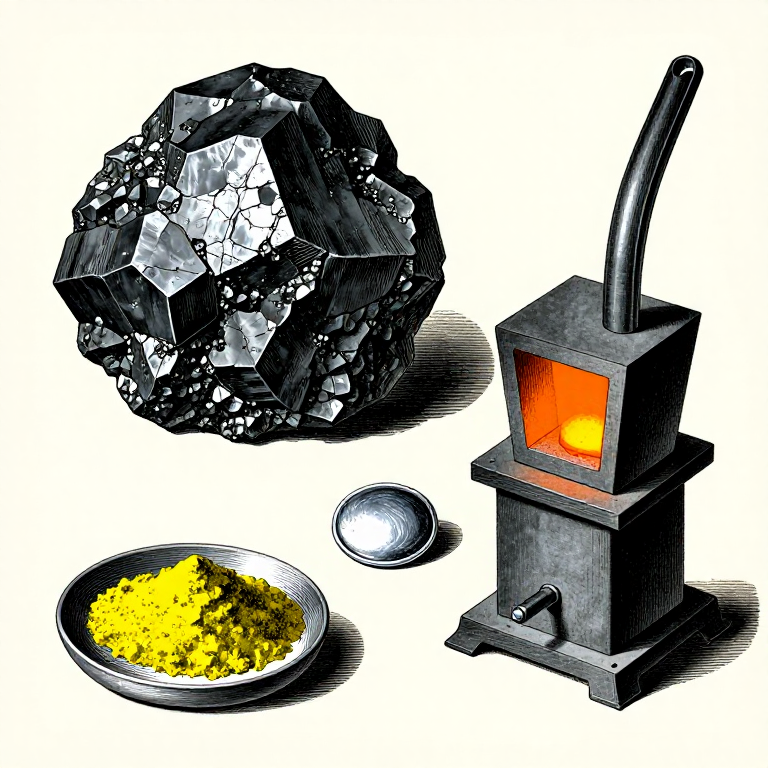
Silver (Ag, element 47, from Latin argentum) has been prized since at least 4000 BCE. Unlike gold, silver rarely occurs as a native metal in useful quantities. The vast majority of ancient silver was extracted from galena (lead sulfide, PbS), which typically contains 0.1–1% silver as a substitutional impurity in the crystal lattice. The process of separating silver from lead is called cupellation — one of the oldest metallurgical techniques, practiced in Anatolia by 3000 BCE and perfected by the Laurion mines near Athens, whose silver funded the Athenian navy that defeated Persia at Salamis in 480 BCE.
Cupellation exploits the different oxidation behaviors of lead and silver. When a lead-silver alloy is heated to approximately 1000 °C in an open, shallow dish called a cupel (made from bone ash or compressed calcium phosphite), air oxidizes the lead to litharge (PbO), a yellow liquid that is absorbed into the porous cupel or skimmed off. Silver, being a noble metal, does not oxidize under these conditions and remains as a molten bead — pure, bright, and gleaming — sitting on the cupel surface.
HAZARD: Lead is a cumulative neurotoxin. Lead fumes and lead oxide dust cause irreversible neurological damage, kidney failure, and anemia. All lead work must be performed outdoors with respiratory protection and lead-rated gloves. Never eat, drink, or smoke near lead operations. All equipment that contacts lead is permanently contaminated.
This blueprint assumes you have already smelted lead from galena using the process described in Peter's 'Extracting Lead from Galena' blueprint. The crude lead ingot produced there is the starting material for cupellation.
Àkóónú tó léwu
Blueprint yii ni awọn ilana ti o lewu. Wọle ki o mu akoonu ti o lewu ṣiṣẹ ninu awọn eto akaunti rẹ lati wo awọn itọnisọna igbesẹ-nipasẹ-igbesẹ.
WọléCC0 Àgbègbè Gbogbogbò
Blueprint yìí ti jáde lábẹ́ CC0. O lè ṣe àdàkọ, yí padà, pín, àti lò láìsí ìyọ̀ǹda.
Ṣàtìlẹ́yìn Olùṣẹ́dá nípa rírà àwọn ọjà nipasẹ̀ Blueprint wọn Ẹ̀san Olùṣẹ́dá tí àwọn Olùtajà gbé kalẹ̀, tàbí ṣẹ̀dá àtúnṣe tuntun ti Blueprint yìí kí o sì fi sínú Blueprint rẹ gẹ́gẹ́ bí ìsopọ̀ láti pín owó-wíwọlé.