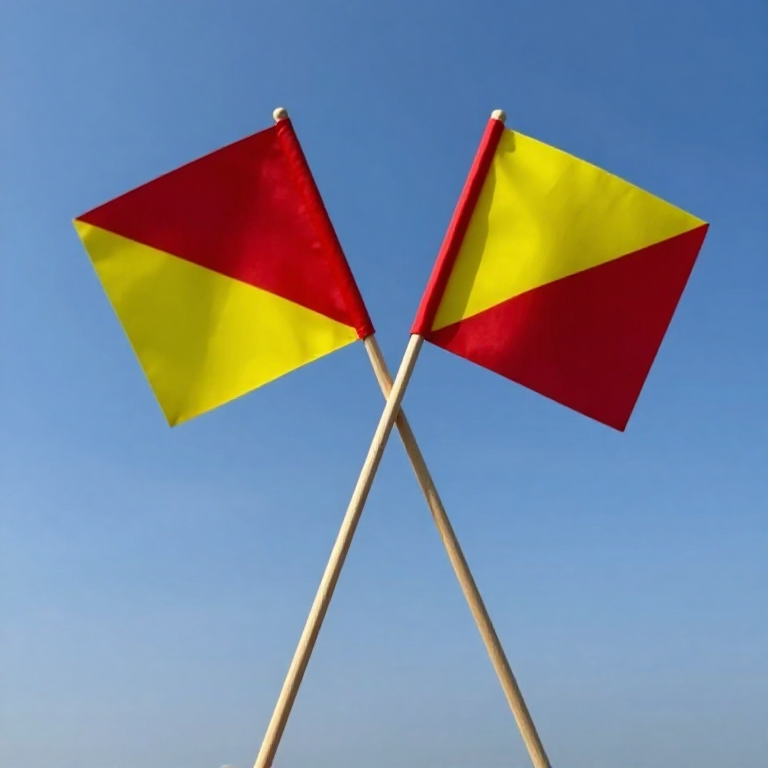


Flag Semaphore
Ìlànà
Make a pair of flags
Make a pair of flags
The flag is a contrast device, nothing more.
- Cut two squares of cloth about 45 cm on a side.
- Make each half one colour and half a strongly contrasting one, split along the diagonal.
- Fasten each to a dowel about 60 cm long.
Àwọn ohun èlò fún ìgbésẹ̀ yìí:
 Aṣọ Mọ́sìlínì Òwú2 metre
 Òpó Igi Dòwẹ̀lì2 ẹyọ
Learn the eight positions, then the circles
Learn the eight positions, then the circles
The alphabet is built systematically, not memorised letter by letter.
- Mark the eight arm positions at 45 degree intervals — down, low, out, high, up on each side.
- Learn the first seven letters, A to G, with the right arm moving through the positions while the left stays down.
- Then hold the right arm at low and cycle the left through for H to N, and so on.
Àwọn ohun èlò fún ìgbésẹ̀ yìí:
 Bébà Àwòrán1 pad
Send at distance and find your real range
Send at distance and find your real range
Measure the limit rather than quoting one.
- Have a partner walk away and send letters at intervals.
- Record the distance at which letters start to be misread.
- Repeat against a cluttered background, and again in poor light.
Àwọn ohun èlò fún ìgbésẹ̀ yìí:
 Aago Ìdúró1 ẹyọ
Compare the three signalling approaches
Compare the three signalling approaches
Same goal — get a message across a distance without wires — three different answers.
- Time yourself sending a ten-letter message by semaphore.
- Send the same message in Morse by lamp or torch and time it.
- Tabulate for each, and for the Chappe tower system: setup cost, range, speed, night capability, portability.
History and context
History and context
Home Riggs Popham, a Royal Navy officer, developed the two-flag hand system around 1803, drawing on the mechanical shutter and arm telegraphs then spreading across Europe. It was adopted for ship-to-ship work, where the sender moves with the fleet and no tower is possible, and the system remains part of naval signalling practice to this day alongside signal lamps and flag hoists.
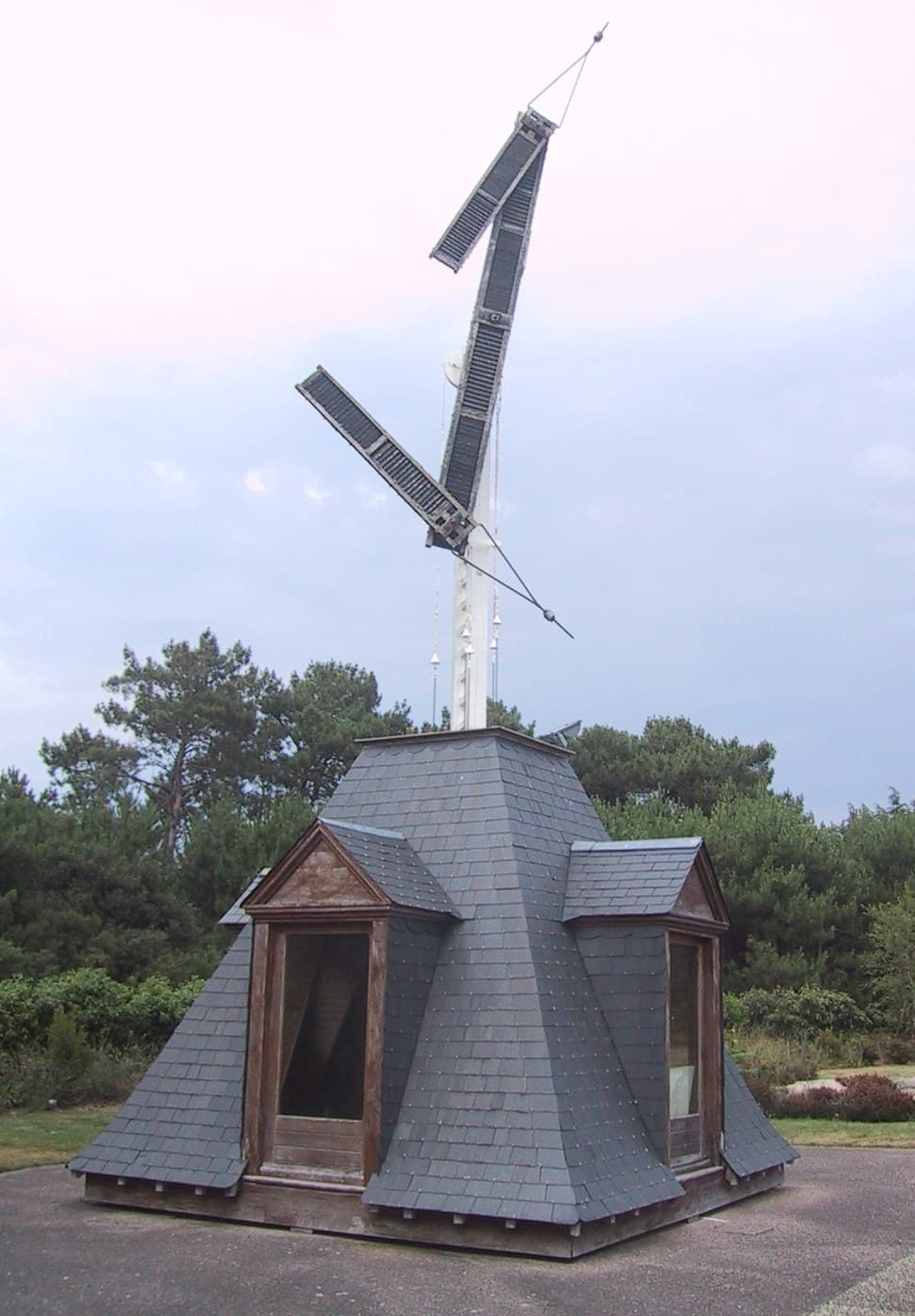
What it changed relative to the towers: Chappe's network could carry a message across France in minutes, but it took years to build, needed staffed stations within sight of one another, and ran only where the line had been surveyed. Popham's version has a range of a few hundred metres and travels in a locker. The infrastructure was traded for mobility — the same trade seen in every mobile-versus-fixed technology since.
It is still specified where independence from equipment matters: in the international regulations for signalling at sea, and in scouting and maritime training, precisely because it needs no power, no spares and no maintenance. A system that cannot fail for want of a battery has a permanent niche.
Where it sits in the catalogue: Chappe's towers, flag semaphore, the heliograph, the signal lamp and Morse by wire are five approaches to moving a message without a telephone. They differ in range, cost, speed, weather tolerance and who must be trained. Collected together, they map the trade-offs of visual signalling more completely than any one of them explains alone.
Àwọn ohun-èlò
4- 2 metreÀyè
- 2 ẹyọÀyè
- 1 padÀyè
- 1 ẹyọÀyè
Ìtọ́nisọ́nà yìí ń ṣe
Blueprint tó jọra
Àwọn blueprint wọ̀nyí pín ìmọ̀ — ọ̀nà, ohun-èlò tàbí ìlànà


CC0 Àgbègbè Gbogbogbò
Blueprint yìí ti jáde lábẹ́ CC0. O lè ṣe àdàkọ, yí padà, pín, àti lò láìsí ìyọ̀ǹda.
Ṣàtìlẹ́yìn Olùṣẹ́dá nípa rírà àwọn ọjà nipasẹ̀ Blueprint wọn Ẹ̀san Olùṣẹ́dá tí àwọn Olùtajà gbé kalẹ̀, tàbí ṣẹ̀dá àtúnṣe tuntun ti Blueprint yìí kí o sì fi sínú Blueprint rẹ gẹ́gẹ́ bí ìsopọ̀ láti pín owó-wíwọlé.