IṢẸ́ ỌNÀ
ẸWÀ ÀTI ÌLERA
IṢẸ́ ỌWỌ́
ÀṢÀ ÀTI ÌTÀN
ÌṢERÉ
ÀYÍKÁ
OÚNJẸ ÀTI OHUN MÍMU
REVERSE ENGINEERING
SÁYẸ́ǸSÌ
ERÉ ÌDÁRAYÁ
ÌMỌ̀-Ẹ̀RỌ
ÀWỌN OHUN WÍWỌ̀
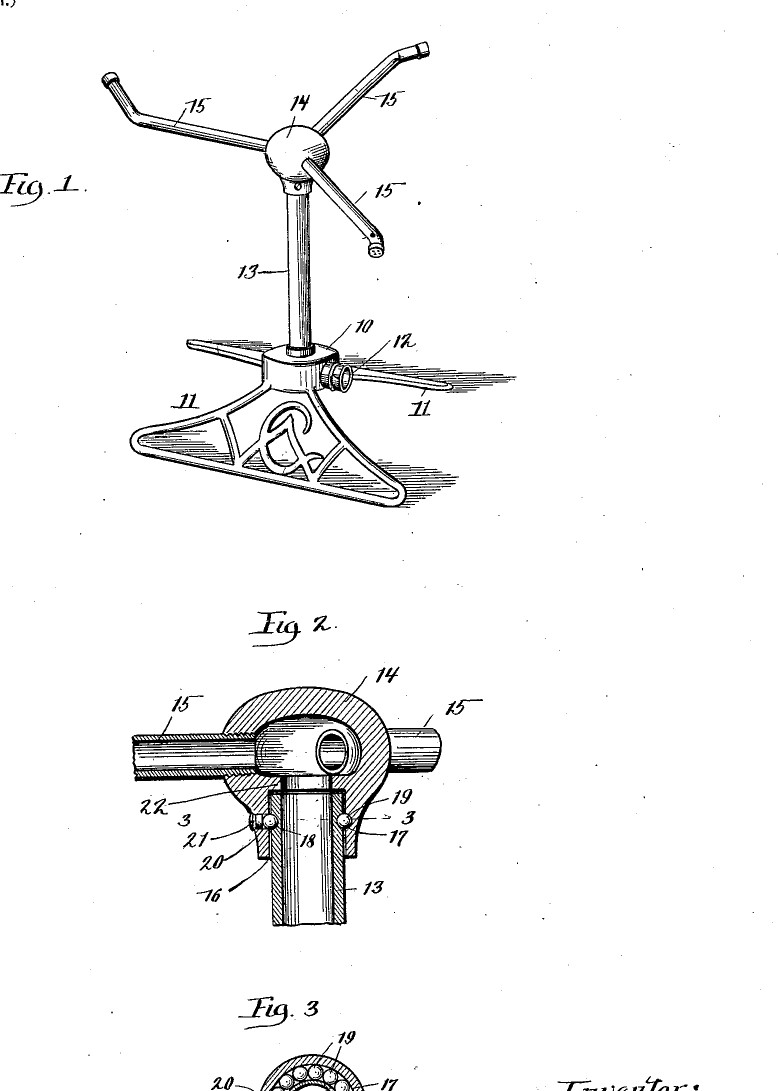


Rotary Lawn Sprinkler: a Barker's-Mill Head Turning on Balls Round the Supply Pipe (Gibbs, 1901)
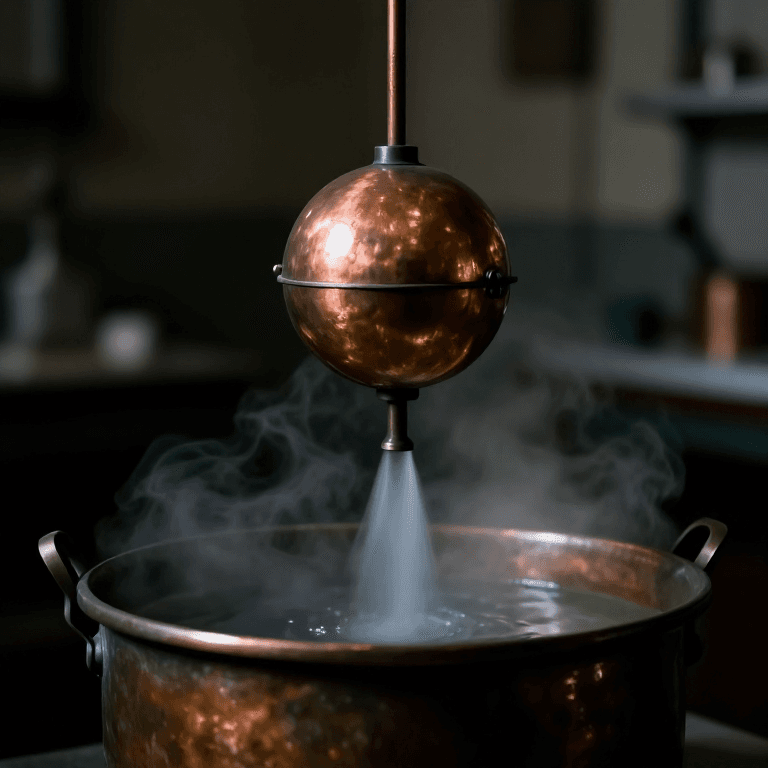
Henry Gibbs of Chicago received US 683,645, dated 1 October 1901, for a lawn sprinkler "operating on the familiar Barker's mill principle": water leaving its arms sideways pushes the head round. His head turns on a ring of steel balls held in matching grooves in the head and in the end of the supply pipe, so it spins freely with little friction and stays on.
We turn the head from brass and the groove in a steel pipe on the lathe. All sizes are ours.
Àárín
About 5 hours
Ìlànà
1
1
How many balls
How many balls
Ń ṣí ìwé Jupyter…
2
2
Read US 683,645
Read US 683,645
"It being only necessary that certain of the orifices shall discharge the water tangentially to revolve the head 14 and spray-pipes 15 in the well-known manner."
3
3
Groove the supply pipe
Groove the supply pipe
Chuck a length of steel pipe (his pipe 13) and finish its top end smooth and round. Cut a half-round groove (his 17) round it a little below the end, to the depth the notebook gives, with a round-nosed tool. Use thick-walled pipe, so at least 1.5 mm of wall is left under the groove (ours).
Àwọn ohun èlò fún ìgbésẹ̀ yìí:
 Páìpù irin (ògiri nípọn, ẹnu oníhá)1 ẹyọ
Àwọn irinṣẹ́ tí a nílò:
 Ẹ̀rọ Ìyí Irin
 Ìmú ẹ̀rọ ìyípo oníka mẹ́ta
 Ohun ìgé ẹ̀rọ ìyí
 Òṣùwọ̀n Kálípà Díjítà Ìnṣì 6
4
4
Turn the head
Turn the head
Turn a brass bar to a short round head (his 14). Bore it from below to loosely fit the pipe end, his bore 16, but stop short of the top so a lip (his flange 22) overhangs the pipe end. Cut a matching groove 18 inside the bore at the same height as the pipe's groove.
Àwọn ohun èlò fún ìgbésẹ̀ yìí:
 Ọ̀pá Róbótó Bronse1 ẹyọ
Àwọn irinṣẹ́ tí a nílò:
Ẹ̀rọ Ìyí IrinÌmú ẹ̀rọ ìyípo oníka mẹ́taOhun ìgé ẹ̀rọ ìyí Ìdìpọ̀ ilẹ̀kùn ààrin
 Àkójọ Orí ÌlùkòkòÒṣùwọ̀n Kálípà Díjítà Ìnṣì 6
5
5
Drill the ball hole and the arms
Drill the ball hole and the arms
Drill a hole (his opening 20) through the head's side into the groove, just bigger than a ball, and tap it for a screw plug (21). Drill three holes round the head into the bore for the spray pipes.
Àwọn irinṣẹ́ tí a nílò:
 Ẹ̀rọ Ìlùkòkò OnídúróÀkójọ Orí Ìlùkòkò
 Ìtò irinṣẹ́ ìgé ihá
 Ìdìmú Tábìlì
6
6
Make the spray pipes
Make the spray pipes
Cut three lengths of copper tube, close their outer ends, and bend the last bit of each upward as his Fig. 1. Drill small holes near the ends, some pointing sideways (tangentially), all the same way round, so the jets turn the head. Solder the pipes into the head's holes (ours; he threads them in).
Àwọn ohun èlò fún ìgbésẹ̀ yìí:
 Ọ̀pá bàbà1 ẹyọ
 Wẹ́là tìnì-lédì1 ẹyọ
 Fúlọ́ksì1 ẹyọ
Àwọn irinṣẹ́ tí a nílò:
 Ayùn IrinÀkójọ Orí ÌlùkòkòẸ̀rọ Ìlùkòkò Onídúró
 Irin Sọ́ldà Oníná MànàmánáÌdìmú Tábìlì
7
7
Assemble with the balls
Assemble with the balls
Slide the head onto the pipe end with the grooves level. Feed balls in through the side hole, turning the head, until the race is full; then screw in the plug. The head should spin freely and not lift off.
Àwọn ohun èlò fún ìgbésẹ̀ yìí:
 Àwọn bearing bọ́ọ̀lù irin1 ẹyọ
 Skurú ẹ̀rọ1 ẹyọ
Àwọn irinṣẹ́ tí a nílò:
 Kọ́kọ́rọ́ tí a lè ṣàtúnṣe
8
8
Make the stand
Make the stand
Bore a hardwood block to hold the pipe upright and glue in three splayed dowel legs (ours; his base 10 and supports 11). Screw the hose coupling onto the pipe's lower end below the block (his coupling 12).
Àwọn ohun èlò fún ìgbésẹ̀ yìí:
 Ìṣù Igi Líle1 ẹyọ
 Àwọn dowel igi líle1 ẹyọ
 Ìdìpọ̀ Igi1 ẹyọ
 Asopọ̀ ọ̀pá-omi1 ẹyọ
Àwọn irinṣẹ́ tí a nílò:
 Ayùn Ọwọ́Ẹ̀rọ Ìlùkòkò OnídúróÀkójọ Orí Ìlùkòkò
9
9
Run it
Run it
Connect a garden hose and turn on the water slowly: the jets push the head round and throw the water in a circle. More pressure turns it faster.
10
10
Troubleshooting
Troubleshooting
Lawn sprinkler troubleshooting.
Flow
Loading...
11
11
History and honest limits
History and honest limits
**Henry Gibbs** of Chicago, assignor to W. D. Allen Manufacturing Company, US 683,645, dated 1 October 1901, filed 20 May 1901. He claimed a single-piece hollow coupling with radial spray pipes having tangential orifices, a bore loosely fitting the supply pipe, "annular grooves in the opposed cylindrical faces of said bore and said pipe" and "bearing balls interposed in said grooves". He gives no sizes or metals; the brass, steel pipe, ball size, soldered copper arms and the wooden stand are ours.
Àwọn ohun-èlò
11- 1 ẹyọÀyè
- 1 ẹyọÀyè
- 1 ẹyọÀyè
- 1 ẹyọÀyè
- Àyè
- 1 ẹyọÀyè
- 1 ẹyọÀyè
- 1 ẹyọÀyè
- 1 ẹyọÀyè
- 1 ẹyọÀyè
Àwọn irinṣẹ́ tó nílò
13- Àyè
- Àyè
- Àyè
Ìtọ́nisọ́nà yìí ń ṣe
Blueprint tó jọra
Àwọn blueprint wọ̀nyí pín ìmọ̀ — ọ̀nà, ohun-èlò tàbí ìlànà



CC0 Àgbègbè Gbogbogbò
Blueprint yìí ti jáde lábẹ́ CC0. O lè ṣe àdàkọ, yí padà, pín, àti lò láìsí ìyọ̀ǹda.
Ṣàtìlẹ́yìn Olùṣẹ́dá nípa rírà àwọn ọjà nipasẹ̀ Blueprint wọn Ẹ̀san Olùṣẹ́dá tí àwọn Olùtajà gbé kalẹ̀, tàbí ṣẹ̀dá àtúnṣe tuntun ti Blueprint yìí kí o sì fi sínú Blueprint rẹ gẹ́gẹ́ bí ìsopọ̀ láti pín owó-wíwọlé.