

Mowing Machine
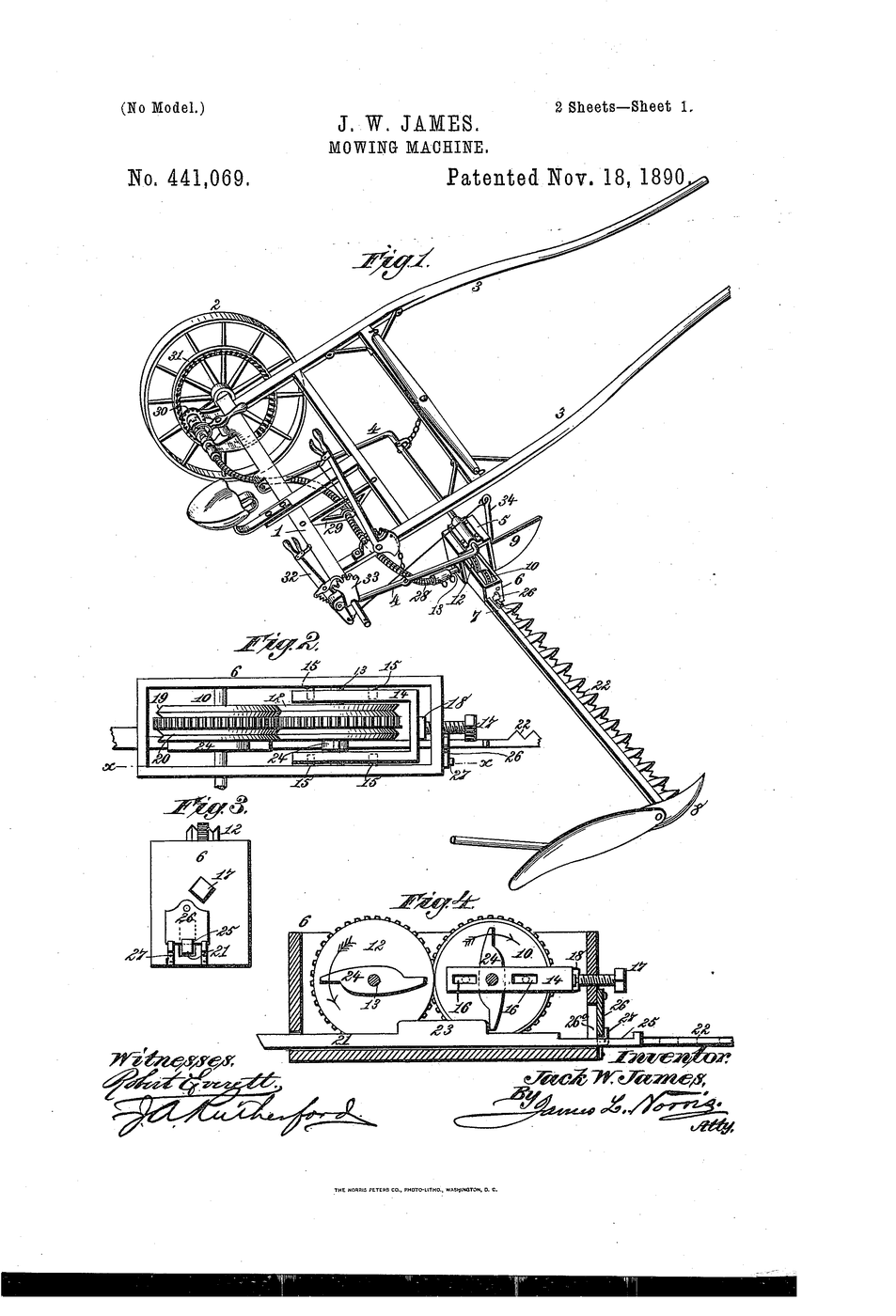
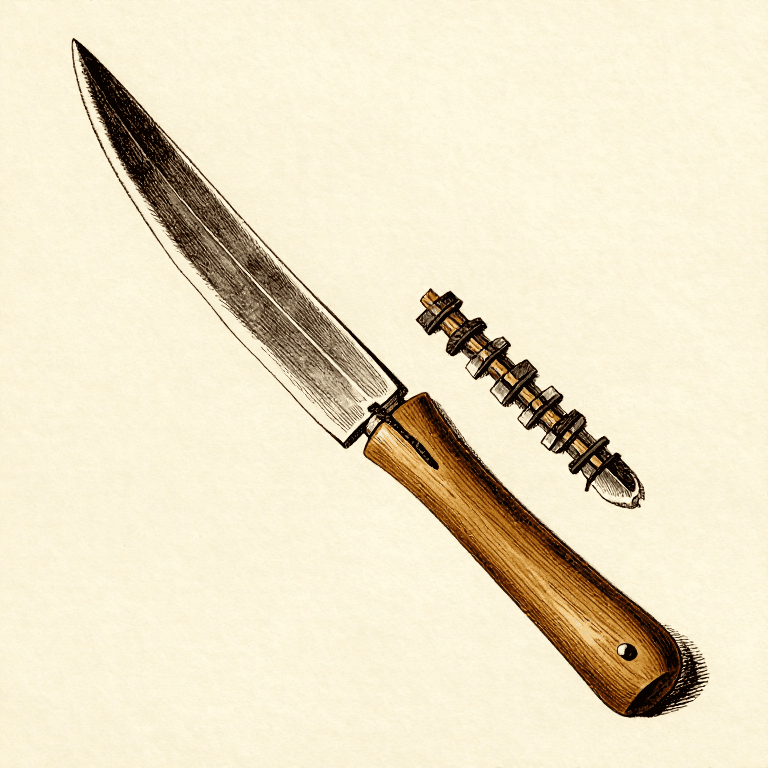
Cutting hay by hand with a scythe is brutal, skilled, weather-racing work — a strong mower clears perhaps an acre a day, and the whole crop must come down in the few dry days before it spoils. The mowing machine put a cutter on wheels: a long bar of little triangular knives that slide back and forth between fixed fingers, shearing grass like a row of scissors as a horse walks it across the meadow.
That reciprocating cutter bar is the heart of every mower — but driving it has a hidden flaw. The usual crank-and-rod (a "pitman") that reciprocates the knife has dead-centers: points at the end of each stroke where the crank pushes straight along the rod and cannot start the knife moving again. Let grass clog the bar at that instant and the whole machine jams.
James's patent drives the cutter without a pitman, so there are no dead-centers to stall on — and takes its power straight from the wheels efficiently enough that one horse can pull the mower instead of two.
US Patent 441,069, "Mowing-machine", granted 18 November 1890 to Jack W. James of Cuba, Tennessee.
Ìlànà
Separate the two ideas in the patent
Separate the two ideas in the patent
The reciprocating cutter bar (knives shearing between fingers) is the old, general principle. James's specific claim is a drive with no pitman and no dead-centers. Note both.
Glasses on — knife edges
Glasses on — knife edges
The knife sections and guards have edges. Glasses on; keep fingers clear of the shear line.
Àwọn irinṣẹ́ tí a nílò:
 Gílásì Ààbò Tí Ó Mọ́
Cut grass with a single blade and feel it fail
Cut grass with a single blade and feel it fail
Try to cut a tuft of grass by pushing one blade at it. It bends away instead of cutting. A single edge cannot cut something that can move — you need a second edge to shear against.
Fit fixed guard fingers along a bar
Fit fixed guard fingers along a bar
Mount a row of slotted fingers (the guards) along a bar. Grass slides into the slots and is held so it cannot dodge the knife.
Àwọn ohun èlò fún ìgbésẹ̀ yìí:
 Ọ̀pá Róbótó Irin Rírọ̀1 ẹyọ
Àwọn irinṣẹ́ tí a nílò:
 Ayùn Irin
Slide triangular knives between the fingers
Slide triangular knives between the fingers
Fit a bar of triangular knife sections that slide side to side across the fingers. Each knife edge shears against a finger edge — a row of scissors.
Àwọn irinṣẹ́ tí a nílò:
 Àkójọ Ìfá Kékeré
Reciprocate the knife and cut a row
Reciprocate the knife and cut a row
Push the knife bar back and forth by hand and feed grass into the fingers. It shears clean. The grass is trapped by the guard and cut by the moving knife — the whole principle.
Drive the knife with a crank and rod (a pitman)
Drive the knife with a crank and rod (a pitman)
Turn a crank that pushes the knife through a connecting rod. This is the usual pitman drive that turns rotation into back-and-forth.
Àwọn ohun èlò fún ìgbésẹ̀ yìí:
 Òpó Igi Dòwẹ̀lì1 ẹyọ
Find the dead-centers
Find the dead-centers
Turn the crank slowly. At each end of the stroke the rod points straight along the crank — a dead-center, where turning the crank cannot move the knife. Mark those two points.
Jam the knife at a dead-center
Jam the knife at a dead-center
Wedge a bit of grass in the knife exactly at a dead-center and try to drive through it. It stalls. This is the clogging-jam James set out to cure — the knife stops precisely where the drive is weakest.
Drive the knife a way with no dead-center
Drive the knife a way with no dead-center
Replace the crank-and-rod with a drive that always has leverage on the knife — for example a grooved cam or a rack, geared from the wheel. Now there is no point where the drive loses its purchase.
Àwọn ohun èlò fún ìgbésẹ̀ yìí:
 Ìdìpọ̀ àwo POM (asetali) fún gíà1 ìtò
Jam it again and push through
Jam it again and push through
Wedge grass in the knife and drive the pitman-less mechanism. It keeps cutting through the obstruction instead of stalling. Compare with step 9.
Hinge the bar and run it over bumps
Hinge the bar and run it over bumps
Hinge the cutter bar so it can rise and fall. Run it across uneven ground: it floats over bumps and follows dips, cutting at an even height instead of digging in or scalping.
History & Context — the scissors that mowed the meadow
History & Context — the scissors that mowed the meadow
The patent. US 441,069, "Mowing-machine", granted 18 November 1890 to Jack W. James of Cuba, Tennessee. Read the specification and James is refreshingly specific about what he claims: not the mower, but a way "for reciprocating the knives without employing a pitman," so that "no dead-centers or dead-points shall be encountered," driven "directly from the traction-wheels" at enough advantage that "an ordinary mower may be drawn and operated by a single horse, instead of a pair."
The cutter bar is older than this patent — say so. The reciprocating cutter bar, with triangular knife sections shearing between fixed guard fingers, is the fundamental mowing mechanism, and it predates James by decades: it appears in the reapers and mowers of the 1830s–1850s (Manning, Hussey, McCormick and others), and it is the same mechanism whether the machine cuts grain (a reaper) or grass (a mower). Steps 3 to 6 build that principle: a single blade cannot cut grass that bends away, so you trap the grass in a guard and shear it with a moving knife — a long row of scissors. That much James inherited.
What James actually improved is the drive, and it is a genuine mechanical insight. The standard way to reciprocate the knife is a crank turning a connecting rod (a pitman), and every crank-and-rod has two dead-centers — the instants at each end of the stroke where the rod lies straight along the crank and the crank can no longer push the knife (step 8). That is exactly where a clogged mower jams (step 9), because a small obstruction only has to hold the knife for a moment at the dead-point. James's pitman-less drive keeps positive leverage on the knife everywhere in the stroke, so it powers through clogs (step 11) — and by taking drive efficiently from the wheels, it halved the horsepower needed. It is a fine example of improving a machine not by changing what it does but by fixing where its mechanism is weakest.
Why it belongs in a farm batch. Haymaking is a race against weather, and mechanical mowing is what let a farm cut far more hay than scythes could manage in the dry window — which pairs directly with the hay press that then baled it. The floating hinged bar (step 12) that follows the ground is still on sickle-bar mowers today, and the reciprocating knife-and-guard shear survives on hay mowers, hedge trimmers and the cutter bars of grain headers. Rotary mowers took over lawns and much of haymaking later, but the scissors principle you built in step 6 is one of the oldest and most enduring ideas in farm machinery.
Àwọn ohun-èlò
3- Àyè
- 1 ẹyọÀyè
- Àyè
Àwọn irinṣẹ́ tó nílò
3- Àyè
Blueprint tó jọra
Àwọn blueprint wọ̀nyí pín ìmọ̀ — ọ̀nà, ohun-èlò tàbí ìlànà

CC0 Àgbègbè Gbogbogbò
Blueprint yìí ti jáde lábẹ́ CC0. O lè ṣe àdàkọ, yí padà, pín, àti lò láìsí ìyọ̀ǹda.
Ṣàtìlẹ́yìn Olùṣẹ́dá nípa rírà àwọn ọjà nipasẹ̀ Blueprint wọn Ẹ̀san Olùṣẹ́dá tí àwọn Olùtajà gbé kalẹ̀, tàbí ṣẹ̀dá àtúnṣe tuntun ti Blueprint yìí kí o sì fi sínú Blueprint rẹ gẹ́gẹ́ bí ìsopọ̀ láti pín owó-wíwọlé.