IṢẸ́ ỌNÀ
ẸWÀ ÀTI ÌLERA
IṢẸ́ ỌWỌ́
ÀṢÀ ÀTI ÌTÀN
ÌṢERÉ
ÀYÍKÁ
OÚNJẸ ÀTI OHUN MÍMU
REVERSE ENGINEERING
SÁYẸ́ǸSÌ
ERÉ ÌDÁRAYÁ
ÌMỌ̀-Ẹ̀RỌ
ÀWỌN OHUN WÍWỌ̀
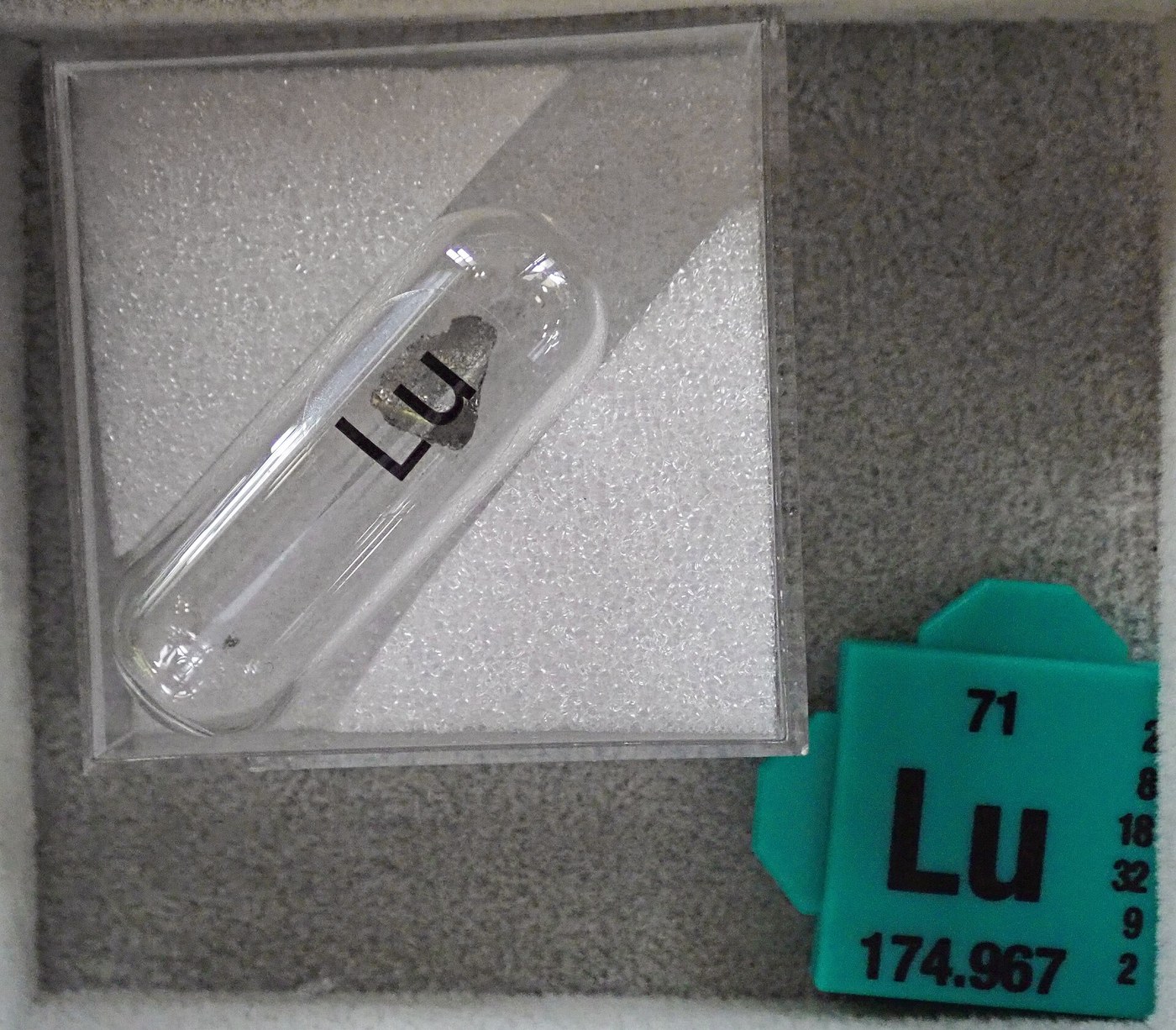

Lutetium: Fluoride Reduced by Calcium in Tantalum under Argon, Remelted under Half an Atmosphere of Argon (Spedding and Daane, 1954)
How Ames Laboratory first made lutetium metal. Calcium takes the fluorine from lutetium fluoride at high heat in a tantalum crucible under argon, leaving the metal under a slag of calcium fluoride. It is then remelted to drive off the leftover calcium, under half an atmosphere of argon because lutetium itself evaporates at its melting point.
Result: lutetium metal holding less than 150 ppm calcium. The paper puts lutetium's melting point at about 1650-1750 °C.
Source: F. H. Spedding and A. H. Daane, The Rare Earth Metals, Journal of Metals 6 (1954), pp. 504-507: lutetium was reduced under the same conditions the paper gives for yttrium. Not given: the lutetium charge and calcium excess, heating times, and how the 1550 °C of the yttrium run was matched to lutetium's higher melting point. Picture: Wikimedia Commons.
Ilọsíwájú
1 day
Ìlànà
1
1
Charge the crucible
Charge the crucible
Put anhydrous lutetium fluoride and calcium into a tantalum crucible. Ames made its crucibles from tantalum sheet 2.0 or 2.5 mils thick, welded under helium. Not given: how much calcium.
Àwọn ohun èlò fún ìgbésẹ̀ yìí:
 Lutetium fluoride1 as required
Àwọn irinṣẹ́ tí a nílò:
 Calcium
 Ìkòkò yíyọ́ tántálọ́mù
2
2
Reduce under argon
Reduce under argon
Heat the charge in an argon atmosphere to the yttrium conditions, 1550 °C; the paper reports lutetium fluoride reduced this way 'with the same results', a well-fused mass of metal under the slag. In the yttrium run there was no boiling, only a light wisp of fumes, and the metal held under 2 % calcium. Ours: an induction furnace, as the same paper uses for open tantalum crucibles.
Àwọn irinṣẹ́ tí a nílò:
 Ìléru induction
 ArgonÌkòkò yíyọ́ tántálọ́mù
3
3
Remelt under half an atmosphere of argon
Remelt under half an atmosphere of argon
Remelt the metal to boil off the calcium. Lutetium has an appreciable vapour pressure at its melting point, so keep a partial pressure of one-half an atmosphere of argon in the system to stop it distilling out of the crucible. At these temperatures the calcium still escapes: under 150 ppm stays in the metal.
Àwọn irinṣẹ́ tí a nílò:
Ìléru induction Ẹ̀rọ ìfàfẹ́fẹ́jádeArgonÌkòkò yíyọ́ tántálọ́mù
Àwọn ohun-èlò
1- 1 as requiredÀyè
Ìtọ́nisọ́nà yìí ń ṣe

Blueprint tó jọra
Àwọn blueprint wọ̀nyí pín ìmọ̀ — ọ̀nà, ohun-èlò tàbí ìlànà
Léwu
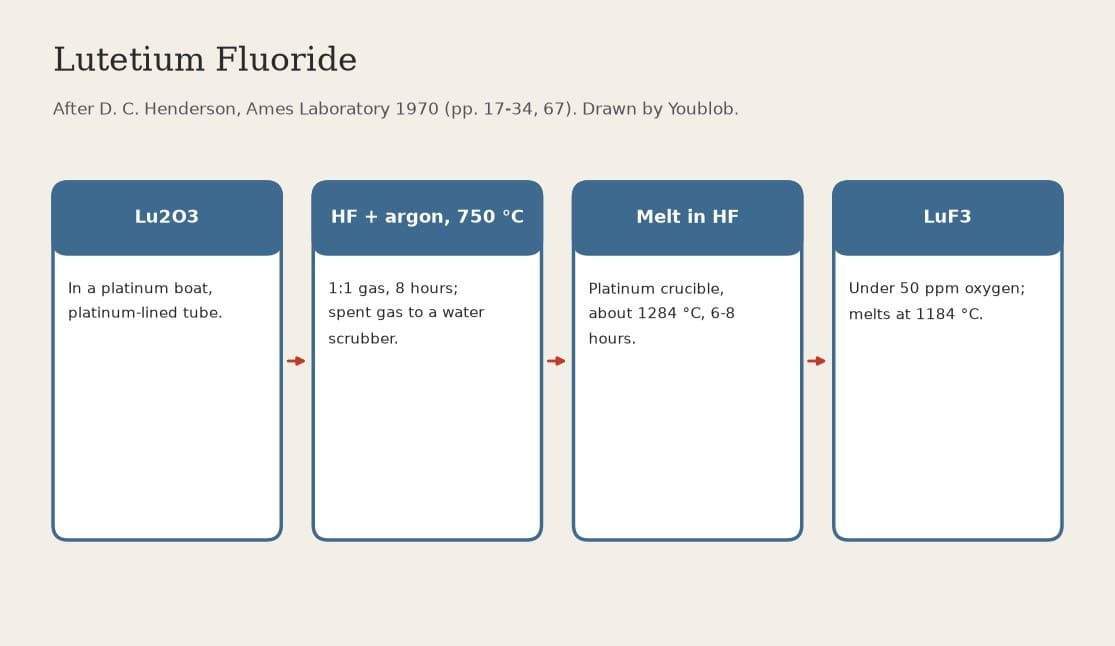
Lutetium Fluoride: Oxide Converted in HF and Argon at 750 °C, then Melted in HF to Remove the Last Oxygen (Henderson, Ames 1970)
láti ọwọ́ Charlie
Inorganic
1
0
0
0
0
0
Léwu
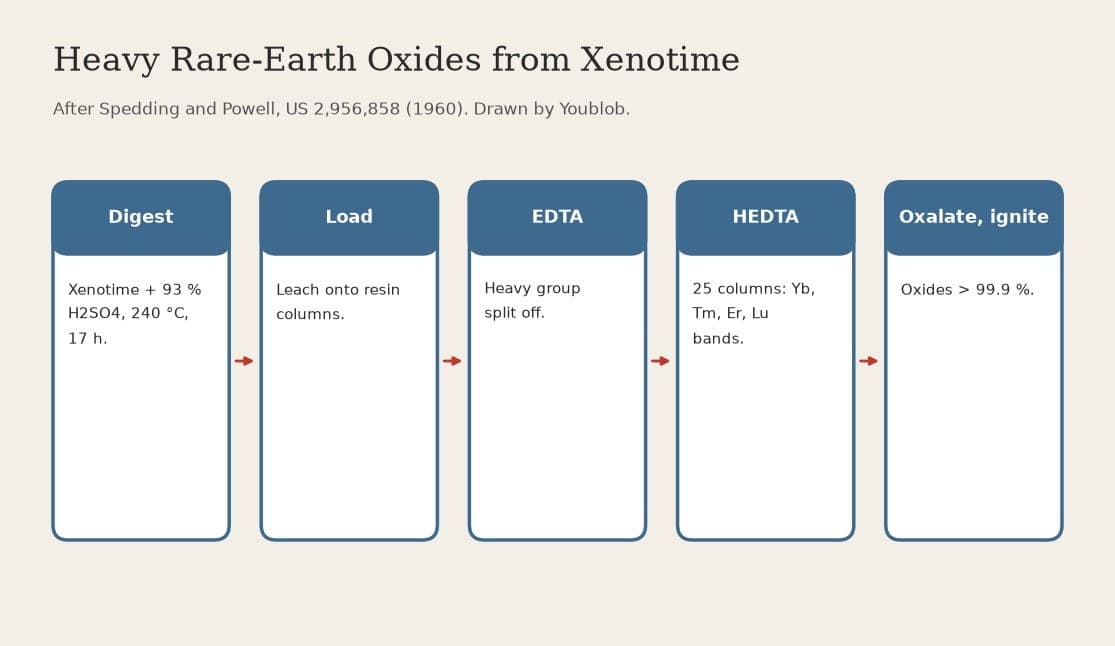
Erbium, Ytterbium, Thulium and Lutetium Oxides: Xenotime Separated on Ion Exchange Columns with EDTA and HEDTA (Spedding and Powell, US 2,956,858)
láti ọwọ́ Charlie
Inorganic
2
0
0
0
0
0
Léwu
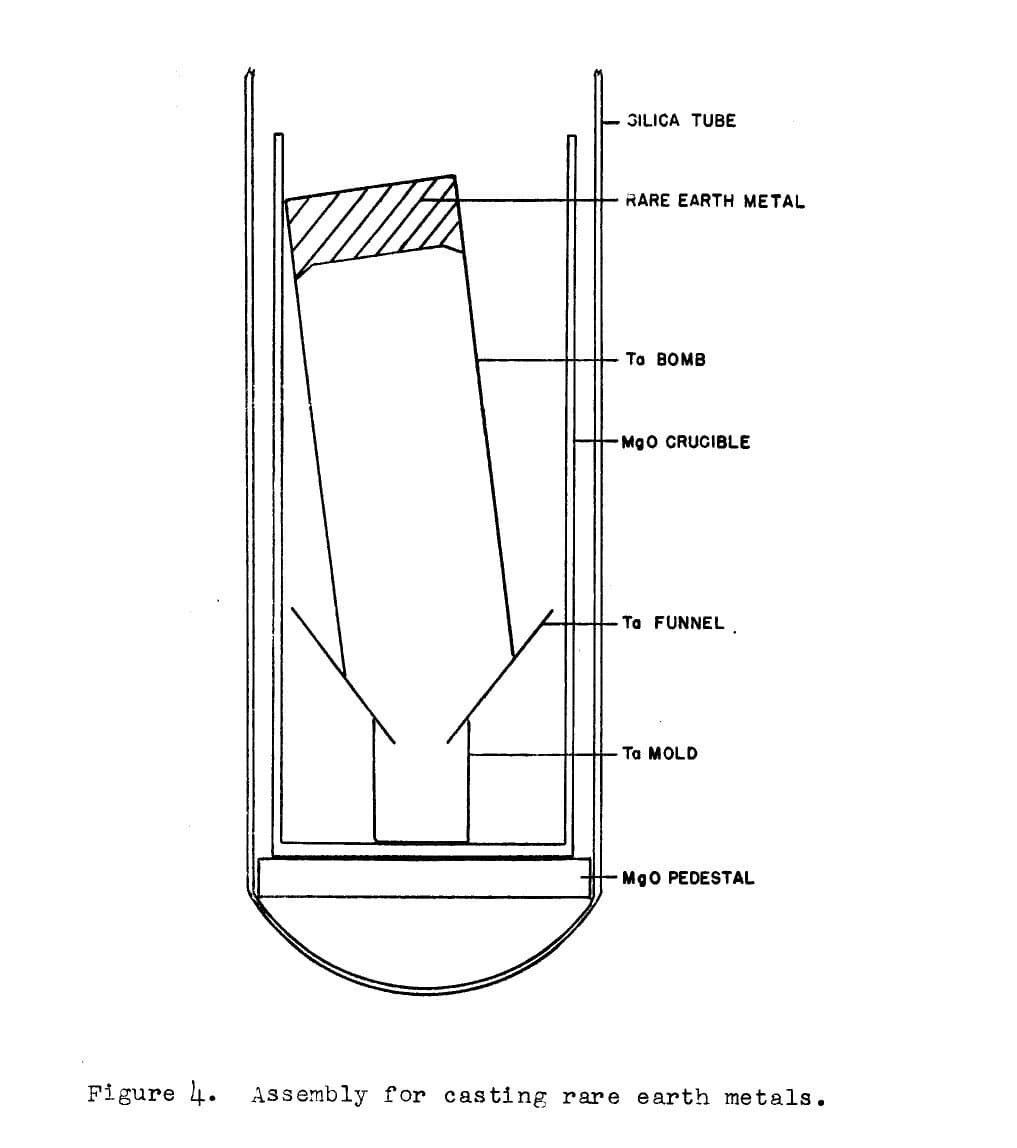
Lanthanum: Anhydrous Chloride Reduced with Calcium in a Tantalum Bomb under Argon, then Vacuum Cast (Daane, Ames 1950)
láti ọwọ́ Charlie
Inorganic
1
0
0
0
0
0
CC0 Àgbègbè Gbogbogbò
Blueprint yìí ti jáde lábẹ́ CC0. O lè ṣe àdàkọ, yí padà, pín, àti lò láìsí ìyọ̀ǹda.
Ṣàtìlẹ́yìn Olùṣẹ́dá nípa rírà àwọn ọjà nipasẹ̀ Blueprint wọn Ẹ̀san Olùṣẹ́dá tí àwọn Olùtajà gbé kalẹ̀, tàbí ṣẹ̀dá àtúnṣe tuntun ti Blueprint yìí kí o sì fi sínú Blueprint rẹ gẹ́gẹ́ bí ìsopọ̀ láti pín owó-wíwọlé.