IṢẸ́ ỌNÀ
ẸWÀ ÀTI ÌLERA
IṢẸ́ ỌWỌ́
ÀṢÀ ÀTI ÌTÀN
ÌṢERÉ
ÀYÍKÁ
OÚNJẸ ÀTI OHUN MÍMU
REVERSE ENGINEERING
SÁYẸ́ǸSÌ
ERÉ ÌDÁRAYÁ
ÌMỌ̀-Ẹ̀RỌ
ÀWỌN OHUN WÍWỌ̀
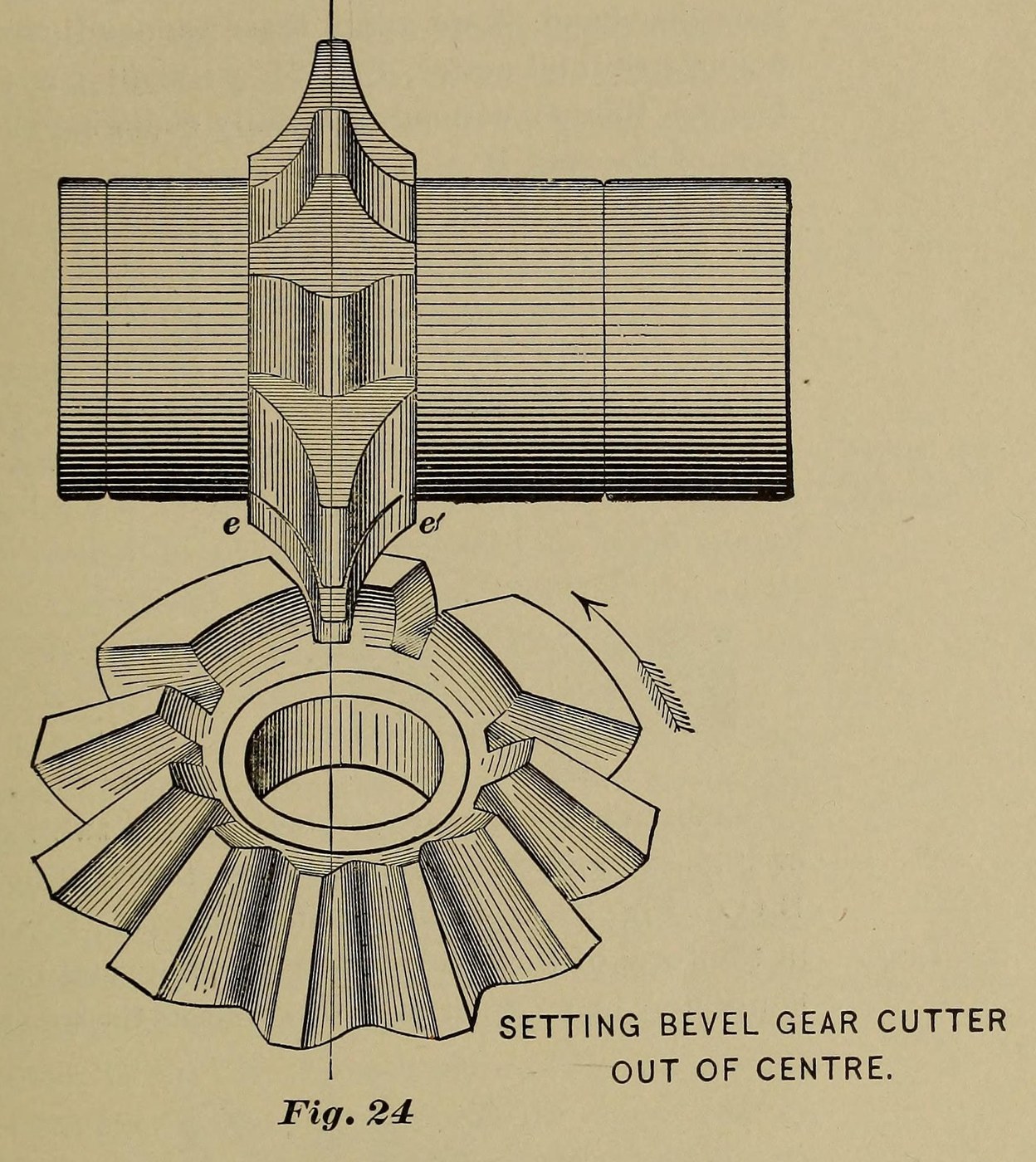


Mitre Gears: a 1:1 Bevel Pair Cut on the Milling Machine (Brown & Sharpe 1911)
Two equal bevel gears on shafts at right angles are mitre gears, and one cutter cuts both. A rotary cutter can only be right for one end of a bevel tooth, so Brown & Sharpe cut each space twice, set off centre to each side, then file the small ends round. Every figure here comes from their rules, worked out for a pair of 16 teeth, 8 pitch.
Source: Brown & Sharpe, Practical Treatise on Gearing (1911), Part I ch. IX–X and Part II ch. III; set-over table p. 58. The tooth count, pitch, face width, steel and bore are ours, and so is the arithmetic. Picture: Brown & Sharpe's Fig. 24.
Ilọsíwájú
2 days
Ìlànà
1
1
Work out and turn two blanks
Work out and turn two blanks
Ours: 16 teeth, 8 pitch, so pitch diameter 2.000 in. Mitre gears have a 45° centre angle (tangent 16/16). Diameter increment = cos 45° × working depth 0.250 = 0.177 in. Apex distance 1.414 in. Angle increment: tan = sin 45° ÷ 8, giving 5° 03′; cutting and face angle 45° − 5° 03′ = 39° 57′. Turn two blanks from steel to 2.18 in outside diameter, with the angle of edge 45° and the angle of face 39° 57′, tried with a protractor against the end of the hub. Face length ⅜ in (ours; no more than a third of the 1.414 in apex distance). Bore and hub are ours.
Àwọn ohun èlò fún ìgbésẹ̀ yìí:
 Ọ̀pá irin rírọ̀1 length for two blanks
Àwọn irinṣẹ́ tí a nílò:
 Ẹ̀rọ Ìyí Irin
 Ohun ìgé ẹ̀rọ ìyí
 Ẹ̀rọ Ìwọ̀n Igun
 Máíkírómítà
2
2
Choose the cutter
Choose the cutter
Back cone radius 1.414 in: twice that × 8 pitch = 22.6 teeth, so a No. 5, 8-pitch bevel gear cutter (21 to 25 teeth). One cutter does both gears. Measure its thickness Tc at the pitch line, 0.145 in (1.157 ÷ 8) from its tip.
Àwọn irinṣẹ́ tí a nílò:
 Ẹ̀rọ ìgé gíà onígun
 Kálípà fẹ́níà fún eyín gíà
3
3
Set the head and the depth
Set the head and the depth
Mount the blank on the dividing head, set to the cutting angle of 39° 57′, to index 16 spaces. Set the depth at the large end to the working depth plus clearance, 0.270 in. Clearance stays the same at the small end.
Àwọn irinṣẹ́ tí a nílò:
 Ẹ̀rọ Ìgégé Irin
 Orí ÌpínyàẸ̀rọ ìgé gíà onígun
4
4
Set over and cut one side of every tooth
Set over and cut one side of every tooth
Set-over: apex distance ÷ face = 1.414 ÷ 0.375 = 3.77, so use the 3¾ column, where a No. 5 cutter has the factor .293. Set-over = Tc ÷ 2 − .293 ÷ 8 = Tc ÷ 2 − 0.037 in. Set the work off centre by that amount to one side, taking up backlash. Run the cutter through, indexing round all 16 spaces.
Àwọn irinṣẹ́ tí a nílò:
Ẹ̀rọ Ìgégé IrinOrí ÌpínyàẸ̀rọ ìgé gíà onígun5
5
Set over the other way and trim to thickness
Set over the other way and trim to thickness
Set over by the same amount on the other side of centre and rotate the blank to line the cutter up with the space at the small end. Take a trial cut, then rotate the blank toward the cutter until the tooth is right: 0.196 in thick at the large end and 0.144 in at the small end. Check both ends with the gear tooth vernier. Right at the large end but thick at the small end means too much set-over; the other way round, too little.
Àwọn irinṣẹ́ tí a nílò:
Ẹ̀rọ Ìgégé IrinOrí ÌpínyàẸ̀rọ ìgé gíà onígunKálípà fẹ́níà fún eyín gíà6
6
Cut round, then make the second gear
Cut round, then make the second gear
Cut the second side of every tooth with that setting. Cut the second blank the same way with the same cutter.
Àwọn irinṣẹ́ tí a nílò:
Ẹ̀rọ Ìgégé IrinOrí ÌpínyàẸ̀rọ ìgé gíà onígun7
7
File the small ends
File the small ends
Round the teeth over at the small ends with a file, where the cutter could not. Do not file them thinner at the pitch line.
Àwọn irinṣẹ́ tí a nílò:
 Ìfá eléyín kékeré
Àwọn ohun-èlò
1- 1 length for two blanksÀyè
Ìtọ́nisọ́nà yìí ń ṣe

CC0 Àgbègbè Gbogbogbò
Blueprint yìí ti jáde lábẹ́ CC0. O lè ṣe àdàkọ, yí padà, pín, àti lò láìsí ìyọ̀ǹda.
Ṣàtìlẹ́yìn Olùṣẹ́dá nípa rírà àwọn ọjà nipasẹ̀ Blueprint wọn Ẹ̀san Olùṣẹ́dá tí àwọn Olùtajà gbé kalẹ̀, tàbí ṣẹ̀dá àtúnṣe tuntun ti Blueprint yìí kí o sì fi sínú Blueprint rẹ gẹ́gẹ́ bí ìsopọ̀ láti pín owó-wíwọlé.