IṢẸ́ ỌNÀ
ẸWÀ ÀTI ÌLERA
IṢẸ́ ỌWỌ́
ÀṢÀ ÀTI ÌTÀN
ÌṢERÉ
ÀYÍKÁ
OÚNJẸ ÀTI OHUN MÍMU
REVERSE ENGINEERING
SÁYẸ́ǸSÌ
ERÉ ÌDÁRAYÁ
ÌMỌ̀-Ẹ̀RỌ
ÀWỌN OHUN WÍWỌ̀
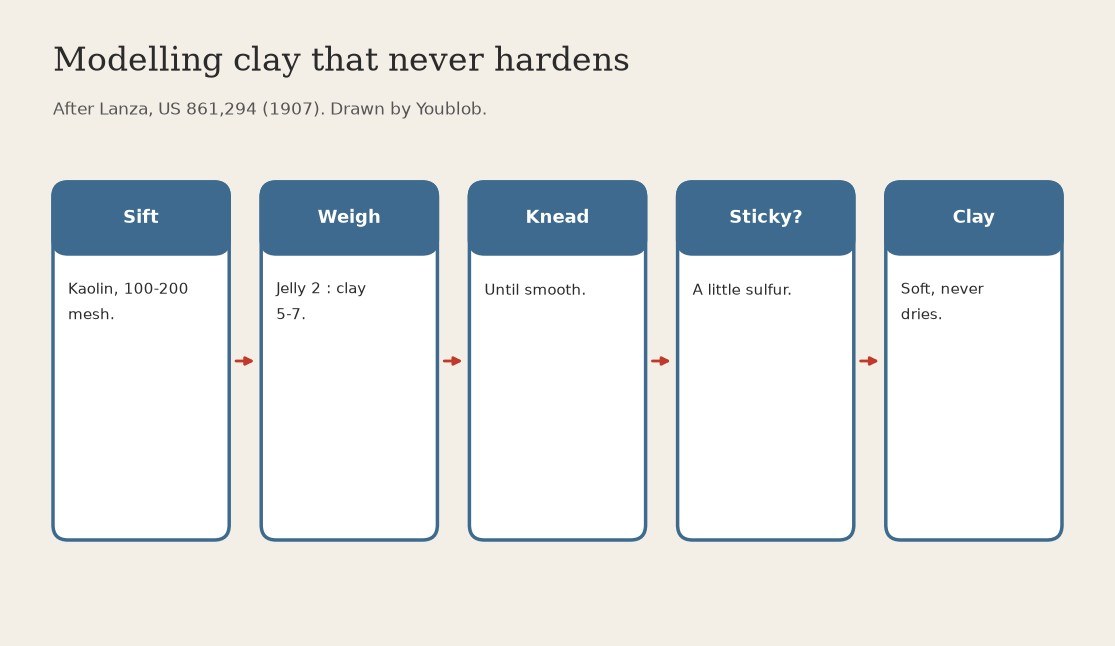


Modelling Clay That Never Hardens: Kaolin Kneaded with Petroleum Jelly (Lanza, US 861,294, 1907)
Clay mixed with water dries, cracks and needs wetting all the time. Lanza bound fine clay with petroleum jelly instead, so it stays soft and workable for good.
Result: a clean, non-hardening modelling clay; the more petroleum jelly, the softer it is.
Source: Lanza, US 861,294 (1907). Not given: batch size, kneading time. Picture drawn by Youblob.
Olùbẹ̀rẹ̀
1 hour
Ìlànà
1
1
Sift the clay fine
Sift the clay fine
Use clay ground fine enough to pass a 100-mesh screen, better 200 mesh. Lanza used kaolin with good results.
Àwọn ohun èlò fún ìgbésẹ̀ yìí:
 Ìyẹ̀fun amọ̀ kaolin5 parts
Àwọn irinṣẹ́ tí a nílò:
 Ajọ Ojú Kékeré
2
2
Weigh 2 parts jelly to 5-7 parts clay
Weigh 2 parts jelly to 5-7 parts clay
By weight: 2 parts petroleum jelly to 5-7 parts clay. Ratio: more jelly (2:5) gives a softer clay, less (2:7) a firmer one.
Àwọn ohun èlò fún ìgbésẹ̀ yìí:
 Vaseline2 parts
Àwọn irinṣẹ́ tí a nílò:
 Òǹwọ̀n ìdọ́gba
3
3
Knead them together
Knead them together
Mix the clay and jelly intimately until smooth. If the clay sticks to the fingers, work in a little sulfur as a filler.
Àwọn ohun èlò fún ìgbésẹ̀ yìí:
 Ìyẹ̀fun sulfur1 a little, if sticky
Àwọn irinṣẹ́ tí a nílò:
 Odó àti Ọmọ Odó
Àwọn ohun-èlò
3- 5 partsÀyè
- 2 partsÀyè
- 1 a little, if stickyÀyè
Àwọn irinṣẹ́ tó nílò
3Ìtọ́nisọ́nà yìí ń ṣe

CC0 Àgbègbè Gbogbogbò
Blueprint yìí ti jáde lábẹ́ CC0. O lè ṣe àdàkọ, yí padà, pín, àti lò láìsí ìyọ̀ǹda.
Ṣàtìlẹ́yìn Olùṣẹ́dá nípa rírà àwọn ọjà nipasẹ̀ Blueprint wọn Ẹ̀san Olùṣẹ́dá tí àwọn Olùtajà gbé kalẹ̀, tàbí ṣẹ̀dá àtúnṣe tuntun ti Blueprint yìí kí o sì fi sínú Blueprint rẹ gẹ́gẹ́ bí ìsopọ̀ láti pín owó-wíwọlé.