IṢẸ́ ỌNÀ
ẸWÀ ÀTI ÌLERA
IṢẸ́ ỌWỌ́
ÀṢÀ ÀTI ÌTÀN
ÌṢERÉ
ÀYÍKÁ
OÚNJẸ ÀTI OHUN MÍMU
REVERSE ENGINEERING
SÁYẸ́ǸSÌ
ERÉ ÌDÁRAYÁ
ÌMỌ̀-Ẹ̀RỌ
ÀWỌN OHUN WÍWỌ̀
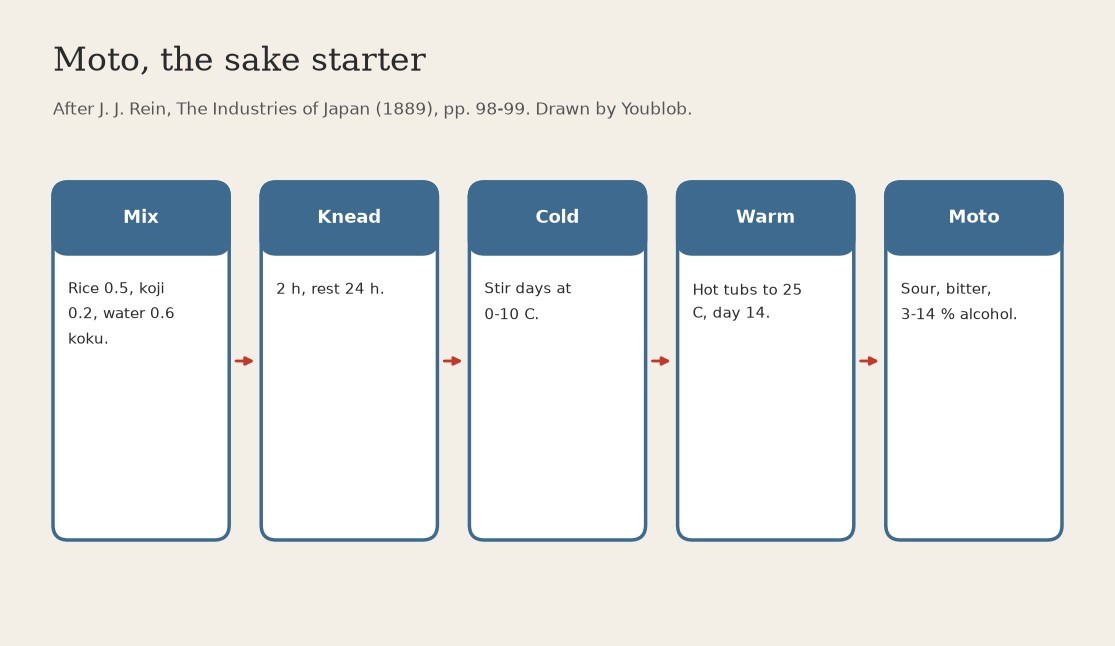


Moto, the Sake Starter: Steamed Rice, Koji and Water Fermented Cold for Fourteen Days (Itami, after Rein 1889)
Old sake brewers added no bought yeast. They made a small, cold mash first, the moto, and let it ferment for two weeks: the koji turns starch to sugar, and the yeast that settles in it grows strong in the cold. The finished moto, sour, bitter and alcoholic, seeds the main brew.
Result: moto, 3 to 14 % alcohol (Nishinomiya 10.5 %).
Source: J. J. Rein, The Industries of Japan (1889), pp. 98-99, the brewers of Itami. Picture drawn by Youblob.
Ilọsíwájú
14 days
Ìlànà
1
1
Steam the rice
Steam the rice
On the third or fourth day of koji-making, steam hulled rice and spread it on mats until the next morning. Ours: steam it over a pot.
Àwọn ohun èlò fún ìgbésẹ̀ yìí:
 Ìrẹsì Japan olóhóró kúkúrú0.5 koku
Àwọn irinṣẹ́ tí a nílò:
 Ìkòkò Ńlá
 Koríko ìrẹsì
2
2
Make the porridge
Make the porridge
Mix 0.5 koku steamed rice with 0.2 koku koji and 0.6 koku water (by weight rice 10, koji 4, water 12). Divide it among six flat 100-litre tubs, each about one-fifth full.
Àwọn ohun èlò fún ìgbésẹ̀ yìí:
 Ìrẹsì koji (Aspergillus oryzae)0.2 koku
 Omi0.6 koku
Àwọn irinṣẹ́ tí a nílò:
 Àwokòtò igi
3
3
Knead, rest, stir cold
Knead, rest, stir cold
Knead by hand into a stiff paste for 2 hours, then leave it 24 hours; it thins. For several days stir it often with a paddle (kai) at the outside temperature, 0-10 C. It turns sweet and milky, then starts to give gas.
Àwọn irinṣẹ́ tí a nílò:
 Ọ̀pá igi gígùn fún rírú
 Ẹ̀rọ Ìwọ̀n Ooru
4
4
Gather and rest
Gather and rest
Within six days pour the tubs, three at a time, into a fermenting vat of about 6 hl and leave it quiet one day.
Àwọn irinṣẹ́ tí a nílò:
Àwokòtò igi5
5
Warm to day 14
Warm to day 14
Wrap the vat in straw mats. Sink a closed tub of boiling water in the mash and move it about; renew it about every 12 hours, as much as the heat needs, until day 14. The mash rises to about 25 C.
Àwọn irinṣẹ́ tí a nílò:
Àwokòtò igiÌkòkò ŃláKoríko ìrẹsìẸ̀rọ Ìwọ̀n Ooru6
6
Cool and check
Cool and check
When the gas slackens and the taste turns from sweet to sour and bitter with a clear smell of alcohol, put the mash back in the flat tubs to cool slowly.
Àwọn irinṣẹ́ tí a nílò:
Àwokòtò igiÀwọn ohun-èlò
3- 0.5 kokuÀyè
- 0.2 kokuÀyè
- 0.6 kokuÀyè
Ìtọ́nisọ́nà yìí ń ṣe
CC0 Àgbègbè Gbogbogbò
Blueprint yìí ti jáde lábẹ́ CC0. O lè ṣe àdàkọ, yí padà, pín, àti lò láìsí ìyọ̀ǹda.
Ṣàtìlẹ́yìn Olùṣẹ́dá nípa rírà àwọn ọjà nipasẹ̀ Blueprint wọn Ẹ̀san Olùṣẹ́dá tí àwọn Olùtajà gbé kalẹ̀, tàbí ṣẹ̀dá àtúnṣe tuntun ti Blueprint yìí kí o sì fi sínú Blueprint rẹ gẹ́gẹ́ bí ìsopọ̀ láti pín owó-wíwọlé.