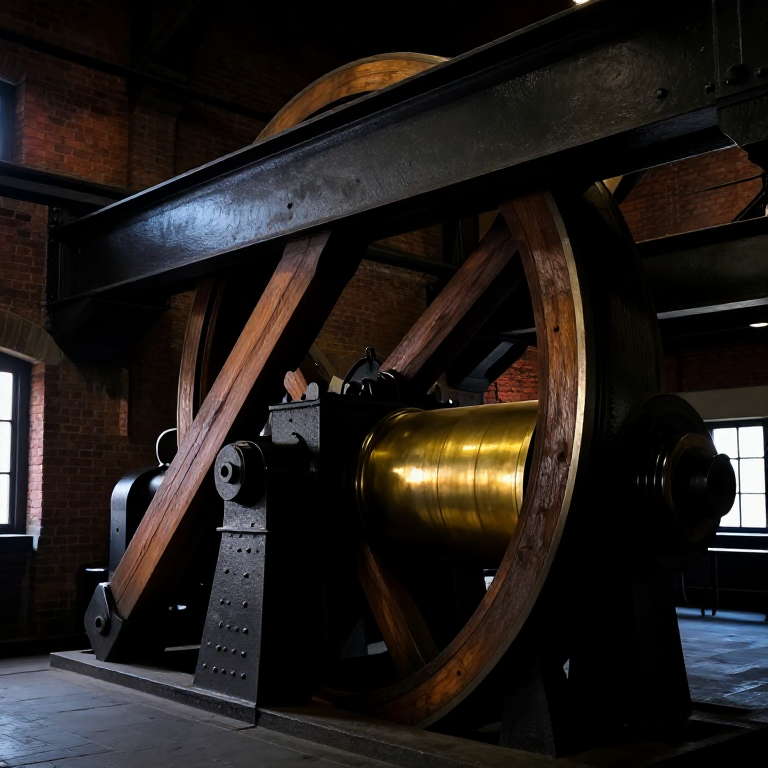


Building a Newcomen Atmospheric Engine — The First Engine to Do Real Work
In 1712 Thomas Newcomen built a machine that changed the world quietly, by pumping water out of coal mines. It was the first engine to turn the heat of a fire into useful mechanical work on a large scale, and every steam engine and motor that followed descends from it.
Its genius is counter-intuitive: the steam does not push the piston. Newcomen's engine fills a cylinder with low-pressure steam, then sprays in cold water to condense that steam into a few drops, leaving a vacuum. The ordinary pressure of the atmosphere — about a tonne on a large piston — then shoves the piston down into the vacuum. That downward stroke rocks a great wooden beam whose far end lifts the mine pump. Because air pressure does the work, it is called an atmospheric engine.
It was thirsty and wasteful, reheating its whole cylinder every stroke, but it was tireless and it worked. For sixty years Newcomen engines drained the mines that supplied the coal that fed the Industrial Revolution — until James Watt's separate condenser made the steam engine efficient enough to drive factories and locomotives.
Ìlànà
Grasp the atmospheric principle
Grasp the atmospheric principle
Build the boiler
Build the boiler
Àwọn ohun èlò fún ìgbésẹ̀ yìí:
 Pẹlẹbẹ Bàbà40 kg
 Bíríkì Tí Ń Kojú Iná120 ẹyọ
Cast and bore the cylinder
Cast and bore the cylinder
Àwọn ohun èlò fún ìgbésẹ̀ yìí:
 Àpótí yíyíká ti irin ìdà1 ẹyọ
 Awọ2 sqm
Erect the great beam
Erect the great beam
Àwọn ohun èlò fún ìgbésẹ̀ yìí:
 Ìtì igi Douglas fir1 ẹyọ
Plumb the steam and water pipes
Plumb the steam and water pipes
Àwọn ohun èlò fún ìgbésẹ̀ yìí:
 Ọ̀pá bàbà6 mítà
Àwọn irinṣẹ́ tí a nílò:
 Ìdìmú òpó
Raise steam
Raise steam
Àwọn ohun èlò fún ìgbésẹ̀ yìí:
 Èédú òkúta bituminous50 kg
Admit steam and let the piston rise
Admit steam and let the piston rise
Àwọn irinṣẹ́ tí a nílò:
 Ẹnu èéfín omi
Inject cold water to make the vacuum
Inject cold water to make the vacuum
Àwọn irinṣẹ́ tí a nílò:
Ẹnu èéfín omiTake the power stroke
Take the power stroke
Àwọn ohun èlò fún ìgbésẹ̀ yìí:
 Omi30 lítà
Drain and repeat
Drain and repeat
Àwọn irinṣẹ́ tí a nílò:
Ẹnu èéfín omiMake it self-acting
Make it self-acting
Àwọn irinṣẹ́ tí a nílò:
Ìdìmú òpóKnow its power and its flaw
Know its power and its flaw
Àwọn ohun-èlò
8- 40 kgÀyè
- 120 ẹyọÀyè
- Àyè
- 2 sqmÀyè
- 1 ẹyọÀyè
- 6 mítàÀyè
- Àyè
- 30 lítàÀyè
Blueprint tó jọra
Àwọn blueprint wọ̀nyí pín ìmọ̀ — ọ̀nà, ohun-èlò tàbí ìlànà


CC0 Àgbègbè Gbogbogbò
Blueprint yìí ti jáde lábẹ́ CC0. O lè ṣe àdàkọ, yí padà, pín, àti lò láìsí ìyọ̀ǹda.
Ṣàtìlẹ́yìn Olùṣẹ́dá nípa rírà àwọn ọjà nipasẹ̀ Blueprint wọn Ẹ̀san Olùṣẹ́dá tí àwọn Olùtajà gbé kalẹ̀, tàbí ṣẹ̀dá àtúnṣe tuntun ti Blueprint yìí kí o sì fi sínú Blueprint rẹ gẹ́gẹ́ bí ìsopọ̀ láti pín owó-wíwọlé.